'What’s Missing?' at Olana State Historic Site
Published on:
July 26, 2026





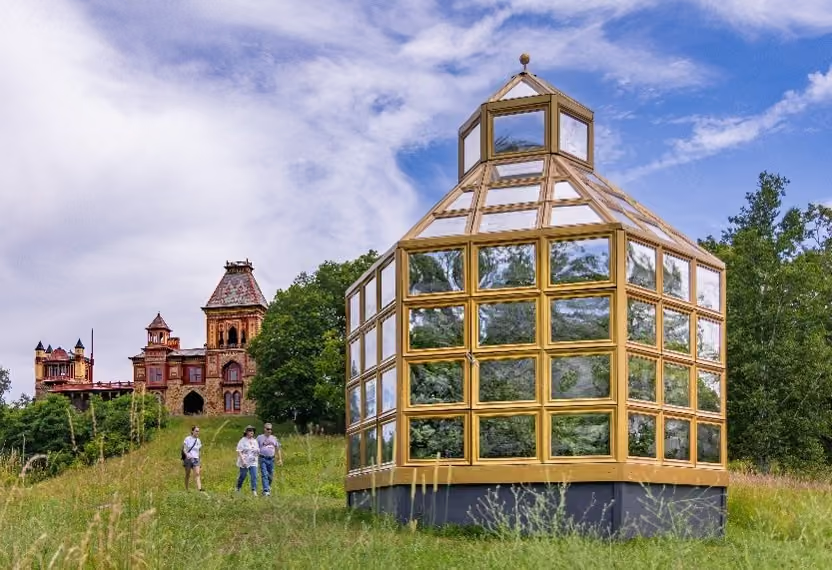





HUDSON―Olana is the most intact historic artist’s environment in the United States, encompassing the Main House and its extensive collections, an historic farm complex, and the 250-acre landscape designed by artist Frederic Church. Despite its remarkable state of preservation, several of Olana’s extant structures were removed years prior to Olana becoming a National Historic Landmark and New York State Historic Site.
In these structures’ absence, stories of the people who built them and the functions they served have also been lost. Visible foundations and archaeological evidence survive for some of these missing structures. In other cases, only photographs, maps, or oral histories bear witness to their past existence. These buildings may have vanished, but their stories remain embedded within Olana’s landscape.
In What’s Missing?, The Olana Partnership commissioned artists Ellen Harvey and Gabriela Salazar to create site-specific outdoor artworks that respond to these missing pieces of Olana’s landscape history.
Harvey’s project, Winter in the Summer House, will activate the site of the Church family’s “summer house,” which remains one of the big mysteries at Olana. The structure appears on the historic 1886 “Plan of Olana,” but no evidence of its appearance or use exists. Harvey’s installation will take the form of a hexagonal enclosed structure constructed entirely of gilded mirrors reflecting views of Olana’s landscape and surrounding viewshed, which visitors will be invited to enter.
“I want people to experience the Olana viewshed the way that Church did—as an artist, literally framing the views,” said Harvey. “Olana belongs to us all, and this piece is intended to literally and symbolically reflect that. The secret engravings on the inside of the structure are a call-out both to Frederic Church’s famous voyage to find icebergs to paint and also to his ecological legacy. He loved nature and the Hudson Valley landscape so much —and I think we all need to be inspired by that or there will be no icebergs left to paint."
Salazar’s project, A Measure of Comfort (Cake and Cord), will consist of two interrelated sculptures activating the stone foundations that remain of Olana’s nineteenth-century woodshed and icehouse, both located in the historic farm complex. Salazar explores the duality of the structures’ former functions and the exploitation of natural resources they embodied, one storing ice for cooling and the other wood for heating.
“A Measure of Comfort (Cake and Cord) is a reflection on the relationship of the environment and natural resources to human needs for heat and cooling," said Salazar. "Inspired by and sited on the former foundations of buildings created to store ice and wood for Olana's inhabitants, and referencing both the larger Hudson Valley watershed as well as the heating system within the walls of the historic house at Olana, the two-part sculpture asks the viewer to reflect on how our desires and needs, both for our bodies and as a society, impact and shape the environment."
Through the presentation of these site-specific artworks, The Olana Partnership aims to integrate the artists’ interrogations of humankind’s ecological impact within the large-scale environment that Frederic Church designed over many years. What’s Missing? is free and open to all and will inspire visitors to explore Olana’s landscape to discover and experience Harvey and Salazar’s respective works within Olana’s unique blend of art, design and nature.
The exhibit runs through October. Visit https://olana.org/whatsmissing/ to learn more.