‘Our Dark Horse' to make world premiere
Published on:
September 17, 2026




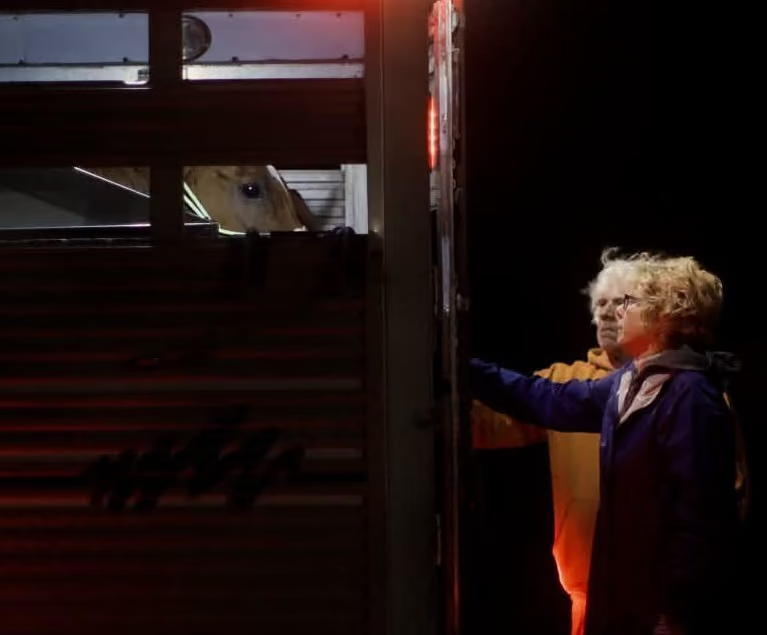




GREENVILLE—For more than two years, cameras quietly followed the daily rhythms of life at Unbridled Sanctuary in Greenville. They captured the early-morning feedings, difficult rescues, and the long, patient process of earning the trust of horses who arrived carrying the scars of their past. Among them was a terrified mare, slowly discovering, one day at a time, what it meant to finally be safe.
Next month, that long-held project will be shared.
Our Dark Horse will make its world premiere at the 27th Woodstock Film Festival on Saturday, October 17 at the Orpheum Theatre in Saugerties.
At the heart of the documentary is Karen Sue's Kitten, known as Miss Kitty, a Thoroughbred mare pulled from the slaughter pipeline after a life of racing, breeding, and barrel racing.
“The cameras stayed as Kitty began to understand that no one would demand anything more from her,” said Unbridled founder Susan Kayne.
“They witnessed her choosing her companions, expressing her boundaries, and slowly reclaiming the authorship of her own life,” Kayne said.
The 78-minute feature is executive produced by Academy Award–nominated documentary filmmaker Ryan White (Good Night Oppy, The Keepers), his producing partner Jessica Hargrave, and actor and lifelong equestrian Zosia Mamet (Girls, The Flight Attendant). It is directed and produced by Grace Barry and shot by cinematographer and producer Dominique Hessert Owens, whose recent credits include the Netflix series Into the Fire: The Lost Daughter.
Kayne said the stature of the filmmaking team is almost difficult for her to comprehend.
“What moves me most is not the prominence of their names. It is that storytellers of this caliber recognized something within Kitty—and within the work of Unbridled—worthy of sustained cinematic witness,” noted Kayne.
“They understood that this is not simply a story about rescuing horses,” she said. “It is a story about recognizing them.”
But the story reaches far beyond the fences of Unbridled, home to some 65 rescued equines. While Kitty was relearning life at the sanctuary, Kayne learned that the mare’s long-lost son Hooper's Joy, was still racing in Oklahoma.
According to Unbridled, the effort to secure Hooper's Joy’s future exposes the uncertainty that meets so many horses once they can no longer earn―and the difference made by people willing to stand between a horse and that fate.
“What began as the story of one rescued mare,” Kayne says, “opened into something much larger: the fate of horses after the racing, breeding, income, and applause end—and the question that has guided Unbridled for more than twenty years: who is the horse when no one is asking her to perform, produce, earn, or obey?”
Every year, more than 20,000 foals are bred into the U.S. horseracing industry. But their careers typically last just three to four years and once they are unable to race, the future is all too often tragic.
In 2025, an estimated 25,000 American horses were trucked across the borders into Canada and Mexico to be slaughtered for meat.
Killing a horse for human consumption is illegal within the United States and the last three known slaughterhouses, located in Texas and Illinois, were shut down in 2007. But the ban is subject to annual congressional review and no nationwide law exists to prohibit the transport of horses across America’s borders.
Just last month, State Police in Warren County arrested a Pennsylvania man transporting multiple horses through New York, with a final destination of a slaughter facility in Quebec. The driver was charged under New York State Agriculture and Markets Law.
Our Dark Horse shines a light on not only the work that Unbridled has done for more than two decades to save these horses, but also on larger efforts to pass the Save America’s Forgotten Equines (SAFE) Act, proposed federal legislation to permanently ban the slaughter of horses for human consumption and make transporting them for that purpose illegal.
"I cannot imagine a more meaningful place for this film to meet the world than Saugerties," said Kayne. "This is a community shaped by horses. For Kitty's story to arrive here, in the Hudson Valley where it was lived and filmed, feels like a homecoming.”
The October 17 premiere will be followed by a Q&A with Kayne and Andrew Elsbree, a director of Unbridled Sanctuary, among others. Tickets are available at woodstockfilmfestival.org.
“I would love nothing more than to look out into that theater and see the faces of the people who made the life captured on film possible,” said Kayne. “Because this moment belongs to every volunteer who carried a water bucket, every caregiver who stood through the night, every adopter who opened a home, every advocate who refused to look away, and every donor and friend whose belief gave a horse another morning.”


%20F.avif)