Honoring those who fought to make our country free
Published on:
June 22, 2026





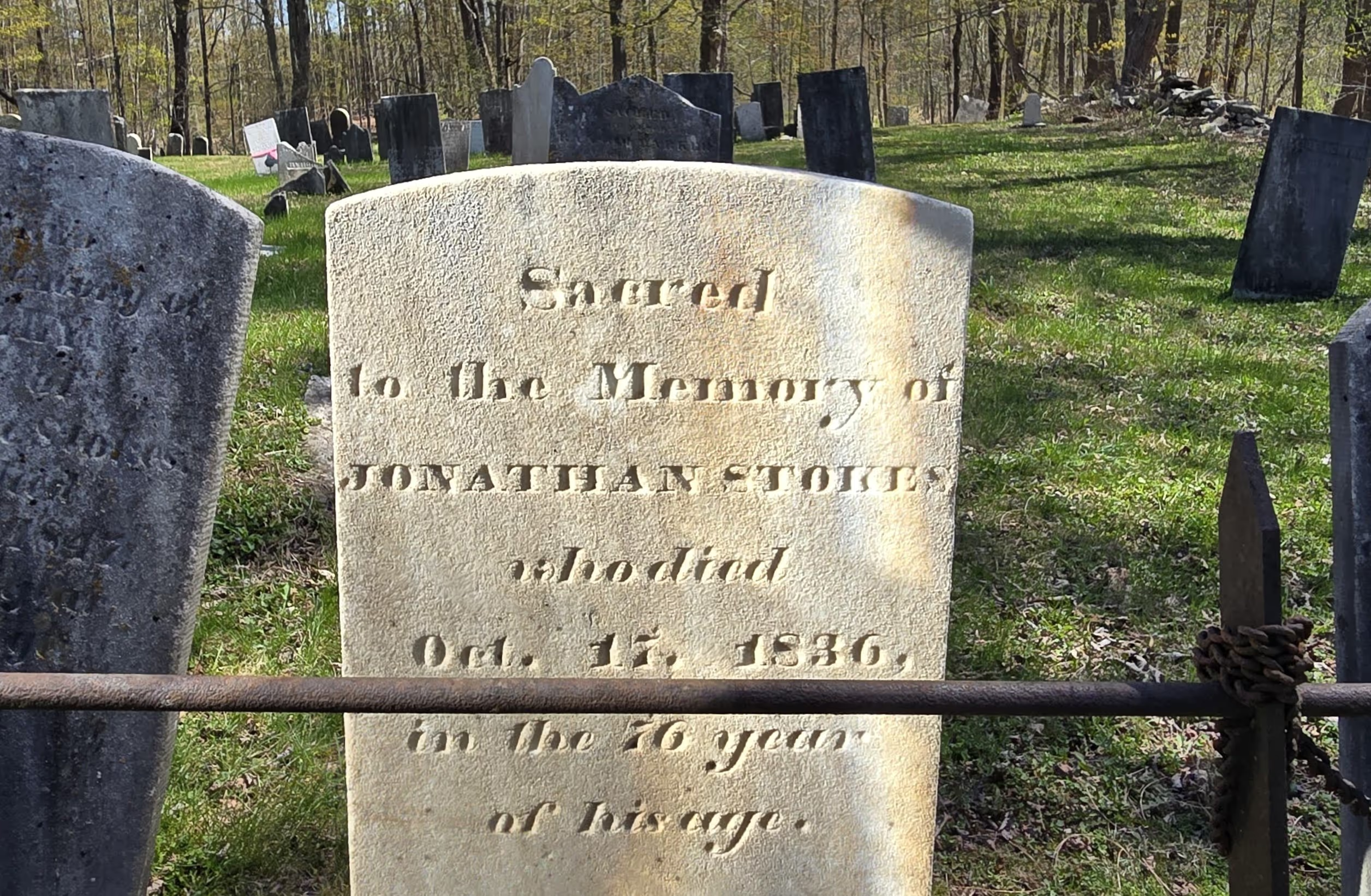





As we celebrate the 250th year anniversary of the founding of America there are numerous events planned nationwide. In Greenville one such project deserves mention.
Two men have led this project. The first is Noel Reese. Noel is a descendant of the Norton family that settled Norton Hill in the late 1700s. The second is Joseph Sicluna, vice president for the Capitol Region Sons of the American Revolution, who works with the William G. Pomeroy Foundation in placing historical markers honoring Revolutionary War Patriots.
Through these men’s efforts, Locust Cemetery on Maple Avenue in Greenville will be receiving a historical marker honoring the nine known Revolutionary War veterans buried there. In order to qualify for this marker, a large amount of documented proof had to be submitted to the foundation. This standard has been met and the marker should be placed in the cemetery this year. In establishing the provenance of this research, the efforts of Greenville Town Historian Don Teator and local Cairo historian Sylvia Hasenkopf, along with former Greenville resident Paige Ingalls, were also invaluable.
Locust Cemetery was established in the early years of the 1800’s. This land was donated to establish a cemetery by Major Augustine Prevost who fought in the British Army against the cause of American Liberty. After the war Prevost reclaimed most of the land in Greenville through the political interference of Aaron Burr who was married to Prevost’s aunt. Many American patriots were displaced from their farms. Prevost and much of his family are interred in Locust. Somewhat surprisingly, these nine American Patriots are also buried there alongside their old enemy.
Who were these brave men who took up arms in the cause of liberty? As it turns out many of these names still echo through Greenville 250 years later.
We will start with Joseph Ingalls, Jr. He is the patriarch of all the Ingalls who have lived in Greenville for the last 234 years. A resident of Rehoboth, MA, he was a member of Samuel Bliss’s company of Minute Men. This unit marched to the alarm of the April 19, 1775 attack on Lexington and Concord. He enlisted in the Continental Army eight days later on April 27, 1775 in Colonel Timothy Walker’s 22nd regiment and served in the siege of Boston. He reenlisted numerous times over the next five years and is listed on the muster rolls of various units of the Continental Army until December 31, 1780. He moved to Greenville after the war in 1792 and purchased 104 acres of land on Elm Lane from Prevost.
Jacob Ingalls, son of Joseph. He enlisted into the Continental Army in June 1780 at the age of 16. He served in Captain North’s company of Colonel Henry Jackson’s 16th Regiment of the Massachusetts Line. He immediately marched west through Springfield and on to West Point, NY. Later, after a short posting in New Jersey, he was present at the hanging of Major Andre in Tappan, NY. Andre, a British officer, was captured with the plan to capture West Point that had been sold to him by Benedict Arnold when he turned traitor. Andre was hanged as a spy. Jacob was discharged in December 1780 and returned home to Rehoboth. In April 1781 he was drafted to a 40-day term and marched to Rhode Island with Simeon Cole’s Massachusetts Militia. His final discharge was at the end of this term. He also came to Greenville in 1792 and lived in his father’s cabin before building his own award-winning farm on Elm Lane.
Captain Daniel Norton, Jr. Born June 17, 1733, Daniel was a French and Indian War veteran. He joined America’s fight for freedom as a 42-year-old. He served in the Guilford, CT Militia during the Lexington alarm. He later served as a Captain in the 7th Regiment of the Connecticut Militia. In the early 1780s he led the Norton family migration to Greenville. Norton Hill was named for him and his home stood near the site of the current Methodist Church. Although we are confident that he is buried in Locust Cemetery, Daniel’s headstone is missing. The toppling of a large tree that once stood in the Norton plot may have destroyed it.
Jonathan Stokes was the son-in-law of Daniel Norton, Jr. He was married to Sarah “Sally” Norton. He served 15 months as a private in the Continental Army. He then went to sea and served in the fledgling US Navy. He served on the Brig of War, the Defense, and later on the frigate “Confederacy.” After the war he joined the Norton migration to Greenville. His farm was located just south of Norton Hill on the current Carter Bridge Road.
David Morse married another one of Daniel Norton, Jr.’s daughters. He married Lucy Norton in Guilford, CT in October 1777. David served three times during the Revolution. In April 1775 he served 16 days during the Lexington Alarm in the Guilford, CT militia. He also served as a private in Captain Hand’s Company of Colonel Talbott’s Regiment from March 22nd to April 18th 1776 during the New York Expedition. Finally, he served as a sergeant in Captain Vail’s Coastal Defense Guards in 1781. He also moved to Greenville after the war. His 68-acre farm is shown in the very northwest corner of the future Town of Greenville on early maps.
Ambrose Norton was Daniel Norton, Jr.’s distant cousin. He served as a member of the Connecticut Line from 1777 to 1783. He achieved the rank of Corporal in Captain Hall’s Artillery Company in the 7th Regiment. He fought at Germantown, PA, in 1777. He survived the brutal winter at Valley Forge in 1777-1778. He then fought at the American victory at Monmouth, NJ, in 1778. He later fought during the storming of Stoney Point, NY, in 1779. In 1781 when the Connecticut line was consolidated, he became a member of Captain Comstock’s Company in the 2nd Regiment. He, too, moved to Greenville following the war, and his farm was located on the southern end of Carter Bridge Road.
Captain Abram Post enlisted in 1776. He served as an Ensign in the 6th Company of Colonel Swift’s 5th Battalion in the Connecticut 2nd Regiment. In those days Ensign was a junior officer’s rank in the Army. At some point he may have been promoted to Captain as that is what is on his headstone. His name appears on a large section of land between Maple Avenue and Ingalside Road on the earliest map. A later map shows him as owner of only a small piece of this property. It is assumed that Post, like most of the earliest settlers, lost claim to his land to Provost after the war and could only buy back a small piece of it.
Jehiel Lamb enlisted in the Dutchess County Militia in October 1777. He served in Peekskill, Fishkill and New Windsor, NY. He was discharged with the rank of Sergeant in January 1778. After the war he moved to southern Albany County. The now almost forgotten hamlet of Lamb’s Corners is named after him and his family.
Lastly, we have Jacob Bogardus, but he really should be first. He is the only known Revolutionary War veteran who lived in Greenville before the war. He arrived in 1772 being just the third European to arrive. His home was the furthest west of any at that time and completely exposed to Native American attack. Having found signs of Iroquois rummaging through his farm when he returned from being married in Coxsackie in 1774, he made the decision to abandon his farm and move with his new wife back to Coxsackie until more settled times. When the war broke out, he joined the NY Militia in Coxsackie. He and his unit served around the State during the fighting. They marched north in 1777 to join the fight near Saratoga. They were later stationed in Fort Johnson (Johnstown) and Schoharie to protect these frontier settlements from British and Iroquois raids. Both of these towns were attacked during the war. After the war he returned to Greenville and lived out his life. His headstone in Locust Cemetery was discovered near his old adversary Prevost’s plot. It turns out that Prevost’s second wife, Anna Bogardus, who married him in Catskill in 1794, was Jacob Bogardus’ daughter.
As we celebrate America’s 250th anniversary, we honor these nine Patriots who are buried in Locust Cemetery.
We do this acknowledging there are thousands of other heroes resting in countless cemeteries around the country. But for these nine at least they are no longer nameless and the details of their service are remembered. These men risked everything to help build a country where men and women could be free.
Having, against all odds and probability, accomplished this, they then came to the wilderness that would become Greenville and helped build a community. This is a noble record of sacrifice and achievement.
This Fourth of July when we are celebrating America’s 250th anniversary, I encourage everyone to take a moment and remember these nine remarkable veterans and all the other brave men and women who fought and continue to fight for our liberty.
God Bless America.






%20F.avif)