Lexington historians hosting Revolutionary cemetery tour
Published on:
August 3, 2026





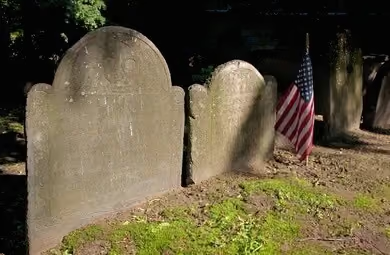





LEXINGTON―As part of America’s 250th anniversary, the Town of Lexington historians are inviting all to visit the final resting places of some of the mountaintop’s earliest military heroes.
Self-guided cemetery tours of Revolutionary War soldiers who lived or died in Lexington will take place on Saturday, August 8 from 9 a.m. to noon. Guide booklets can be picked up at the West Kill-Lexington Community Hall on Spruceton Road and include stops at the Lexington Cemetery, Angle Cemetery, Windham Cemetery, Jewett Cemetery and Prattsville Cemetery.
“We have about 25 Revolutionary soldiers that either lived in Lexington or are buried in Lexington,” explained Mary Palazzolo, who serves as town historian along with Christine Dwon.
“I believe this is the first tour Lexington has had,” she said.
Among the soldiers featured is Captain Silas Fowler who fought in the Battle of Bunker Hill and the Battle of Lexington.
“He was a native of Connecticut and settled in New Goshen,” explained Palazzolo.
“He was also instrumental in renaming our town name to Lexington along with Charles Vorse and ‘a band’ of Revolutionary war veterans that first approached the very first town board meeting about changing the name from New Goshen to Lexington,” she added.
Vorse is one of a few soldiers whose graves could not be located, said Palazzolo, noting that he died in Lexington in 1856.
“After his father went to war, following the Lexington [Massachusetts] alarm of 1775, Charles ran away to the Hudson River at the Highlands, where his father’s regiment was guarding against the British troops in New York City,” she explained. “He enlisted as a drummer boy. He was about 15 years old.”
Vorse served in the 4th Connecticut Regiment and, along with his father, was honorably discharged by George Washington in 1783.
“He is supposed to be buried in the Windham Cemetery but we couldn't find his grave,” she said.
Another solider was Daniel Angle, who came from Brunswick, Germany under British General John Burgoyne. Angle was part of the Convention Army that surrendered at Saratoga in October of 1777.
“He joined the American Revolution and served for three years,” said Palazzolo. “He was honorably discharged at West Point and came to Lexington.”
Another Patriot, John Maben participated in many skirmishes during the Revolution and became one of the bodyguards for General Marquis de Lafayette. He settled in Lexington where he is buried today.
The tour is free and light refreshments will be served at the West Kill-Lexington Community Hall.






%20F.avif)