Food for Thought: Why order out?
Published on:
June 22, 2026




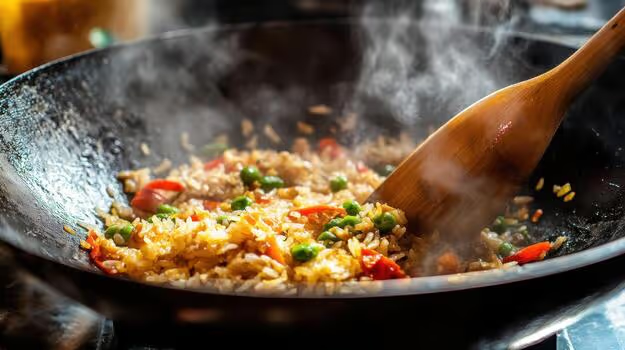





My Sicilian ancestors are probably throwing bolts of lightning from the heavens for what I am about to say. If I were to give up all foods but one, including Italian (Sicilian), for the rest of my life and only be able to dine on one ethnicity it would be Chinese food. Yes, you heard me correctly. If I could eat nothing but Chinese cuisine, I would be a happy man.
I am not sure why that is. Maybe it is a carryover―not a carryout―from another life. Or maybe as a child on special days my father would take us out to a Chinese restaurant and it was a real treat. We used to go to Albany, either House of Wong or China Pearl. Both of which are no longer around.
I do love Asian cuisine. I have studied many different cuisines from many different cultures. I have found that true Chinese food is at least for me the most difficult to replicate. Not to discourage anyone, but being a well-trained chef is not enough. I think you have to be part chemist.
What makes Chinese cookery so unique, I believe, is that it is so multifaceted. It has so many things going for it. It is a cuisine born of a poor people―that is a good thing. It is one of the oldest cuisines on the planet, thus well defined. Its larders or lists of ingredients is incredible and hard to fathom. It is a culture which over time has had to feed billions upon billions of mouths. It is a culture which has created incredible dishes with little to no heat source from which to cook from. Hence, the invention of the wok.
China did not have a surplus of wood or coal or fossil fuels. The cook area and work area were at the center of heating the home and produced the day’s meals. Depending on the region of China, each dish has a unique flavor or style. Canton near the water is rich in seafood. Hunan is known for its spice and pickled dishes. Szechuan is known for its diversity in peppers and spices being along the trade routes. In Peking, the home of royalty, emperors required the best, most developed dishes like rich, time-consuming Peking Duck.
I am getting hungry just writing this. Now in order to get some "good" Chinese food we are going to have to travel a bit. But if you wish to do it yourself here are some tips I can share. First off, get yourself a good Chinese cookbook―one with pictures. It must have photos in order for you to see what the finished product should look like. After all, we eat first with our eyes. Now you don't necessarily need a wok, your home frying pan will do.
If you’re thinking of buying a wok you should consider a few things. Make sure it is made from rolled carbon steel, nothing else. This will ensure the heat will transfer to the food items you are cooking quickly. If you have a gas stove, buy a traditional round bottomed wok. If you have electric stove buy a flat bottomed wok. They are out there, just shop a little. The pan should have a large direct contact with the heat source in order to receive the high temperatures you will be using.
When it comes to food shopping we are lucky. We are relatively close to some great Asian markets. I used to make the sacrifice and drive to Chinatown in New York City to do a large shopping back in the day, but no longer. The Asian market on Culvert Avenue and the one on Central Avenue in Albany are easy to get to and well stocked. My better half hates it when I do my shopping there. I am there for hours. I buy what I need to stock my kitchen. Tons of vegetables, some fruit, some meats and fish, lots of dry goods, spices, noodles, rice and more. Often I purchase items I am not quite sure what they even are. But I buy them anyway, go home, get on the internet and do some research.
It is difficult to ask staff for help at some of these markets because of the language barrier. I do not speak Mandarin or Cantonese, but it all adds to the experience. Like in most cultures, convenience is taking over. There are many premade, pre-prepped and pre-cooked Chinese items available. In the freezer section, soups, dumplings, unusual fish dishes, and even desserts are there for those of us less adventurous. But don't be afraid to jump in headfirst.
I would like to pass on one recipe which I find works very well for many stir fry dishes. It is basic, easy to prepare and can be applied to a multitude of meats, vegetables and noodles. A plus is that even those who are not big on Chinese food will enjoy this sauce, especially the kids. Sometimes we get into a cooking rut. We get tired of the same old meals. Take-out is great, but where we live we are limited, and it can get expensive. So, why order out? Try this instead. That is good food for thought.
Basic Chow Sauce
Use this on any stir fry. It is great vegetables, fish, chicken, beef or pork. The recipe can also be modified. If you like hot and spicy, add chiles. Prefer sour? Add some white vinegar. If you want a little sweetness, drizzle in some honey or add brown sugar. A garlic lover? Add two teaspoons of fresh chopped garlic.
1 cup vegetable or chicken stock, plus more if needed
1/4 cup brown sugar
¼ cup soy sauce
1/4 teaspoon white pepper
2 teaspoons corn starch
1 teaspoon sesame oil (optional)
Blend all ingredients. The stock needs to be cool or room temperature.
Stir fry as per your own recipe and pour in the sauce. It will thicken as it comes to temperature. If the sauce appears too thick, add more stock. Done in five, ten minutes!
Paul Ventura is a retired local chef. He is the owner operator of Ventura's Catering and Cheesecakes. A Greenville resident for almost 65 years and past food service director for the Greenville Central School District for 27 years. He has his education from GCS, AAS from Mohawk Valley CC, BA from SUNY Albany and continuing education degree from the CIA in Hyde Park. He has been in the food service industry for over 54 years.






%20F.avif)