Food for Thought: Don't go against the grain
Published on:
September 4, 2026




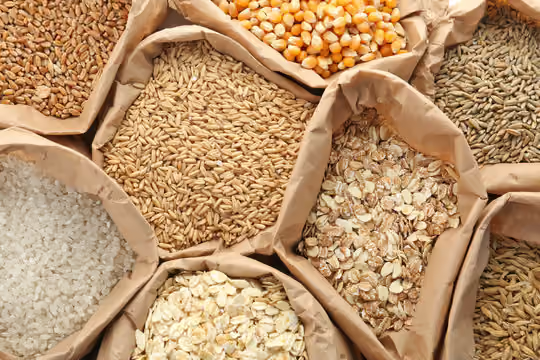





All too often we do not journey very far outside the box when it comes to meal prep. We seem to fall back on rice or a pasta dish and call it a day. Let's broaden our horizons, shall we.
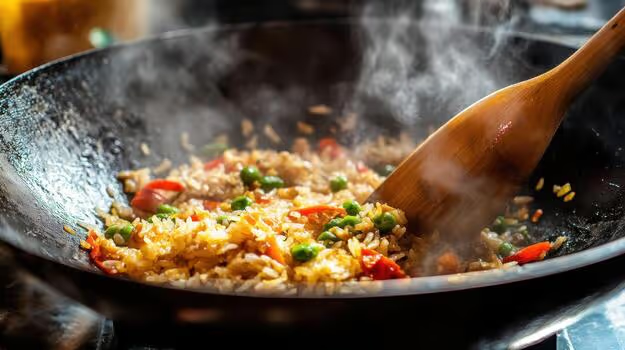
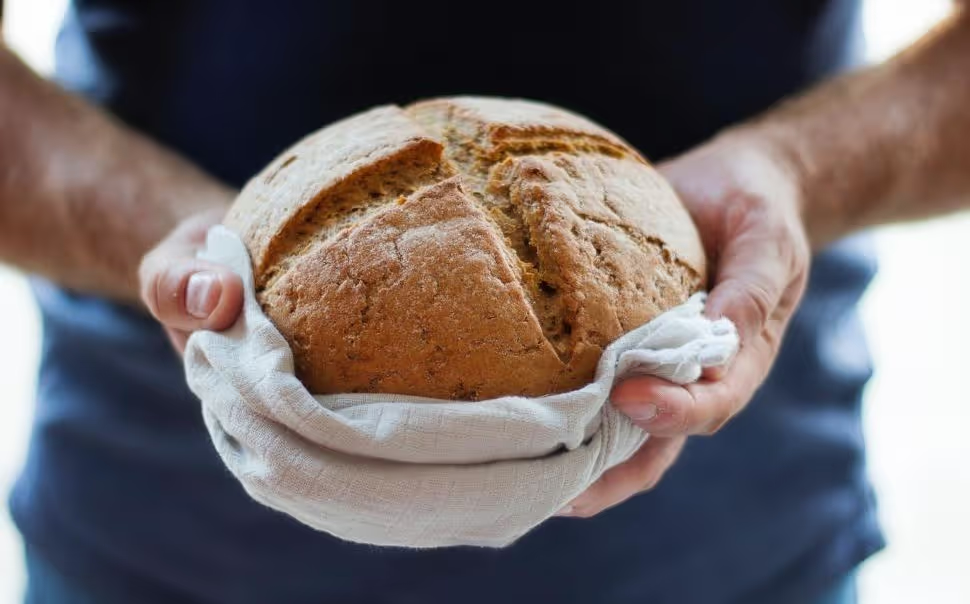
Any food made from wheat, rice, oats, cornmeal, barley or another cereal grain is a grain product. Grains are divided into two subgroups: whole grains and refined grains. Whole grains contain the entire grain kernel: the bran, germ and endosperm. Examples of this include whole wheat flour, bulgur (cracked wheat), oatmeal, whole cornmeal and brown rice.
Refined grains have been milled, a process that removes the bran and germ. This is done to give grains a finer texture and improve their shelf life, but it also removes fiber, iron and many B vitamins. Examples include white flour, de-germed cornmeal, white bread and white rice. Most refined grains are enriched. This means certain B vitamins (thiamin, riboflavin, niacin folic acid) and iron are added back after processing. Fiber is not added back to enrich grains.
We should check the ingredient list on refined grain products to make sure the word "enriched" is in the grain name. Some food products are made from mixtures of whole grains and refined grains. It should be noted, in order to truly eat healthy, you should make at least half of your grain, whole grains.
So, in order to add to our weekly menu planning, we need to become more familiar with various food products that are out there.
Amaranth
The basic staple of the Aztecs, recently rediscovered. It is still chiefly found in health food stores. A tiny grain with a nutty, spicy flavor, it is very high in protein; can be popped like corn or made into flours, pastas and commercial breakfast cereals.
Barley
One of the earliest grains cultivated, it can grow in areas where wheat cannot. It is extremely nutritious, but chiefly eaten pearled, or polished, with the hull removed, in soups; also available whole and annulled, flaked, in grits, flour, or made into a malt (sweet syrup). Close to half the U.S. crop of barley is used for brewing beer and almost all the rest for feeding livestock.
Buckwheat
Not a true grain, but a grass―which means that people allergic to wheat can eat it. Brought to America by Dutch and German settlers, it is best known used in the form of a flour to make pancakes; the rest is used agriculturally. Kasha is a classic Russian dish made with buckwheat groats.
Bulgar
Whole wheat that has been steamed, the hull removed and cracked, shortening the cooking time. Because only the hull is gone, bulgur retains all its nutrients and is popular for use in salads such as tabbouleh, which mixes it with chopped mint, scallions, and tomatoes, flavored with cumin, and also in stuffing, soups, and entrees.
Millet
This ancient grain has been cultivated since Neolithic times. An important food source in the Far East, it is rich in iron and amino acids and contains phosphorus and B vitamins; in the U.S., however, it is still chiefly known as birdseed. It can be used as whole grain, without the inedible hull; also used like other cereals, ground into meal and flour and puffed.
Quinoa
Pronounced “keen-wah,” this was an Inca staple, along with corn and potatoes, and has only recently been reintroduced. Because it comes closer than any other food to supplying all the nutrients needed to sustain life, has been called "the super grain," though in fact the fruit of an herb. It contains twice as much protein as barley or rice; available in whole-grain and flour forms, also made into pastas. As it is gluten-free, there are no allergic problems with quinoa.
Rye
Grown in Europe since medieval times, rye is hardy and thrives under poor conditions. It ferments easily for making whiskey, and has a strong, somewhat sour flavor in breads, high in protein, with low gluten content, it is available in whole grain, grits, groats, or meal forms, or ground into light, medium,dark, and pumpernickel flours.
Sorghum
Through in the United States it is used almost entirely as a feed grain for livestock, it is the third largest food grain for human consumption on the globe. It can be grown in areas where corn cannot be cultivated. Some U.S. mills sell it as flour; sorghum molasses- a thick syrup produced by boiling down the juice extracted from the stalks- is sold as a table syrup.
Triticale
A combination of rye and wheat that has a superior balance of amino acids and constitutes a nearly complete protein, it is genetically unstable compound in nature. However, scientists have been able to breed it successfully in the laboratory, making it the first humanly engineered grain. It thrives in poor soil; the flavor is milder than rye, stronger than wheat. It is available as whole-grain berries or groats, or as flour.
Now after reading this, you may find my words or the material, well... a little dry. No pun intended. But here is something you may not have considered. Man's discovery that wheat and barley could be planted, grown, cut and reaped, thrashed, and winnowed―which occurred some 10,000 years ago in the Middle East―was a critical juncture in the development of civilization. In consequence of that realization, our hunter-gather ancestors no longer had to roam in search of food but could settle in one place, build homes, domesticated animals. Thus, society as we know it today, the people who are reading these words, all began with a grain. Now sit down enjoy a cold beer (a grain) and reflect on that food for thought.