Dorothy Frooks: Writer, military officer, lawyer and suffragist
Published on:
June 22, 2026





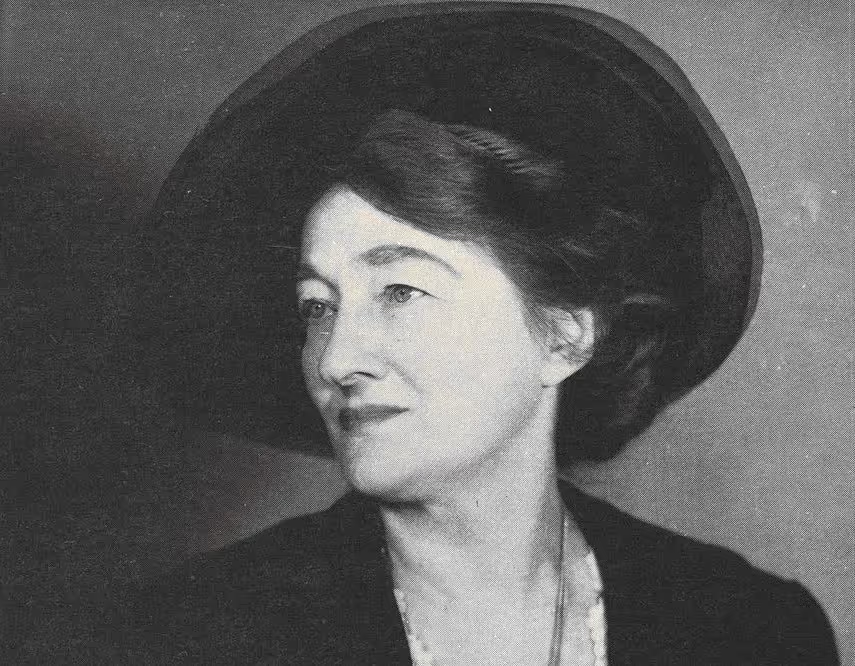





ASBURY―As communities across the nation prepare to commemorate the 250th anniversary of the United States, many are reflecting on the individuals whose lives helped shape the American story. In the Saugerties hamlet of Asbury, one such individual is Dorothy Frooks.
Though her name may not be familiar to many residents today, Frooks lived a life that embodied the spirit of civic participation, public service, and determination that has long defined the American experiment.
Born in 1899 on Wilhelm Road near the Saugerties-Catskill border, Frooks came of age during a period of profound change. As a young woman, she became involved in the movement for women's suffrage, joining countless others who fought for the right of women to vote.
When the 19th Amendment was ratified in 1920, guaranteeing women the right to vote nationwide, Frooks was part of a generation that had witnessed and helped advance one of the most significant expansions of American democracy.
Her accomplishments did not stop there.
Frooks went on to become a lawyer at a time when few women entered the profession. She devoted much of her legal career to helping ordinary citizens navigate the justice system. She is widely credited with helping establish New York City's Small Claims Court, a system designed to give everyday people an affordable way to resolve disputes without the expense and complexity of traditional litigation.
In addition to her legal work, Frooks was a journalist, publisher, political candidate, and veteran. She served in the United States Navy during World War I and later in the United States Army during World War II. She also sought public office, running for Congress at a time when female candidates were still a rarity.
Perhaps most remarkably, she remained active and engaged throughout a life that spanned nearly the entire twentieth century. By the time of her death in 1997 at the age of 98, she had witnessed everything from horse-drawn transportation to the dawn of the internet age.
As America approaches its semiquincentennial, stories like Frooks' remind us that our nation's history is not only written by presidents and generals. It is also written by local citizens who saw problems and worked to solve them, who challenged barriers, and who expanded opportunities for future generations.
The story of Frooks is, in many ways, a distinctly American story. It is the story of a woman who believed in public service, fought for greater participation in democracy, answered her country's call during wartime, and worked to make justice more accessible to ordinary people.
For those reasons, she deserves a place among the local figures we remember and celebrate as our nation marks 250 years of independence. Her life serves as a reminder that the ideals upon which America was founded continue to be strengthened by the contributions of individuals from communities just like our own.





%20F.avif)