The story of Frederic Church and Cleopatra’s Needle
Published on:
June 29, 2026






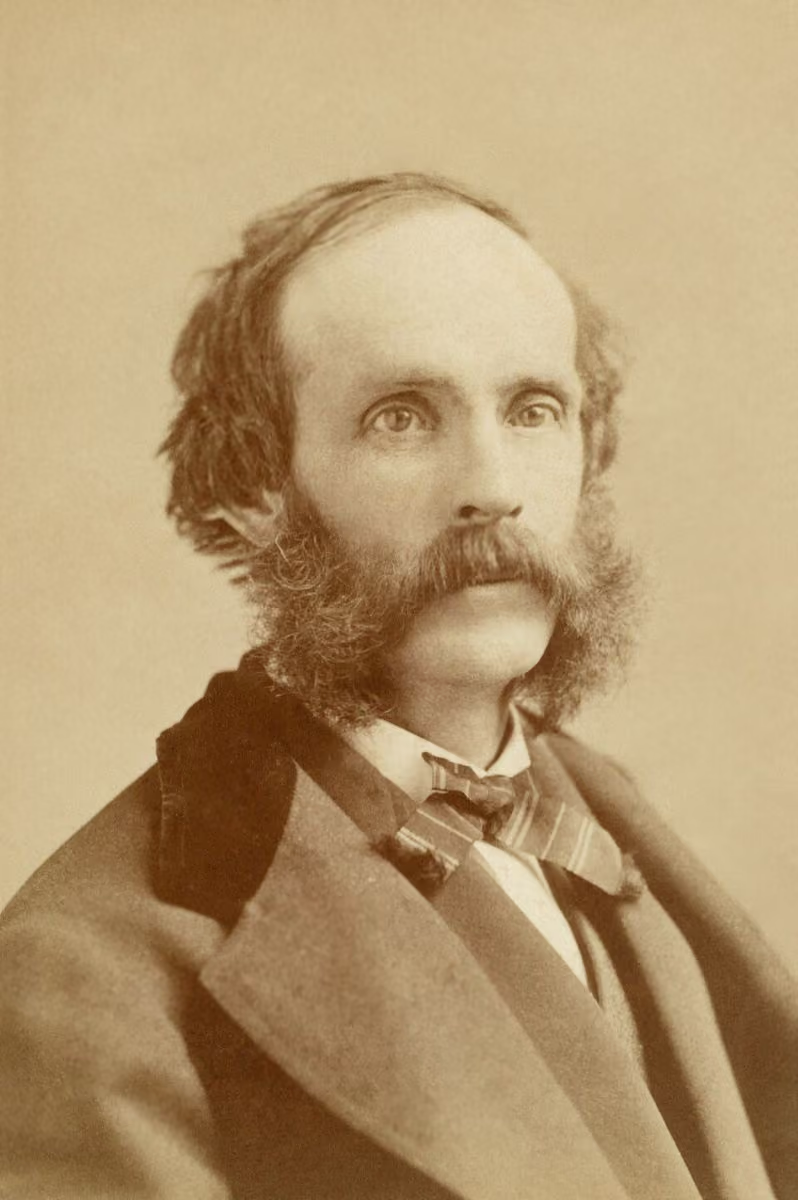





HUDSON―A central figure in the Hudson River School of American landscape painters, Frederic Church is considered one of the most famous 19th century American artists.
Olana, his Persian-inspired castle home and studio that overlooks the Hudson River and Catskill Mountains, is perhaps his greatest masterpiece. But another towering example of Church’s enduring legacy can be found in New York’s Central Park.
Church served as a New York City Parks commissioner from 1871 to 1873 and was a key figure in shaping the naturalistic identity of what would be the nation’s first landscaped public park. As such, he played a crucial role in the placement and installation of what is known as Cleopatra’s Needle.
The 220-ton Egyptian monolith is a single piece of stone carved out of granite and standing at around 69 feet tall. It was one of a pair of obelisks commissioned by Pharaoh Thutmose III, some 3,500 years ago, for the Temple of the Sun in Heliopolis near the Nile River.
By 12 BC, when the Romans discovered the two obelisks, partially buried in the sand, both had collapsed. They transported the monuments and re-erected them at the entrance to the Caesareum of Alexandria, a temple dedicated to Julius Caesar built under Cleopatra. Thus, is one theory of how they became more modernly known as Cleopatra’s Needles.
“One, which had fallen in an earthquake in 1301, lay half buried: it was presented by Ali Pasha, the Sultan of Egypt and Sudan, to the British Government in 1819, in commemoration of the defeat of French forces at the Battles of the Nile [in] 1798, and Alexandria [in] 1801,” noted Dr. Elizabeth Mankin Kornhauser in Frederic Church: Global Artist, a specially published catalogue for an ongoing exhibit of the same name at Olana.
The second obelisk, still standing, was gifted to the United States by Ismail Pasha, the Khedive of Egypt. He had led Egypt’s construction of the Suez Canal, leaving the country in near financial ruin.
“A prominent gift to the United States might, he wagered, stimulate American investment in his country,” noted Kornhauser, curator emerita at The Metropolitan Museum of Art.
“Ismail Pasha enlisted William Henry Hulbert, a correspondent for the New York World, as an intermediary, and soon William Henry Vanderbit was enlisted to bankroll the removal of the obelisk and its transportation to New York,” she added.
Vanderbilt, a businessman and railroad magnate, contributed $103,732, the equivalent of more than $3 million today.
The Central Park Conservancy described the move as an “unprecedented engineering feat.”
The obelisk’s cross-Atlantic journey on the cargo steamship SS Dessoug took a month but moving it from the banks of the Hudson River to its final resting place at Central Park would take another 112 days.
The delicate process required laborers to inch the monument on parallel beams, aided by roll boxes, 32 horses and a pile-driver engine, according to the New York City Department of Parks and Recreation.
Church was one of a select few commissioners who helped design the obelisk’s base and determine its exact location―where it could be easily viewed from the windows of The Metropolitan Museum of Art.
“This provided a harmonious extension of the museum into the newly created park, mirroring the ways in which Church linked Olana’s interior to its exterior designed landscape,” Kornhauser remarked.
A crowd of some 10,000 spectators were on hand when the monument was erected on January 22, 1881.
For his efforts, Church was presented with a small lead-and-brass model of the obelisk, crafted by Tiffany & Co.
“We display the obelisk on the fireplace mantle in Church’s studio in the main house at Olana and to my understanding it’s been in this location for as long as anyone can remember,” said Maggie Dimock, associate curator for The Olana Partnership.
“Photographs taken in the studio in the mid-1960s just prior to Olana becoming a State Historic Site show it in that spot. It makes sense to us today, since the studio wing was a later addition to the house―begun 1888, completed 1890―and many of its furnishing and decorative art objects relate to Church’s later years, during which he served as a founding trustee of The Met and a commissioner of New York’s Central Park,” Dimock added.
But the iconic replica is not presently at Olana. It will spend the next nine months much closer to the real thing.
The Metropolitan Museum of Art is displaying Church’s model obelisk as part of a major exhibition that focuses on cross-cultural encounters in Europe and the Middle East during a period of growing imperialism and colonialism.
Orientalism: Between Fact and Fantasy, which opened June 12 and runs through February 27, 2027, will present works of art traditionally identified as Orientalist in conversation with objects from the Middle East. It will feature exceptional paintings, drawings, photographs, illustrated books, architecture, arms and armor, textiles, garments, glassware, ceramics, and metalwork. Highlighting the plenitude of museum’s holdings, it presents approximately 180 objects enriched by rarely seen loans from the United States and abroad, all displayed in new and stimulating contexts.
“Years before The Metropolitan Museum of Art opened to the public on April 13, 1870, Church established a global network of artists, scientists, collectors, and dealers through his extensive travels,” noted Kornhauser.
“His experience as a global artist/traveler proved invaluable as he assisted The Met in creating an encyclopedic collection of art that could stand alongside other great world museums—a cultural institution that, as one founder described it, would ‘present the whole stream of art-history in all nations and ages’,” she added.
“His oversight in siting the Egyptian obelisk in Central Park in proximity to The Met,
Dimock said, “is just another example of his influence on the New York art and cultural world in the 19th century.”
Frederic Church: Global Artist
On May 17, Frederic Church: Global Artist opened at Olana State Historic Site in Hudson. The exhibition commemorates the 200th anniversary of the birth of Church.
Church was celebrated as a preeminent American landscape artist whose life and work was indelibly shaped by global travel that effectively brought the world to America. Early trips took him to South America, across the northeastern United States, to Jamaica, and to the icy waters of the North Atlantic. Later he visited Europe and the Middle East, and in his final decades he made 15 winter sojourns in Mexico. Olana, the designed landscape and home overlooking the Hudson River that he built with his wife Isabel, reflects his global travel and collections.
In addition to rarely seen works from the Olana collection, the exhibition features consummate loans from a number of major public and private collections, including the Cooper Hewitt, Smithsonian Design Museum, The New York Historical, and The Terra Foundation for American Art.
Frederic Church: Global Artist is curated by Kornhauser, who also serves as senior curator and chair of The Olana Partnership’s Frederic Church Bicentennial Committee; Tim Barringer, Paul Mellon Professor in the History of Art at Yale University; and Jennifer Raab, professor in the History of Art at Yale University.
The exhibition is accompanied by the groundbreaking new publication from Yale University Press in association with The Olana Partnership, also titled Frederic Church: Global Artist, co-edited by Barringer, Raab and Kornhauser.
The lavishly illustrated volume features original essays by scholars from across the humanities that reveal Church as an artist whose works engage with questions of industrialization and environmental destruction, the rise and fall of empires, the construction of national identity, and the cataclysmic effects of slavery and civil war.
The exhibition will be presented in the Sharp Family Gallery at Olana State Historic Site until October 25.
A number of public programs and special exhibition tours have been organized to complement the exhibition. Visit https://olana.org/fc200/ for updates and more information.





%20F.avif)