No measles cases reported in Greene County this year
Published on:
October 5, 2026









ALBANY―A growing number of measles cases across rural parts of New York has prompted Governor Kathy Hochul to declare a state disaster emergency.
So far this year, 101 cases have been reported in 22 upstate counties. None of those cases are in Greene or the surrounding counties, according to New York State’s Measles Dashboard.
"Department staff are working closely with local health departments and regional partners to track and contain the current measles outbreak,” said New York State Department of Health (DOH) Commissioner Dr. James McDonald.
Otsego County currently tops the list with 20 year-to-date cases, followed by Seneca County with 17 reported. In Steuben County, along the Pennsylvania border, has had 14 cases of measles.
The Pennsylvania Department of Health announced on Monday that 1,004 measles cases have been confirmed across 39 counties there so far in 2026.
"No one should get seriously ill or die from a vaccine-preventable disease. That is why I have taken steps to increase the number of health professionals who can vaccinate and test,” said Hochul.
The state disaster emergency extends the pool of eligible individuals who can administer measles vaccines, including paramedics, advanced EMS providers, pharmacists and midwives, and in addition to physicians, also allows nurses to order testing.
“The measles, mumps, and rubella vaccine is the best protection—protecting nearly all people against disease who receive the recommended doses,” McDonald said.
According to the Centers for Disease Control and Prevention (CDC), measles was declared eliminated in the United States in 2000. In recent years, however, national measles, mumps, and rubella (MMR) vaccine coverage among kindergarteners has decreased and is now below the CDC’s 95% target for herd immunity.
The CDC reported 2,289 measles cases nationwide last year. So far in 2026, that number has climbed to 3,887, with only about 5% of those infected confirmed to have been vaccinated.
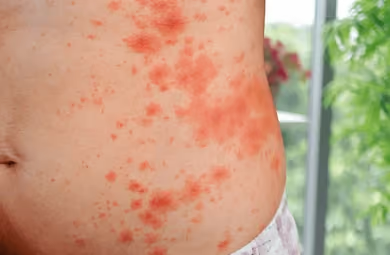
Measles is a highly contagious respiratory disease that typically causes fever and a rash. In some cases, it can weaken the immune system, making it harder to fight other infections, including pneumonia. The virus spreads through the air when an infected person coughs or sneezes and, less commonly, can spread by touching a contaminated surface and then touching the eyes, nose or mouth.
Death from measles, though rare, occurs in one to three patients per 1,000 cases.