Greenville Local History Group: A century of Ingalls family reunions
Published on:
January 22, 2026





.avif)
.avif)
.avif)
.avif)





Program & Notes by Paige Ingalls
Reflections by Greenville Town Historian Don Teator
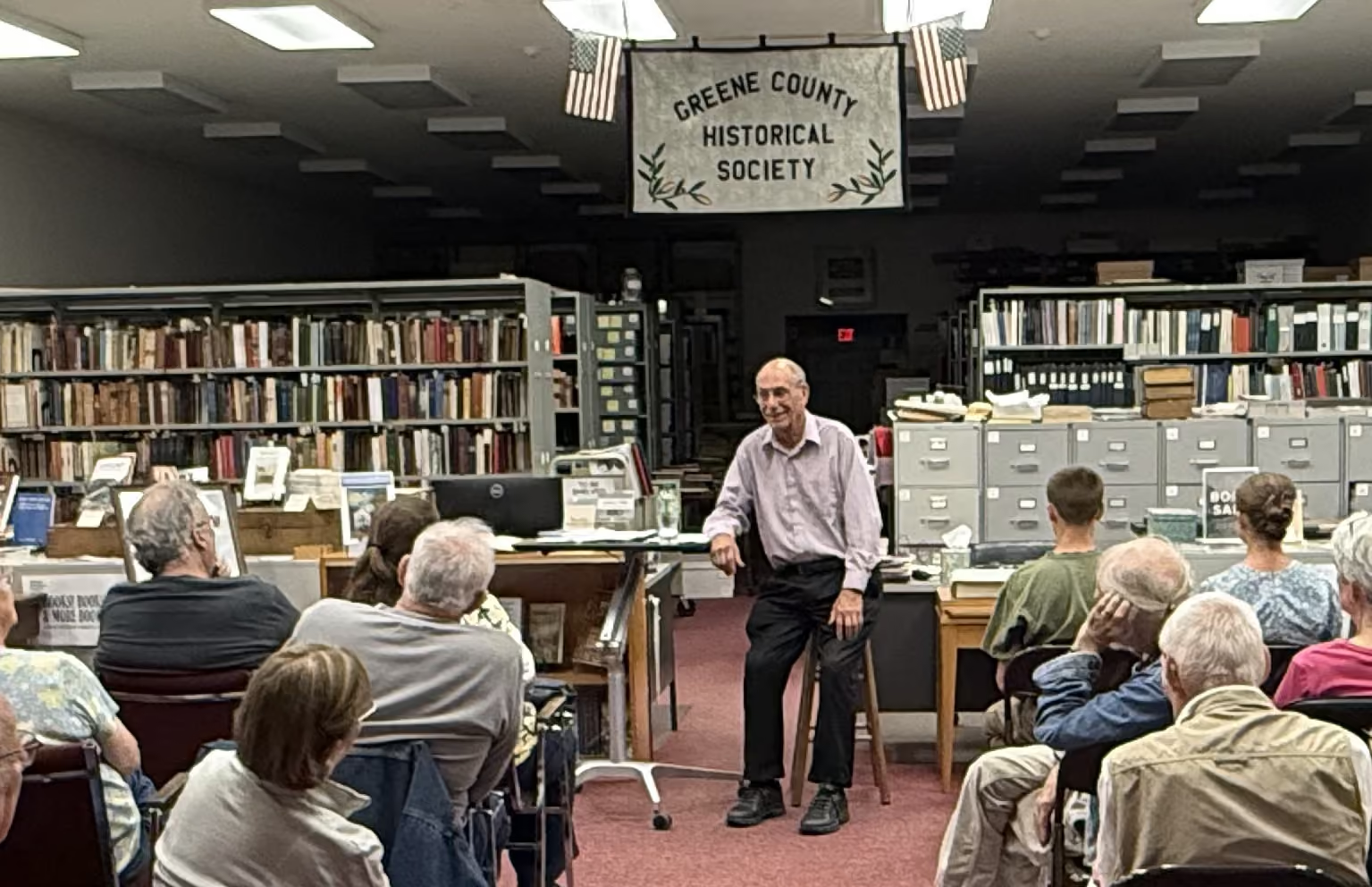
The charm and energy needed to maintain an annual family reunion is portrayed in Paige Ingalls’ program presented to the Greenville Local History Group in August 2025.
The sudden clang of Jacob Ingalls’ cowbell startled and thrilled the audience. Paige explained that the bell had been passed down through the generations and is rung at the beginning of each Ingalls Reunion. After giving credit to Don for instigating the program, Paige dove into the details of the annual Ingalls Reunion, which was first held in 1925.
It should be noted here that although the reunion was begun 100 years ago, it was not held during the four years of World War II or in 2020, the first year of the COVID-19 pandemic. Therefore, the reunion is technically only 95 years old.
The Ingalls name, Paige explained, is of Scandinavian origin from “The Ingialld,” a valley in Norway. From there, these “Norsemen” migrated to Denmark and then to England 500 years before Columbus “discovered” America.
A will on file from 1555 in Lincolnshire may be the earliest identifier of an Ingalls, Henry. He was the grandfather of Edmund, the Ingalls ancestor who arrived in Salem, MA, in 1628. Edmund, with his brother Francis and four others, founded the settlement of Lynn, MA, in 1629.
Five generations later, Jacob Ingalls was born in 1764, married Susannah Goff, and fathered five sons from whom the “Greenville, NY, Ingalls” are descended. Jacob, a Revolutionary War veteran, was buried in Locust Cemetery (Maple Ave, Norton Hill) at age 77. His gravestone is barely legible today, but a 1974 rubbing by Claribel Ingalls Gardiner has preserved a worn but readable facsimile.
To give an idea of what one generation can add to a family tree, here are the five sons of Jacob Ingalls and their offspring:
- Enoch Ingalls, who had six children: Alfred, Silas, Harvey, Lovina, Nancy Jane, and Cyrus
- Henry Ingalls, who had three children: Susan, Mary, and Lucius Henry
- John Ingalls, who had four children: George Washington, Sarah E., Edwin Davis, and Anna
- Truman Ingalls, who had seven children: Leander, Lucinda, Eleanor, Diantha, Joseph Truman, Ransom Benjamin, and William Henry Harrison
- Cyrus Ingalls, who had one son: Thaddeus Warsaw (and who also had a son, Cyrus).
This led to a discussion of the roles that genealogies and diaries have played in the Ingalls family. A 1903 genealogy traced the family from its 1629 beginnings in America and was reprinted in 1984.
In 1926, a genealogy was published that took over where the family’s information ended in the genealogy printed in 1903. It was the first genealogy specific to Jacob Ingalls and his descendants. This was updated in 1948, only to be updated again in an easier to read format in 1978. The most recent update came on the 75th anniversary of the Ingalls Reunion in 2003. An update is planned for the 100th reunion in 2029.
Paige noted the importance of diaries in preserving a family’s history. Several of the Ingalls clan have kept these. Ransom Benjamin Ingalls kept a diary, as did Eleanor Goff Ingalls. The town historian is most familiar with the diaries of Carrie Spalding Ingalls written in the years 1886-1951, having transcribed their one million words. He has referred to their contents in many ways over the years, and his transcriptions and summaries are available online. After Carrie’s passing, her daughter Leona continued to keep diary until her passing, and now her (Carrie’s) great granddaughter Paige continues the tradition.
What is a family tree without its notable, and sometimes notorious, members? Paige pointed out a few famous Ingalls ancestors: Laura Ingalls Wilder (writer of the “Little House on the Prairie” books), US President James Garfield, Mayflower passengers John Alden and Thomas and Joseph Rogers (father and son), and Fletcher Dorman Ingalls, author of NYT crossword puzzles. One notorious Ingalls was Martha Allen Carrier. She was accused of being a witch in Salem, MA, but maintained her innocence even when being hung at the gallows in 1692.
Paige next delved into the history of the Jacob Ingalls family reunions by showing a photograph of the first invitation from 1925. That reunion was held at the Charles Rugg residence in Lambs Corners, and Paige showed a photo of the house taken in 2014. A freak snowstorm made traveling difficult, and legendary, that day. Roads were nearly impassable, trees had fallen across some of them, and reunion accommodations were blown over, forcing a large crowd indoors. It was quite a start!
The following years saw more typical weather, mostly due to holding the reunions in June and July instead. The sites of the reunions varied, ranging from Cornwallville, Medusa, Westerlo, Ingalside Farm, the Legion Hall, and a half dozen other places. In the recent past, reunions have been held in October at the Asbury United Methodist Church in Norton Hill.
Reunion attendance was highest in the first ten years; recent attendance has numbered in the 50s or thereabout. Special celebrations (the 50th and 75th anniversaries) saw spikes in attendance.
Currently, about 200 invitations are sent out and, with no RSVP required, whoever shows up on the day of the reunion, shows up. This makes planning a bit challenging. The host family supplies the “meat, biscuits, and butter” and decorates the tables while others bring dishes to share. No more fancy-ware so paper and plastic aid in more convenient clean-up. Officers are elected, with the VP becoming president the following year. Meeting minutes are maintained for each reunion. The treasurer “passes the basket” and gives a report, and the historian provides updates about vital records. A roll call of families, or branches, is taken.
One of the final acts of these reunions (usually three hours in length), is the Entertainment. Paige described her review of a list of these events over the years as “eclectic” and then “speed read” some of them.
Of particular note is the family’s possession of a single teaspoon of importance to Jacob’s descendants. Paige held it up and pointed out that the silver for it came from a silver tea set won by Jacob in 1818 for having the best fenced and best kept farm in Albany County. According to family lore, sometime in the mid-1800s, it was decided to melt down this prize into silver spoons of Fiddlehead design, with each great grandchild getting one. Only one of these teaspoons survives.
Blessings and poems play a significant part during the reunions.
For example, whenever Walter Ingalls’ gave grace before the meal, he would intone:
Heavenly Father, thank you for families who cherish their roots. Thank you for those who document this history and those who have made it possible for us to meet for many years after the first reunion in Lamb’s Corners. Now let us enjoy this food and fellowship as we enjoy each other. In your name we pray. Amen.
And again, Walter, as a wreath was placed at Jacob Ingalls’ grave following the 75th Ingalls Reunion, prayed:
We are all gathered together, all grandchildren of Jacob Ingalls. We take this moment to honor him for his efforts in establishing family values, which we have carried down through the generations. As we leave today, may we cherish our family history; let us strive to enrich the new generations; and let us return next year to continually renew our friendships. Amen.
Paige then delivered some sobering news. With relatives now spread far and wide and attendance dwindling, it has been decided to end the reunion as currently run after its 100th, in 2029. It has been a difficult decision to make, but the family agrees it is time.
Lastly, a photograph with a lovely view of the Catskill Mountains was shown on the screen. It was taken in July 2025 in front of where the Ingalls Homestead once stood on Elm Lane (formerly Ingalls Road).
Paige noted she would close her presentation by reading a poem written by Edmund Henry Ingalls, born in 1900, and named for the first Edmund Ingalls who came to America in 1628. Prior to doing so, she told how, while hospitalized at Albany Medical Center, he took a day’s leave to attend the 1980 Ingalls Reunion. He had never missed a reunion, and he didn’t want to miss this one! He attended one more, in 1981, before passing away in April of 1982.
My Mountains
By Edmund Ingalls
How oft when I wake in the morning
I see the mountain tops capped with white;
What a wonderful change old Nature has wrought,
Through the shadowy stillness of night.
I love to look at those mountains,
As they tower serenely on high;
They stand like sentinels of heaven,
Guarding the gates of the sky.
God made those wonderful mountains,
They speak of His glory to me;
I ever shall feel He is near me,
If my mountains I always may see.
In tempest, in trials and sorrow
Those mountains give me new strength;
They lighten the weight of my burden,
They shorten the weary day’s length.
Sometimes the dark mists hide them,
My mountains no longer I see;
“Roll away, ye mists o’ the valley,
And bring back my mountains to me.”
What care I for the whirl of the city,
For its bustle, its din and its glow;
Take me back to my dear old mountains,
Where the trees and the wild flowers grow.
Take me back to my dear old mountains,
Where the birds sing so sweet in the glen;
Take me back to my dear old mountains,
And I will never leave them again.
When my journey in this life is ended,
And on my death bed I peacefully lie,
Prop me up with my face toward the mountains,
And with a smile on my lips I will die.
Notes from Don Teator:
Having instigated my own family’s reunions in 1992 and sharing my Teator genealogy findings, I find myself attached to family enterprises like this. To know who came before me, to be aware of some of the experiences they endured whether from family lore or census records or legal accounts makes me feel enriched. Now an Honorary Ingalls for my Carrie Ingalls diaries transcriptions, just a mention of some of the Ingalls names makes me visualize a person or a place that in turn connects me even closer to added meaning of place and life.
As Town Historian, I have found the Ingalls Reunion and family history to be a valuable local history resource. The Historian prior tome was Edna Ingalls Adams; Deb’s and my closest adult life friends are Tim & Judy Adams; my siblings and I graduated with a slew of Ingalls and their relatives; and in the Historian’s Records Room are kept the contributions that family members have made for posterity.
I did chuckle when Paige told the story of one of the Ingalls family who, on reunion day, whined that he wished his name was Layman, not Ingalls, and thus would not have to endure another Ingalls Reunion. I suspect we all have suffered through tales of family history and rolled our eyes wondering what the worth of it was. Yet, after 2029, there will be some pining for another reunion since the longest running reunion in the Greenville area will have ceased to exist.
Paige, thank you for such an auspicious start as a GLHG program producer. May there be more in the works. Your efforts and time are warmly appreciated. In my mind’s eye, I can see the faces of all those who would be very proud of what was presented about your family that evening.
Don Teator is the Town of Greenville historian. He and guest writers chronicle Greenville’s past people, places and stories.
Past Greenville Local History Group feature articles are archived at https://porcupinesoup.com/greenville-local-history.




%20F.avif)