The history of the whitetail deer in New York State
Published on:
February 22, 2026





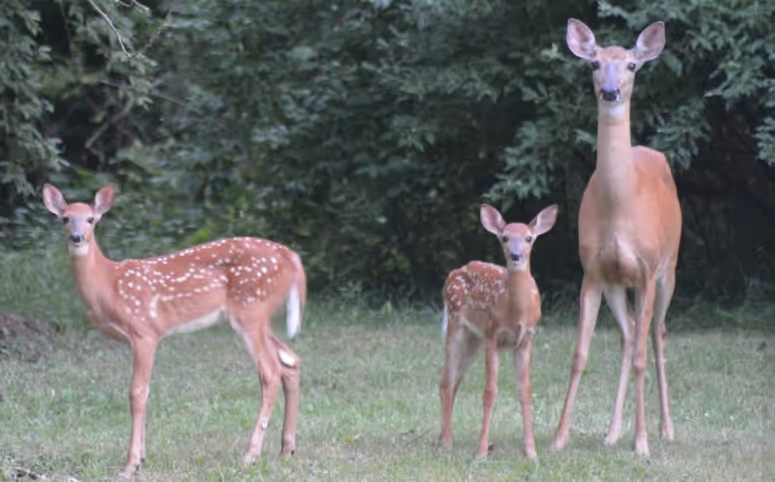





One of the pleasures of growing up and living in Greenville is being surrounded by America’s most popular big game animal: the whitetail deer. These beautiful animals are so ubiquitous that it is hard to go a day without seeing signs of one. We see them in the fields and around our houses. When driving we have to be careful as they are constantly crossing the roads and approximately 60,000 a year are hit by cars in New York alone.
In the winter we see their tracks in the snow. When the snow gets deep, they come into our yards and eat our birdseed, plants, and bushes. In the spring they shed their winter coats and in May and June we start to see their newborn fawns. They spend all summer raising their young and putting on weight for the next winter.
Around Labor Day the bucks scrape the velvet off their newly grown antlers and prepare for the coming breeding season. In October and November friends and families gather to participate in the fall hunt. This event while frowned on by some is actually a very necessary activity in managing the population of the deer herd. Then winter returns and this yearly cycle starts all over again.
There is, however, much more to the whitetail story.
Whitetails are the oldest existing deer species in the world. Their ancestors came from Asia to the Americas five million years ago. By three and a half million years ago they had evolved into their current form, Odocoileus Virginianus. There is a rich fossil history from this time forward.
To understand how long ago this was it must be remembered that humans only started using primitive tools 3 million years ago. We only learned to use fire around one and a half million years ago. The Whitetail presence in the Americas predates human use of fire by two million years.
The years from 2.5 million years ago to 11,700 years ago are known as the Pleistocene Epoch. This epoch was marked by periods of much colder temperatures and the advance and retreat of the glaciers. There were times when New York was completely covered in ice.
The whitetails range fluctuated north and south during these climatic changes. During this period whitetails shared the Americas with at least 15 carnivore species larger than the modern coyote. These included among others, dire wolves, the American lion, saber tooth cats, the American cheetah and the enormous bulldog bear, the largest mammalian carnivore to ever prowl the Americas.
Through it all the whitetail persevered while all these other species went extinct. It is explained by some that the Whitetails survived when so many others disappeared because they specialized in one skill: adaptability.
The end of the Pleistocene was marked by the retreat of the final glacier. New York gradually took on the vegetative look of the temperate deciduous forest that continues today. It was also marked by the die off and extinction of most of the world’s Mega Fauna. Most of the large mammals both predator and prey went extinct.
The whitetail, however, found a way to survive. In the Americas, the giant predators were replaced by new smaller but still lethal species of predators. Many of these like the grey wolf, the cougar, and black and grizzly bears survive to this day.
At around the same time an entirely new species of predator would arrive. Humans came to the Americas. The Whitetails would have to adapt again to deal with all these new threats.
By 1500 when Europeans came to the new world, whitetails had settled into an environmental balance with both the Native American and animal predators that inhabited their world. There was an estimated whitetail herd of 24-34 million. It would be the influx of these new European predators that would take the whitetail to the brink of extinction.
Taking New York State as an example, this is what happened to the whitetail. Before the European arrival the whitetail flourished around the Native American settlements. Whitetails could not survive in large numbers in the mature hardwood forests that covered most of New York. The large trees block out the sun and limit the amount of low-lying browse that deer need for food.
The Native American slash and burn agricultural methods provided open spots in the forest. Fields were cleared and the crops planted. After a number of years, the soil was depleted, the fields were abandoned, and the Indians moved on to clear new fields. The abandoned fields were allowed to grow back into brush.
For that reason, the areas where the Native Americans lived in larger numbers like the Mohawk Valley and the Finger Lakes had the most deer even though that is where they were hunted the hardest. Areas like the Adirondacks and the Catskills which had limited agricultural opportunities held few Native American villages and very few deer.
New York’s Iroquois certainly killed and consumed large numbers of whitetails. Their bones litter Iroquois refuse sites. Many have an image of an Iroquois silently stalking through the forest with a bow and arrow and harvesting individual deer. While I am sure this happened on occasion, this was not how Native Americans hunted deer.
Deer hunting was a community occupation. Large numbers would line up and drive the deer into either a lake or river. There, waiting hunters in canoes would kill them as they struggled in the water. In areas where no large body of water was available large catch traps thousands of feet long were built and the deer were driven into them and killed.
These traps were used year after year. On some occasions they even used fire to drive the deer. All these methods were designed to harvest large numbers of deer in a short period of time. This careful whitetail-Native American balance went on for approximately 5,000 years.
With the successful outcome of the American Revolution in 1782, New York saw a massive transformation. The Iroquois were forced to leave New York State. What was native forest was cleared into farmland. By 1880 there were 241,000 farms in New York consisting of 22,900,000 acres. This represented 75% of the total acreage of the state. When one considers the numerous lakes and rivers as well as the mountainous areas that were impossible to farm almost all the tillable land had been cleared.
The deer simply didn’t have any place to live. At the same time most of the early laws written to try to protect the dwindling deer herd were simply ignored. Year-round hunting of bucks, does, and fawns was common. Hunting at night with lanterns and chasing deer with dogs was routine. If a deer was seen it was shot and killed and used for food.
By 1890, New York’s deer herd had hit rock bottom. There wasn’t a single deer in New York east of the Hudson. The entire central strip from Albany to Buffalo had been shot out along with the whole southern tier. In 1875 the few remaining deer in the northern Catskills were killed during a bad winter when they couldn’t escape the hunters. They were killed for their hides and the meat was left to rot.
Surprisingly, there was a small population surviving on Long Island. There was also a small population in Sullivan and Orange counties in the southern Catskills. It was only in the Adirondacks that the whitetail was found in any numbers. There, two factors gave them a chance. First, the same agriculture and hunting practices that had decimated the whitetail had all but eliminated all the major predators from New York State. Other than man and the weather, whitetails had no natural predators.
Secondly, widespread logging had changed the nature of the northern forests. Clearcuts grew back into brush that provided food and cover for the whitetails. Also, the area was plagued by forest fires caused by the logging. This kept much of the land in a perpetual stage of regrowth for many decades. Even there, however, the whitetails struggled. The severe winters and huge snowfalls made survival difficult. Huge winter kills were a common occurrence every time the population exceeded the carrying capacity of this very marginal habitat.
In neighboring states, the story was the same. Massachusetts had a small residual herd in the Berkshires. There was also a tiny herd of about 300 animals near the entrance of Cape Cod. In the rest of the state the whitetail had been exterminated. By 1890, Rhode Island, Connecticut, and New Jersey all reported no known living deer. In Vermont, New Hampshire, and Maine, isolated deer survived only in the far northern regions.
The slaughter would move west. The land was cleared and the market hunters would arrive before conservation laws could be enacted. In 1859 the last known deer in Iowa was killed. In 1880, 100,000 deer were shot in Michigan and sold in Chicago as food. An 1890 report listed the following western states where whitetail numbers were at or near zero: Maryland, West Virginia, Ohio, Kentucky, Tennessee, Illinois, Kansas, Missouri, and Nebraska. The last known deer in Indiana was killed in 1893 near Red Cloud.
Whitetails were on the brink. The population had fallen from some 30 million to 300,000 animals. For almost any other species the destruction of 99% of its population would have been the end. But, once again, the whitetail would adapt and survive.
The Long Road Back
Finally, in New York, some people decided to help. In the large Adirondack camps, winter time feeding programs were instituted in order to try to end the wild swings in population caused by winter kill. In the large Catskill estates, known as parks, captured deer were released in a stocking effort. Both these efforts met with only limited success. These well-intentioned efforts were trying to increase the deer herd in New York’s most marginal deer habitat. As it would turn out, the deer knew better.
At the same time, the western migration of farmers to better lands combined with the migration of rural Americans to the industrialized cities caused a marked decrease in farms in New York. A town like Greenville saw its population peak in 1830. These numbers would go downhill until they bottomed out in 1930. Greenville would not hit its 1830 numbers again until 1980. Between 1880 and 1935 New York lost 25% of its farms. More than 4 million acres, 18% of farm land, was abandoned and allowed to regrow back into forest.
Deer live in matriarchal groups. Related does of various ages live together in a localized area as long as there is sufficient food. Every year in an act that is known as dispersal, the previous year’s male fawns are driven away. When neighboring groups of does increase in numbers to where they are overlapping, they will move away from each other to vacant areas, if they exist.
In this way deer started to repopulate New York. They returned not in a flood but in a trickle, expanding their range a few miles at a time. In years of drought or food shortages this process was sped up as the deer searched further for food and water.
From the east out of the Berkshires deer started to move into the New York lands east of the Hudson. From the south out of the remnants left in the Poconos in Pennsylvania they moved into the southern tier and central New York. They expanded into the Northern Catskills and Delaware River area from the small herd in the southern Catskills. Also, from the Adirondacks they spread south and west.
What did these whitetails find as they returned to New York? They found deer paradise, four million acres of recently abandoned farm land that had grown into the cover and browse they preferred. Surrounding this was 18 million acres of active farms that the deer could feed on as long as they weren’t too greedy. They found a state that had absolutely no predators to prey on them and very limited legal hunting.
In ideal conditions like this, a reproductive response called the compensatory rebound effect kicks in. The rate of twins and even triplets greatly increase. Deer can almost double their population every year. Deer numbers in New York exploded.
By the 1930s, deer had started to overpopulate some areas. Winter kills were reported in the southern Catskills where the earliest migration had taken place. In 1928 deer hunting was legalized in all counties in New York. Deer density was not however universal.
Places like Greenville and southern Albany County which were further from the residual herds that repopulated New York took longer.
In 1940, seeing a deer in Greenville was only slightly more common than seeing a bear today. But this too would change. Large farms that had once taken in guests converted over to full-time summer boarding houses and much of the agriculture was abandoned. Greenville which had 80% of its land in crops in 1880 was almost devoid of farms a hundred years later and around 40% of this farm land was reforested. At the same time, by the 1950s much of the farm land that had been abandoned earliest had regrown into hardwood forests that were mature enough to be commercially harvested. This harvest also improved whitetail habitat.
What did this all mean? The available records go back to 1927. That year, 36 adult bucks were harvested in Greene County. The number would surpass 100 in 1933 when 145 were taken. Between 1937 and 1940 the number jumped from 192 to 331. Almost none of these early kills were shot in Greenville.
Greene County was repopulated in a south to north direction. Very few deer reached Greenville before 1940. The harvest numbers continued to climb: 417 in 1944, 543 in 1946, 657 in 1949, 829 in 1951, and 923 in 1955. Albany County was one of the last places to repopulate. Not a single buck was shot from 1927 till 1942. In that year 24 were harvested. These were the first taken in Albany County in almost 75 years. They had finally expanded their way north out of Greene County around 1940. Numbers would steadily increase until 345 were taken in 1955.
It is from this point on that Greene County’s deer population soared. Unfortunately, New York stopped reporting deer take by county switching instead to management units. Somewhere around 2,000 bucks a year are shot in Greene County now.
This trend closely follows the statewide harvest trend. In 1954, some 38,549 deer were taken statewide. By 1975 the number jumped to 103,225. The year 1987 would see a harvest of 204,715. 2002 would be the peak harvest with 308,216 deer taken.
This remarkable number is only slightly smaller than the estimated size of the entire whitetail herd in North America at its low point 120 years earlier. The deer take in New York has averaged around 220,000 during the last 10 years. This harvest now includes large numbers of does that were mostly protected when the whitetails were recovering but now must be harvested to control the population.
This same recovery in whitetail populations has been repeated all over the country. Remarkably, Whitetail numbers have rebounded to around 30 million in North America. This is approximately the same number as existed before Europeans first came to the Americas. It is truly an amazing recovery story.
So, the magnificent whitetail marches onward. It now faces a whole new set of challenges. Predators have returned to New York. Coyotes, unknown 50 years ago now, live here in large numbers. Bears, one of the only predators that can smell and find the almost scentless newborn fawns, have greatly increased in numbers. There are even scattered reports of mountain lions returning.
Declining numbers of hunters has led to over browsing in many areas. New diseases like chronic wasting and Epizootic Hemorrhagic Disease (EHD) have attacked the herd. Yet, somehow, the whitetail continues to adapt and survive. Adaptation is after all their super power. I wouldn’t bet against them. They have survived 3.5 million years. I have a feeling they will be here long after we are gone.
Thanks for reading.
Comments? Contact Garth Bryant at gbryant11@tampabay.rr.com.