Greene County holds line on tax levy despite 9.5% spending hike
Published on:
October 14, 2026





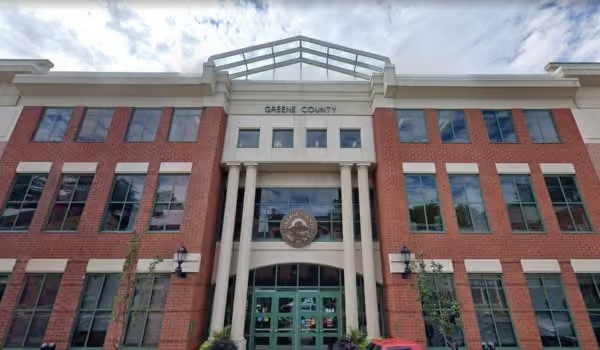





CATSKILL―For the eighth consecutive year, Greene County will hold the line on its property tax levy.
County officials on Tuesday unveiled a tentative 2027 budget that calls for a 9.5 percent increase in spending, bringing total expenditures to $157,799,174, up from $144,105,325 this year. Despite the nearly $13.7 million increase, the proposed budget calls for no increase in the total amount raised from property taxes, which has stood at $27,404,370 since 2020.
And while the tax levy will remain flat, county taxes across individual towns will continue to adjust based on their equalization rate―the state's measure of a municipality's level of assessment, calculated as the ratio of total assessed value to total market value.
For 2027, that means county taxes will be increasing in Catskill (2.7%), Coxsackie (2%), Durham (6%), Greenville (1.3%) and Hunter (3.1%).
County taxes will be decreasing in Ashland (4.6%), Athens (1.2%), Cairo (1.8%), Halcott (9.7%), Jewett (5.5%), Lexington (6%), New Baltimore (2%), Prattsville (1.9%) and Windham (4.6%).
“Success in maintaining the property tax levy as flat is due to understanding all sources of revenue and projecting expenses accurately,” noted Legislator Charles Martinez (R-Coxsackie), who serves as budget officer.
“Greene County has consistently used multiple year budget models to forecast both,” he said, adding that holding the line on property tax increases seems confident for 2028 and 2029.
One of those key revenue sources is sales tax, which has consistently outpaced projections in recent years. In 2025, the county collected $56.5 million in sales tax revenue, up from $45.8 million in 2022. However, officials do not expect those upward spikes to continue much longer.
“By fiscal year 2029, we will no longer have the benefit of sales tax surpluses to offset traditional budget expenditure increases,” noted Martinez, projecting 2027 and 2028 sales tax revenue of $57 million and $58 million in 2029.
“Therefore, the planning for future budgets may rely on the use of fund balances and previous years’ surpluses unless other forms of revenue can be realized. As this would be a new practice in budget formulation, it is not unexpected and our previous budgets recognized these financial trends. We knew we would get here and have been planning accordingly,” he said.
At first glance, the nearly 10 percent spending increase―the highest in recent years―seems unusually large, Martinez acknowledged.
“However, a large portion of the increased costs are either out of County control, represent voluntary increases not mandated or, in some cases, are supported by new revenue to the budget,” he said.
Unlike other states in the country, New York does not take responsibility for required social network programs, Martinez noted.
“As a result, Greene County will need to increase spending by approximately $1.1 million in Fiscal Year 2027 to finance SNAP and other Social Service programs,” he said.
“In addition, New York State retirement pension costs will increase nearly $825,000 due to investment policies and philosophies that do not take advantage of Wall Street baseline practices,” he added.
Expansion of ambulance system expenditures is also adding another $1.9 million to next year’s budget.
“In fiscal year 2026, Greene County provided financial assistance to our towns with $1.5 million of direct support to local budgets,” Martinez pointed out.
“Additionally, the County absorbed the full cost of the paramedic fly car system totaling $2.9 million. Also, at that time, the County discussed the prospects of adding additional transport ambulances to the system to further assist local efforts dealing with medical emergencies,” he said. “This budget maintains these efforts and will budget an additional amount of $1.9 million to expand the transportation network with one or two fully equipped transport ambulances.”
Increased payroll and benefit costs are also factored into the budget.
“This past year saw multiple workforce collective bargaining contracts renewed that provided, in some cases, significant wage increases,” said Martinez. “The increases were evaluated against market conditions and correlated with employee recruitment and retainage efforts. The contracts were multiple-year agreements with significant impact in the first year of the agreement versus the outer years."
Another $500,000 was also factored into the budget for the Highway Fund in order to expand road surface treatments and highway fleet turnover.
“Of concern within the highway budget are expenditures on diesel fuel and road salt, each of which has risen considerably,” Martinez said.
Martinez, who has served on the legislature for more than four decades, said he is encouraged by the financial condition of the county.
“Think of the public works projects completed over the last couple years, with the exception of the Justice Center, all were paid with cash and not through the issuance of indebtedness. Road repairs, particularly road slides, have been financed with the use of budget surpluses. The reconditioning of all solid waste facilities by improving citizen safety features and amending transportation of waste has greatly been improved. Lastly, our heavy equipment fleet has seen incredible fleet changeover, not only lowering the average age of frontline trucks but also reducing maintenance costs," he noted.
“I don't think we've ever been in such a strong financial position,” Martinez said.
A public hearing on the 2027 tentative budget is scheduled for 6:15 p.m. on October 28 at the Catskill High School auditorium.