County tax levy to remain flat for eighth straight year
Published on:
September 25, 2026




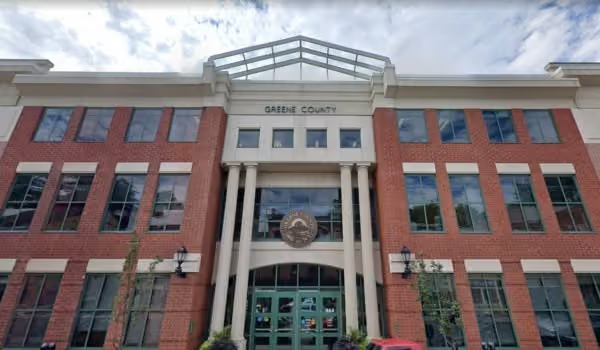





CATSKILL―If anybody out there amongst the mules of taxation likes rattling a piggy bank and not hearing it empty, an October 28 public hearing has been scheduled by the Greene County Legislature on the 2027 budget.
Lawmakers will gather, as usual, in the auditorium at Catskill High School at 6:15 p.m., taking input on the proposed county fiscal package that is anticipated to again contain no tax levy increase.
Nothing is definite until the spending plan is approved, traditionally in late November, and while the overall numbers will be changing, the ultimate bottom line is expected to be the same as a West Texas highway.
“It will be flat,” says County Administrator Shaun Groden, “for the eighth straight year.”
While expenditures have absolutely gone up since 2020, those dollars have been offset by plugging in a little nest egg of sales tax revenue and fund balance.
Lawmakers, last year, okayed a $141,858,252 fiscal plan, even while overcoming a nearly $5.8 million rise in overall spending. That kept the taxpayer burden at $27,404,370, a figure expected to be repeated, drawing upon sales tax revenues.
Those sales tax dollars have annually been exceeding all expectations since the pandemic but the abundance of income is determined by uncontrollable elements―a key factor in planning.
Even with that, Groden says, “We can also predict one more zero in 2028.”
“After that it gets ducky. We try to put together three budget years, so we are working not just on 2027 but also through 2029,” he added.
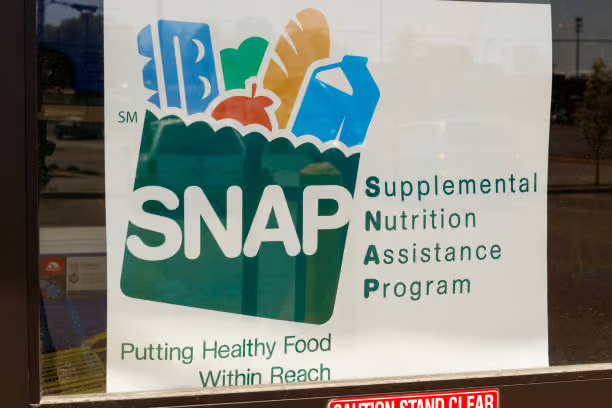
“A lot of what will happen in 2028 and 2029 depends on the changes that are happening at the federal level,” particularly within the Supplemental Nutrition Assistance Program (SNAP), Groden said.
Lawmakers recently passed a resolution related to SNAP, more commonly referred to as food stamps, in response to a federal mandate that results in states and counties absorbing more of the financial load for the program.
Language in the One Big Beautiful Bill Act reduces the federal share of SNAP administration from 50 to 25 percent, effective October 1. That translates to an estimated quarter-million dollar hit for Greene County in the last fiscal quarter of 2026, Groden says, and at least four times that amount possible in 2027 for other associated costs.
Local lawmakers are appealing for a two-year “delay in implementation,” giving the county time to get their ducks in a row.
Meanwhile, there are other vital financial considerations, such as the potential creation of a countywide ambulance system.
Talks were slated to take place this week on establishing a new reserve fund to pay for that potential transition, a multi-million dollar undertaking.
Part of that plan would include buying two new transport ambulances now, helping ease gaps in the current operations as the emergency response landscape continues to undergo a shift away from municipal squads.
Bearing all that in mind, Groden says, “we are looking good for 2027.”
“My focus is on thinking further ahead, past 2028, with all the unknowns, to have incremental increases, if needed, not a whopper,” he said.
Meanwhile, multiple infrastructure jobs, deemed necessary as county buildings age out, “have been paid in cash,” Groden says, avoiding expensive borrowings.
Legislature Chairman Patrick Linger voiced confidence in the county’s current direction.
“We try to be conservative and smart,” said Linger. “We have an economic team that is consistently drawing new business to the county, working with them from start to finish which goes a long way, sending the right message.”
“As I look around, I see several towns and villages, as well as a dozen or so counties, passing resolutions to exceed the [State mandated] two percent tax cap limit. We aren’t doing that here,” Linger continued.
“We are fortunate to have the sales tax revenues, but we are very careful in how we use it while still investing in infrastructure and investing in things like grant money for college students,” he said.
“We know, going into any budget year, we are going to be spending $2.5 million more for collective bargaining right off the top,” Linger said. “We know fuel costs are increasing significantly, making multiple trips for solid waste daily [to western New York] in addition to other highway department trucks and sheriff’s vehicles.”
“The fact that we have had seven straight budgets with no increase in the tax levy―looking to make that eight straight―shows we are trying to use every tool we can so this does not fall on the backs of taxpayers,” he added.






%20F.avif)