For Kiskatom woman, life is becoming unbearable
Published on:
June 2, 2026





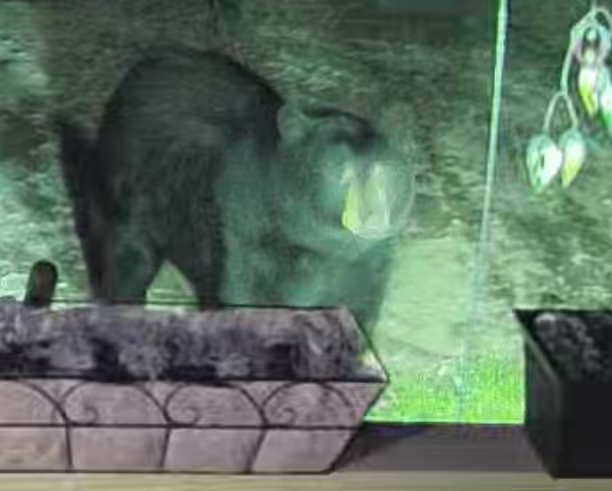





KISKATOM―Since last year, Jeanette Ricucci has had bears destroy her retaining wall, knock down part of her deck and even chase her across the yard. But she has never had a physical encounter with one. That is, until last week.
Around 8 p.m. on Friday, Ricucci was outside her Mossy Hill Road home and said she got the feeling someone was watching her. When she turned around, she was face to face with a black bear standing on its hind legs.
“It put its paws up and cuffed me,” said Ricucci. “Whacked me across the face and then trampled over me when it ran off.”
“It was probably about 200 pounds but when you are that close it looks more like 600 pounds,” she said.
Ricucci, 70, managed to get in the house and phone her daughter-in-law who immediately called State Police. Troopers arrived along with an ambulance.
“Thank God he didn’t have his claws out, he would have torn my face open,” she said. “I’m on blood thinners. I would have bled to death."
After being checked out by EMS, Ricucci opted not to go to the hospital.
“The next day I felt like someone beat the hell out of me,” she said. “I went to the orthopedic doctor on Monday and ended up with a shot of cortisone in my elbow. My foot is bruised, my knees are bruised, my eye is bruised.”
About two and a half hours after the encounter, Ricucci said an environmental conservation officer came to her house, followed on Monday by a Department of Environmental Conservation (DEC) biologist.
“She said, well you live in bear country and it sounds like he just bumped you… it sounds like someone must be feeding them in the area because they have lost their fear of people,” Ricucci says she was told.
“Because someone is feeding it doesn’t make it okay for the bear to come up and swat me in the face in my own yard,” she said. “The point is, we made contact and I got hurt.”
And it’s not the first or even the second or third time Ricucci said she has had DEC at her property. She estimates since last year she has called them more than 15 times for various bear issues.
“We had about 10 bears coming around this time last year. My security camera picks up all of the pictures,” she explained, adding that some of the bears a 300-500 pounds.
Initially, Ricucci was told the problem was her garbage cans. So, she says, she made sure no garbage was left outside and the containers were cleaned with ammonia. But the bears kept coming.
Next, she says, they tore apart her retaining wall―apparently looking for grubs.
“They absolutely destroyed it,” she said.
Another time, a bear took the entire front section of her deck down.
“Between the wall and the deck, they did about $20,000 in damage,” Ricucci estimates.
And yet another time, she said one of the bears chased her into the house.
“DEC came down and gave me a rubber bullet. One rubber bullet,” she said. “And it was the wrong gauge.”
On Tuesday morning, Ricucci said she was getting ready to take her dog out when a motion alarm went off on one her outside cameras.
“I looked and there it was, standing in the yard just looking at my deck,” she said. “I got my shotgun and went outside and could hear him under the deck. I let a buckshot go and he came out and ran into the woods.”
According to DEC, this time of year, young bears, particularly one-year-old males, disperse from the area of their birth and may move several dozen miles in this process. During the spring and early summer months, black bears have depleted fat reserves and will search extensively for easily obtainable, calorie-dense foods, which can lead to an increase in the potential for human-bear conflicts.
Roughly 80 percent of human-bear conflicts are resolved with some simple advice, such as removing food sources like bird feeders or trash, DEC notes. If a bear still presents a problem, DEC may negatively condition it.
“The bear will be hazed in hopes of teaching the bear that obtaining food near humans is unacceptable. DEC tags any bears that it handles so that they can be readily identified if encountered in the future. This data influences future decisions, should a bear have further encounters with people,” DEC states.
But if a bear presents a “clear threat to public safety,” DEC may trap and euthanize it. They do not relocate or place bears at animal sanctuaries.
“A relocated bear will often travel great distances to return to where it was originally captured. If it can't find its way back, it will often seek out new human-created food sources in the area where it was released. Further, zoos and sanctuaries usually have too many bears already and will not accept more,” the agency reports.
Instances of black bears attacking or injuring a person in New York are extremely rare. A person is 374 times more likely to die from a lightning strike than to be killed by a black bear, according to the American Bear Association.
But incidents do happen. Last August, a 63-year-man in Cairo was hospitalized after he happened upon a bear in his entry room where food and trash were stored. The bear, who according to DEC scratched the man while trying to flee, was later located and euthanized.
When contacted about Ricucci’s situation, DEC issued a statement acknowledging the incident Friday night.
“ECOs, forest rangers, and DEC wildlife experts continue to monitor reports of bears in and around Greene County and is specifically working with this resident to create a less desirable environment for bears,” DEC stated.
Ricucci said no one is currently working with her.
“What are they going to do, wait for someone to get really hurt?” she said.
“I’ve been here for 45 years. I’m not a dummy. I have learned to live with bears,” she added. “But enough is enough. I’ve done everything you are supposed to do.”
Ricucci said now she is afraid to leave her house, especially after dark, and cannot sleep in fear one of the bears is going to break in.
“I carry a gun now just to walk the dog in my own yard,” she said.