Firehouse Jiu-Jitsu brings new energy to historic Catskill building
Published on:
March 30, 2026




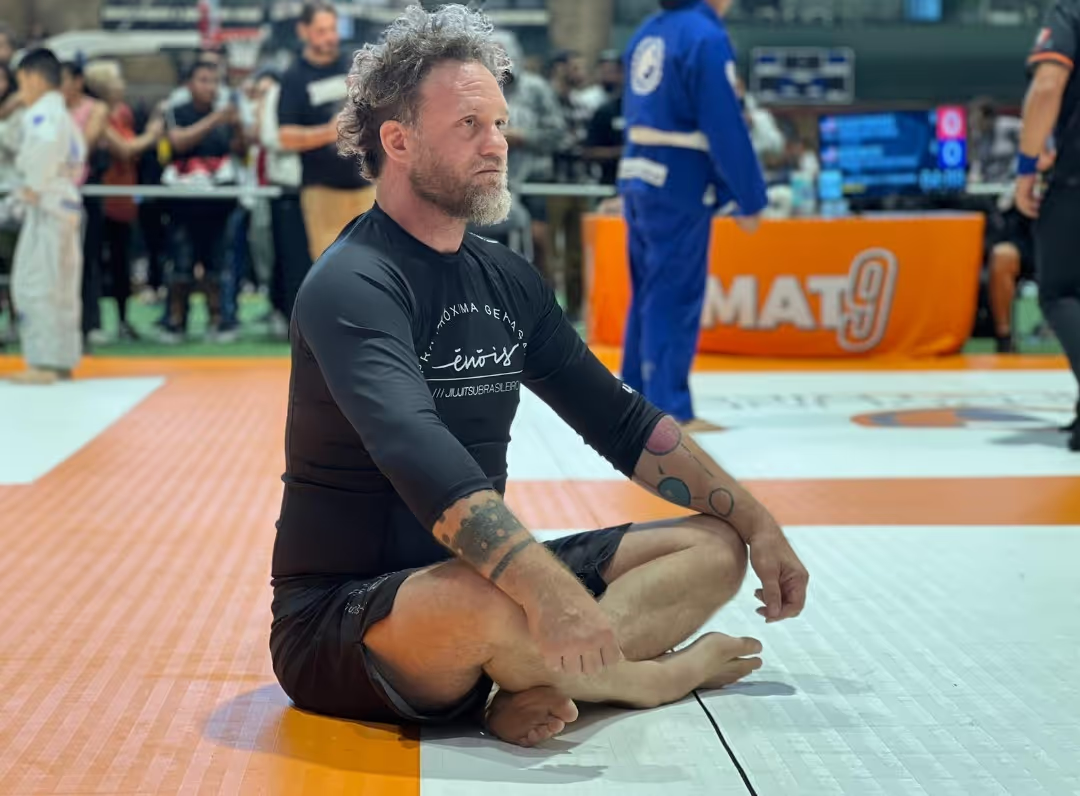





CATSKILL―At 30 West Bridge Street, a century-old building where blaring sirens once wailed is now home to a quieter discipline.
Firehouse Jiu-Jitsu, owned and operated by Paul James Anthony “PJ” Bekanich has transformed the former fire station into a thriving martial arts academy rooted in resilience, humility, and community.
For Bekanich, the journey to opening the school began not with mastery, but with a humbling defeat.
“I was manhandled like a child,” he recalled of a sparring session with a close friend he trained with regularly.
When that friend explained the techniques came from Brazilian Jiu-Jitsu, Bekanich was instantly captivated.
He soon enrolled at the Pedro Sauer Academy, where his passion for the art took hold. Often translated as “the gentle art,” Brazilian Jiu-Jitsu focuses not on striking, but on control, leverage, and submission.
“It’s not about hurting your opponent,” Bekanich said. “It’s about subduing them.”
A lifelong athlete, Bekanich grew up playing soccer and rugby and competed at several colleges, including the University of Utah, where he also developed a love for snowboarding.
While immersing himself in Jiu-Jitsu, Bekanich worked professionally as a headhunter, helping Olympic athletes transition into post-competition careers—something he describes as a kind of job transition counseling.
By 2003, his path had shifted toward education. As a global social studies teacher, he launched his first Jiu-Jitsu program as an after-school initiative at Urban Peace Academy in East Harlem. It quickly grew in popularity.
“Besides basketball, it became the most popular after-school activity,” Bekanich said.
Within just eight months, his students were prepared to compete in tournaments.
Even as he rose to become an assistant principal, Bekanich continued teaching on the mats. During the Covid-19 pandemic, he kept the art alive by hosting small, informal seminars in his Queens apartment.
“I wasn’t going to stop training,” he said.
That commitment eventually brought him north. Initially familiar only with nearby Hudson, where friends lived, Bekanich soon found himself drawn to Catskill’s character and history—including its connection to legendary heavyweight boxer Mike Tyson.
“There’s grit here,” he said. “It’s a tight-knit place.”
His move was also personal.
“My daughter was at Penn State, about three hours away. I wanted to be within driving distance wherever I settled,” Bekanich added.
Together with his wife, Krystal, he took on the challenge of restoring the long-vacant firehouse into a working academy. The early days were anything but easy.
“We started with one mat, limited heat, and barely any hot water,” Bekanich said. “There were a lot of cold showers and nights in sleeping bags.”
He credits his wife―who handles all of the academy’s graphic design, branding, and promotional work―for helping push through those primitive conditions.
“She was like a Viking,” he said with a laugh. “This place doesn’t run without her.”
From those modest beginnings, Firehouse Jiu-Jitsu has grown into a full operation with expanded mat space, upgraded equipment, and a staff of eight coaches. Youth programs for children ages 6 to 14 have become a cornerstone of the academy, with Coach Chris Adler working with a wide range of students.
One young child with cerebral palsy has participated in modified training sessions, showing measurable improvement over six months, Bekanich said.
The academy also offers women-only classes led by Coach Chris Karl, fostering a tight-knit group that has even formed its own book club.
Firehouse Jiu-Jitsu operates on a sliding-scale membership model, reflecting Bekanich’s desire to make training accessible.
“I see a lot of unity out on the mats,” he said. “Muslims and Christians, cops and chefs—everyone’s training together, looking forward to seeing each other each week.”
That shared experience builds trust, he noted.
“Someone might have me in an arm bar to show control,” Bekanich said, “But I trust them not to take it too far. That trust carries over into everything.”
Families, too, are a major part of the gym’s culture. Parents train alongside their children, using the time to bond while learning self-defense and discipline.
“It leads to these great, multi-generational conversations,” Bekanich said. “It just makes sense on the mat.”
Wrestling Coach Shane Dinkelacker has also joined the academy, adding another layer of grappling expertise to the program.
On Saturday, April 18, Firehouse Jiu-Jitsu will host its annual Founder’s Day celebration from 10 a.m. to 2 p.m., featuring food, socializing, and a traditional belt promotion ceremony. In a playful rite of passage, newly promoted students often receive their belts mid-match—wrapped around their waist while still grappling, a symbolic welcome to the next level.
This year’s event will also introduce a new initiative called Community Jiu-Jitsu, offering free Sunday classes designed to teach core self-defense concepts such as managing distance, standing and seated grappling, and escaping holds.
The philosophy behind the academy is rooted in the history of the art itself. Brazilian jiu-jitsu traces its origins to the early 20th century, when Japanese practitioners brought traditional jujutsu and judo to Brazil. There, the techniques evolved—most notably through the Gracie family—into a system focused on leverage and ground fighting, allowing smaller individuals to defend themselves against larger opponents.
That history mirrors Bekanich’s own journey—one shaped by learning, adaptation, and persistence.
Looking around the once-abandoned firehouse, now filled with energy and purpose, he reflects on what has been built.
For Bekanich, the goal has always been to create a place where people feel like they belong.
“I really feel like I did it with this,” he said.