County budget narrowly passes amid tax debate
Published on:
November 19, 2026









CATSKILL—The Greene County Legislature narrowly adopted its $132.9 million budget for 2027 Wednesday night following a contentious discussion over whether to go a step further and lower it.
The spending plan holds the county property tax levy flat at $27.4 million for an eighth consecutive year. However, due to how that levy is distributed among the county's 14 towns, taxpayers in five municipalities will see increases, prompting an unsuccessful effort to reduce the levy by approximately $1.57 million.
The 14 legislators were evenly divided, 7-7, but the budget passed by a weighted vote of 5,407 to 4,593. Under the county's weighted voting system, legislators representing more populous towns have greater voting power.
Voting in favor were Legislature Chairman Patrick Linger of New Baltimore and legislators Daryl Legg (Halcott, Lexington, Hunter), Greg Davis (Greenville), James Thorington (Prattsville, Ashland, Windham, Jewett), Charles Martinez (Coxsackie), and Sherry True and Harry Lennon, both of Cairo.
Opposing the budget were legislators Jay Lucas, Matt Luvera, Michael Bulich and Michael Lanuro, all of Catskill, along with James O’Connell (Athens), Patty Handel (Durham) and Thomas Hobart (Coxsackie).
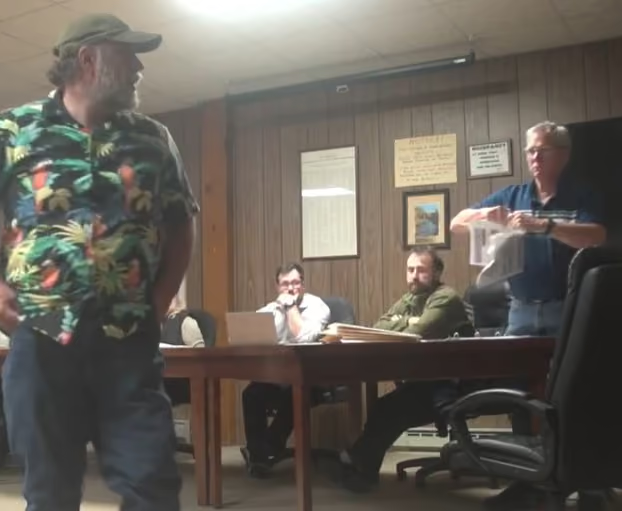
Luvera, the Legislature's Republican majority leader, questioned why lawmakers were being told the budget could no longer be amended after he said earlier discussions suggested that reducing spending was possible.
“I had asked about reducing the budget $1.567 million to bring all of the levies down for next year,” Luvera said, referring to the possibility of using money from the county's fund balance.
“There wasn't support for that so then I asked about potentially reducing our expenses by that same amount and the county administrator said that was doable. So, now I am being told we cannot do that because of a legal process,” he said, requesting an explanation from County Attorney Ed Kaplan.
County Administrator Shaun Groden said the issue was no longer simply a matter of whether legislators supported changing the budget, but whether they could legally do so at that stage of the adoption process.
County Attorney Ed Kaplan explained that state law gives the Finance Committee 15 days to review the tentative budget and recommend changes. That deadline expired October 28, the same day the county held its public hearing.
Kaplan said changes after that point are generally limited to those required by law. The Finance Committee met again November 16 and approved the tentative budget without revisions.
Although state law allows counties until December 20 to adopt a budget, Groden said rejecting the spending plan Wednesday night would require another public hearing. He also explained that if lawmakers failed to adopt a budget by that deadline, the proposed spending plan would automatically take effect.
“We do have the time and we could certainly have a public hearing before December,” Luvera said.
The adopted budget maintains the county property tax levy at $27,404,370 despite increasing appropriations by approximately $5.6 million. However, changes in equalization rates and taxable property values mean that taxpayers in Durham, Hunter, Catskill, Coxsackie and Greenville will see increases in their share of county taxes.
Durham faces the largest projected increase at 6%, followed by Hunter at 3.1%, Catskill at 2.7%, Coxsackie at 2% and Greenville at 1.3%.
The other nine towns are projected to see decreases: Halcott, 9.7%; Lexington, 6%; Jewett, 5.5%; Ashland and Windham, 4.6% each; New Baltimore, 2%; Prattsville, 1.9%; Cairo, 1.8%; and Athens, 1.2%.
Although the county is collecting the same total amount in property taxes, the share paid by each town can change because of New York state's equalization system.
An equalization rate compares a municipality's assessed property values with their estimated market values. For example, a rate of 50% means properties are assessed, on average, at half their market value, while a rate of 100% means assessments reflect full market value.
Because towns conduct reassessments at different times and property values change at different rates, the state uses equalization rates to determine each municipality's share of county taxes.
The county also has little discretion in how those taxes are distributed. State law requires the levy to be apportioned among towns according to their proportion of the county's total full value of taxable real estate.
During an earlier committee discussion this month, Greene County Real Property Tax Service Director Ray Ward explained that the county cannot simply shift some of the tax burden from the five towns facing increases to the nine towns receiving decreases.
“We cannot gift money,” he added. “It's a matter of law.”
That leaves reducing the overall levy as an option for providing relief across all 14 towns.
During the earlier discussion, Groden explained that reducing the levy by approximately $1.6 million would eliminate Durham's projected increase, while the other four towns facing increases would instead see decreases. He said approximately $1.7 million would be needed to bring Durham into a decrease as well.
Durham's situation is somewhat different from the other towns. Of its projected 6% increase, approximately 1.6 percentage points are attributed to a decline in its equalization rate. The remaining 4.4 percentage points stem from an adjustment to the taxable value of GSK property following a legal challenge to its assessment.
Equalization rates are expected to continue changing as real estate markets fluctuate, potentially leaving the county facing the same issue in 2028, with some towns paying more and others paying less even if the overall levy remains unchanged.
Reducing the levy also establishes a lower starting point for future budgets. If the county later needs to restore that revenue to maintain services or cover rising expenses, increasing the levy could be complicated by New York's property tax cap, county officials have said.
Sales tax, Greene County's single largest revenue source, has consistently exceeded projections in recent years, growing from $45.8 million in 2022 to $56.5 million in 2025. However, officials do not expect that growth to continue at the same pace.
When presenting the tentative 2027 budget in October, Martinez warned that by 2029, the county would no longer be able to rely on sales tax surpluses to offset rising expenses. He projected sales tax revenue of $57 million in 2027 and 2028, increasing to $58 million in 2029.
Martinez said future budgets may require using fund balances and prior-year surpluses unless additional revenue sources are identified―a possibility the county has anticipated in its long-term financial planning.
“A reduction in spending of $1.6 million dollars could have been made somewhere in this budget, a very small percent of our budget and it was voted down,” Luvera said in a statement following Wednesday night’s vote.
Luvera maintained that lawmakers still had time to reject the budget, hold another public hearing November 30 and schedule a special meeting to adopt a revised spending plan with a lower tax levy.
“I'm extremely proud of the fact that our board has kept our tax levy the same since 2020 while maintaining services for our residents. This isn't true for many other counties. It’s because of fiscal conservative leadership by our legislature,” Luvera said. “I appreciate the work done by our administration and county employees, but I work for the taxpayer and could not support an increase in taxes for some of our residents.”
Linger, meanwhile, defended the decision to maintain the county's existing levy, saying the discussion originated with a request from Handel to use fund balance or reduce the levy enough to prevent increases in any of the county's 14 towns.
Durham’s 6% increase is the largest of any town but Linger pointed out that the town's county tax rate decreased by roughly 15% for 2026 and had also declined in each of the previous two years.
“The County has nothing to do with equalization rates, or revaluations that would affect them,” Linger said.
He praised Groden's financial management and said lawmakers considered the alternatives before deciding to maintain their current approach.
“Shaun Groden is amazing at his job and brings us options and hypotheticals. As a whole, we felt our current tax rate is one of the top 10 lowest rates in the state and we should stay the course,” Linger said.
He also pointed to additional financial pressures facing the county, including $1.2 million in SNAP benefit costs attributed to changes under the federal legislation commonly known as the One Big Beautiful Bill.
“Why? Because New York State is one of three states that requires counties to cover those costs. We asked for relief from the State but got nothing,” Linger said.
Linger said that the county's financial position reflects years of deliberate decisions to build reserves, control expenses and prepare for major infrastructure needs.
“Our job is to provide services. When I took office in 2016, there was very little in fund balance, and nothing saved for a jail that the county knew needed replacing. Every winter our phones would ring as plow trucks broke down and roads collected snow. Solid waste was costing taxpayers over $1.5 million annually,” he said.
“We changed our procurement policies. We changed our economic development strategy. We put extra available funds into multiple reserve funds. We are in great financial shape, handed towns $1.5 million last year to help with EMS costs and took over the town share of the Greene EMS budget of almost $400,000,” Linger said.
He contrasted Greene County's approach with proposals in neighboring counties, particularly the proposed Ulster County for Fair Taxes Act, which would authorize a local income tax, and a potential 24% property tax rate increase in Schoharie County.
“We're deliberately conservative, transparent, and stay in our lane,” Linger said. “I'm happy with our collective efforts.”