C-GCC budget decreasing by $1.3 million
Published on:
August 17, 2026





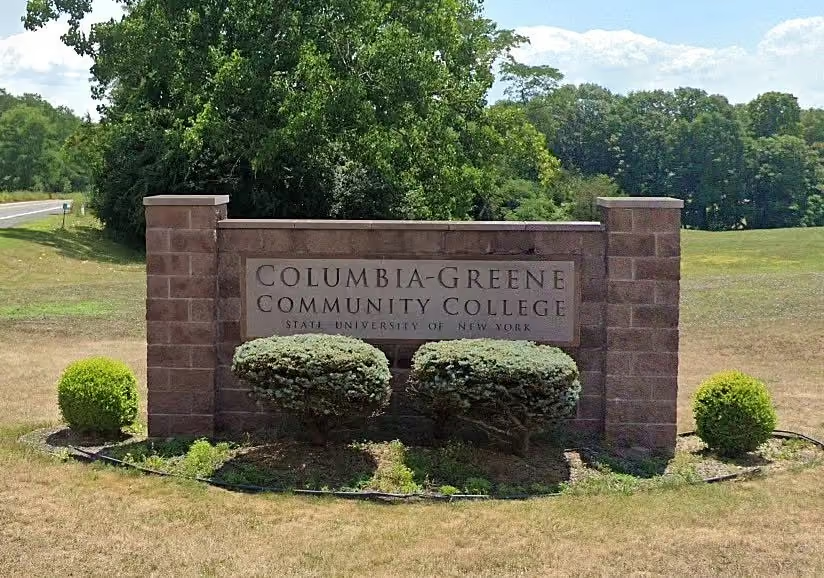





CATSKILL―Everybody loves pie, particularly if it is a pie chart showing that we mules of taxation on this side of the Hudson River will be paying less toward the 2026-2027 Columbia-Greene Community College budget.
The college’s spending will be plunging by over $1.33 million due to multiple in-house administrative changes as well as purse string tightening.
C-GCC’s bottom line will decrease from $19,793,532 to $18,462,326, a significant financial turnaround reflecting $18,486,126 in anticipated revenues―topping predicted costs by $23,800―the budget shows.
Greene County legislators, during a recent County Resources Committee meeting, got a breakdown of the proposed spending plan, later setting a public hearing for August 19 to vote aye or nay.
Dr. Bryant Morgan, the interim chief fiscal officer and vice president for finance and administration at C-GCC, explained that Greene County’s contribution to the college will be dropping slightly.
Greene and Columbia counties annually pay a “sponsor share” of the college’s total financial package, dividing the cost factored on their percentage of the twin-county based student population.
While student ratios ebb and flow, the dollar amount has been steady over the past seven budget cycles, staying at $6,448,350, with Greene County ponying up $3,014,229 this year, budget figures show.
That is $35,588 less than a year ago, with Columbia County’s portion of $3,434,121 going up by the same amount.
Both figures are based on a three-year average of students rather than actual head counts, which were provided to lawmakers merely as a reference point and illustrating what would be a wider percentage gap.
Greene County was hit last year with an increase of $5,363. Greene County Legislative Chairman Patrick Linger conservatively rued the dollars and cents rise while liking that it also represented a jump in Greene County enrollees.
Lawmakers have an established Greene County Cares Fund to help students with college-related expenses, such as tuition and travel.
Money not spent in one year rolls over to the next, assisting recent high school graduates, non-traditional students and adult learners seeking to improve their lives by earning a degree or a certificate.
Greene County dedicates $100,000 annually to the program, administered by the Columbia-Greene Community College Foundation that provides quarterly updates and a yearly report to lawmakers detailing distribution of the funds.
So, while it is always pleasant to save a few thousand bucks it remains, “a double-edged sword,” Linger says.
“I’m pleased that we will now pay less but disappointed our percentage of students is going down,” he said. “We wonder why that is happening. Is it because some of the course work being offered needs to change, offering courses our students want?”
“I don’t mind paying more if we can keep our people here. We are in dire straits to get people to work here, stay here. That’s a much bigger issue than a few thousand dollars,” Linger said.
Morgan, in a follow-up phone interview on the subject of programming said, “We try to be sensitive to the needs of people in this area in developing new programs.”
“One of the things we are more aware of is the changing demographic of students. There is a shrinking number of traditional-age students,” Morgan explained.
“There are greater numbers of people in both counties who are needing certain credentials to complete their degree or advance in their careers. The entire SUNY system is aware of this trend,” he added.
Legislator Michael Bulich of Catskill praised Morgan for his stated commitment by the college to alleviate the use of fund balance to offset expenses.
There had been a period of four straight years during which C-GCC drew heavily on reserves to support operations, reversing that in 2026-2027 by filling the piggy bank with the $23,800 in projected surplus.
“I can’t stress enough, you stopping the bleeding on fund balance,” Bulich said. “Thank you for that. I hope more surplus can be added going forward.”
“Without a doubt, they have been using a large amount of fund balance instead of making tough decisions,” Bulich added.
“We are being attentive to exercising discipline in preserving fund balance,” Morgan said.






%20F.avif)