The average age of a Co-Greene student is now 27
Published on:
July 8, 2026










HUDSON―The number of adult learners at Columbia-Greene Community College is on the rise.
College President Dr. Victoria Walsh, who spoke at a meeting of the Greene County Legislature this month, said the average student age is now 27.
“We’re seeing a lot more students from both counties coming to the college to either up-skill, change careers, get a better job… and that’s what we’re here to do now because, as you know, the demographic is shifting in the counties and the college has to respond to that,” said Walsh.
“But we’re really pleased to see an increasing adult market coming,” she added.
In one class, Walsh noted, a mother and daughter are both enrolled.
“Which is pretty different to when I started teaching a while ago,” Walsh said.
Statewide, there has been a push to get more older New Yorkers into the classroom.
In the fall of 2025, the state launched CUNY and SUNY Reconnect, a program that provides free community college tuition, books and supplies for students ages 25-55 who don’t already have a college degree and want to pursue an associate degree in a high-demand field.
In its first year, CUNY and SUNY Reconnect enrolled over 12,000 eligible students.
Columbia-Greene Community College was also awarded a $50,000 state grant last year for marketing and recruitment targeted to specific adult learner populations.
The purpose of Walsh’s visit to county lawmakers was to give an update on the Greene Light to Enrollment Scholarship, a program funded by the legislature that provides tuition assistance for Greene County residents. Last year, 32 full-time and 22 part-time students benefited from the scholarship, administered through the Columbia-Greene Community College Foundation.
“Sometimes, that money is the difference between them going and continuing with their education or them starting and staying,” Walsh said.
The legislature expected to pass a resolution later this month to allocate $50,000 for its Greene County Cares Fund for the 2026-27 school year. Launched in 2020 with an initial $181,600 investment, it supports not only the Greene Light to Enrollment Fund but also other programs that cover emergency transportation and academic tutoring.
“One of the trends that we're really seeing in the students now is that they’re coming, but they’re stopping because of finance,” said Walsh.
“Finance continues to be the top driver of students not completing their education. So, getting them to the finish line―which is what this scholarship does―is becoming increasingly critical because if they leave without their degree or their certification, they leave in a worse position than when they came with financial aid exhausted, maybe not as positive about education, and without the credentials they need to move on to the next stage,” she explained.
Walsh also presented lawmakers with thank you letters from students supported by the scholarship.
“They’re using words like, ‘this provides relief, ‘it provided assistance during a difficult time,’ ‘it helped me complete my goal,’ I can now be a nurse,’ ‘this makes a difference to my family.’ So, it’s really important to reflect to you their gratitude for what all of you do for them because they are the people in your community,” she told lawmakers.
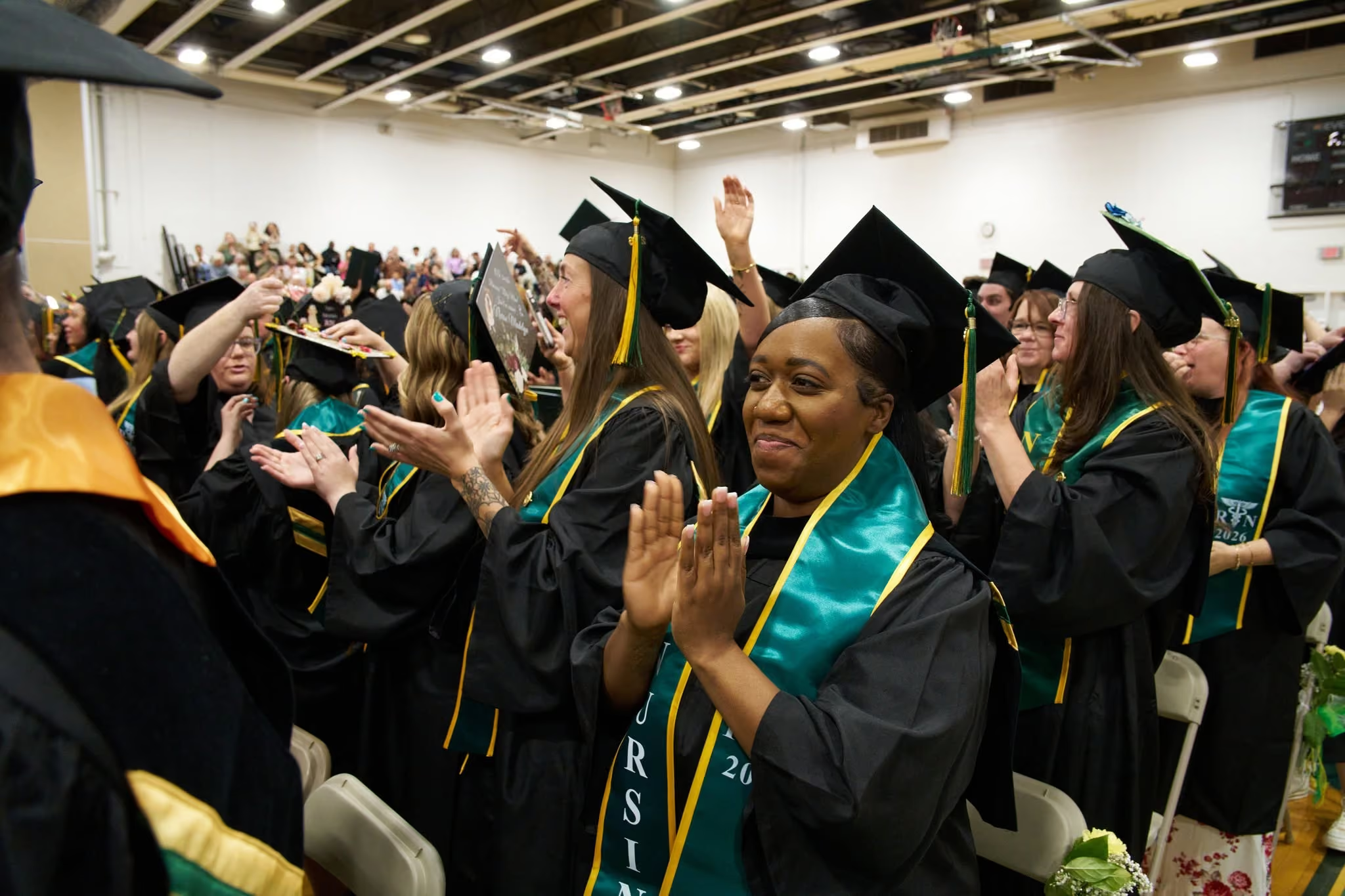
A primary program those students are enrolled in, Walsh said, is nursing.
“Once they leave with their RN associate’s degree they can walk into a 60, 70, 80 [thousand], maybe a six-figure job. So, nursing is primary,” she explained. “Business administration is also very big for these students, and some of our construction programs, too.”
Another program that is in the works at the college would train future EMTs and paramedics. It’s something county legislators have advocated for.
“[It] is $250,000 to stand up the program, which would help with the equipment purchase, the infrastructure, starting with a new faculty member, and, maybe, some additional scholarship aid to get the first cohort going. So, that proposal will probably be ready for you next week,” said Walsh.
New York State recently expanded the SUNY Reconnect program to include emergency management among its identified high-demand fields, she noted.
“So, we might even be able to build a bridge from that program into a degree that would be provided free eventually,” said Walsh.