Appellate court rules against former Catskill medic
Published on:
April 24, 2026










CATSKILL―A state appellate court has ruled against a former Catskill paramedic who sued the state Department of Health (DOH) claiming the agency’s disciplinary procedures violate his constitutional rights.
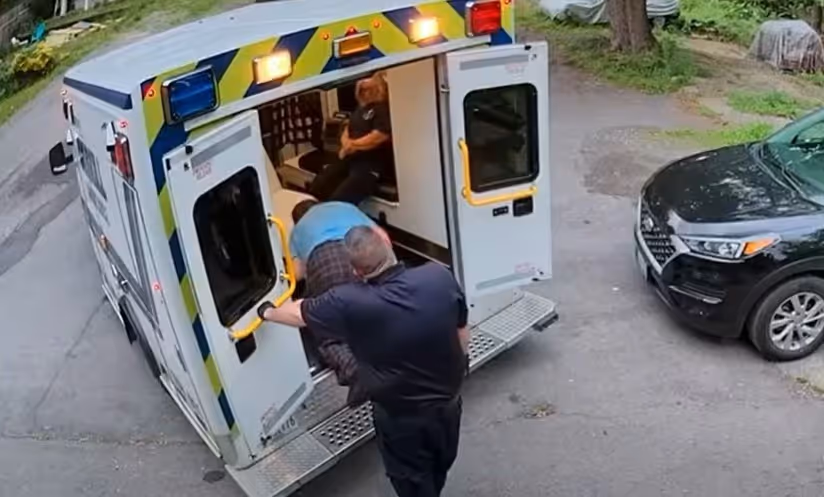
Justin Ball is facing a $10,000 fine and revocation of his EMT-Paramedic certification from the DOH as the result of a call on Main Street in Catskill in May of 2024. A video that showed Ball and his EMT partner mistreating their elderly patient went viral, ultimately resulting in his resignation from the Town of Catskill Ambulance and DOH charges.
In September of 2024, Ball, who resides in Middleburgh, filed a lawsuit against the DOH in New York State Supreme Court in Schoharie County, arguing that he is entitled to a jury trial rather than a DOH hearing―and Judge Thomas Marcelle agreed.
“What happened, at least according to Respondent Department of Health's (DOH) telling, is a disturbing story. A 63-year-old man had fallen and couldn't get up. Ball believed that the patient was faking. As a result, he lacked any modicum of sympathy. Instead, Ball heaped scorn and ridicule upon the patient,” Marcelle had summarized in his 27-page decision.
“Upon arriving at the hospital, it turned out the patient was not feigning sickness; he was quite ill,” Marcelle noted.
“Ball quickly realized that his mistreatment of the patient might spell trouble for him. So, he decided to secretly record a conversation with the patient where he attempted to cajole the patient into casting Ball's actions in a favorable light. The gambit failed. Upon a complaint by the patient outlining the above allegations, DOH lodged charges against Ball,” Marcelle continued.
“DOH set in motion the bureaucratic machinery to fine Ball and to revoke his license. DOH scheduled a hearing; but Ball did not like this forum,” Marcelle wrote. “Instead of adjudication by DOH, Ball wants a jury to decide if he did these horrid things.”
The Seventh Amendment, as made applicable to the States through the Due Process Clause, “grants, affords, and entitles” Ball to a civil jury trial in New York State Supreme Court to determine whether he is liable for and subject to civil penalties under Public Health Law and subject to revocation of his EMT-Paramedic license, Marcelle ruled.
“If Ball did everything that DOH says he did,” Marcelle added, “he is deserving of punishment.”
“However, it seems wise to recall that the Seventh Amendment exists to protect the individuals, particularly unpopular ones,” he concluded.
DOH, represented by the New York State Attorney General’s Office, appealed the decision to the Appellate Division of the State of New York, Third Judicial Department that on Thursday issued an opinion and order stating, in part, “the right to a trial by jury provided in the NY Constitution does not extend to those proceedings concerning professional licensure ‘where the object is not the punishment of the offender, but to purge of an unworthy member a profession in which purity of conduct and character are all important’.”
Ball could appeal to the New York State Court of Appeals, the highest court and court of last resort in most cases.
Meanwhile, the patient in the case, Thomas Weygant, and his wife Rose Weygant filed a civil lawsuit in State Supreme Court in Greene County in May of 2025, against Ball, now-former EMT Laura Mastrantuono, the Town of Catskill and Town of Catskill Ambulance.
The lawsuit states that Thomas Weygant is developmentally disabled and multiple health issues require him to utilize a wheelchair or walker. He was suffering from diabetic shock accompanied by unsteadiness and balance problems, prompting his wife to call 911, the lawsuit notes.
Ball and Mastrantuono responded and, according to the lawsuit, “forced Mr. Weygant to slide down the outdoor stairs of his apartment building on his backside, unassisted.”
“EMT defendants chose not to use the stretcher, but rather forced Mr. Weygant to crawl onto the ambulance using his hands and knees, and without assistance… while they mocked and taunted him,” the lawsuit alleges.
“Weygant unsuccessfully heaved himself on the stretcher and it ultimately fell off it. Rather than assist Mr. Weygant, who was now stuck between the stretcher and ambulance wall, EMT defendants continued to verbally taunt and abuse him for his inability to raise himself off the floor,” the lawsuit continues.
“Defendant Mastrantuono violently dragged Mr. Weygant’s arm, causing him to scream in pain. Defendant Ball violently dragged Mr. Weygant by the legs towards the back of the ambulance, causing further pain and embarrassment,” the lawsuit alleges, adding that, “EMT defendants then ordered him to get on the stretcher if he wanted to get to the hospital, but again deliberately withheld assistance.”
Thomas Weygant was transported to Columbia Memorial Hospital where he remained for several days.
The lawsuit, seeking unspecified compensatory and punitive damages, remains ongoing.