Union: Prisons are in a ‘full-scale systemic emergency’
Published on:
April 21, 2026





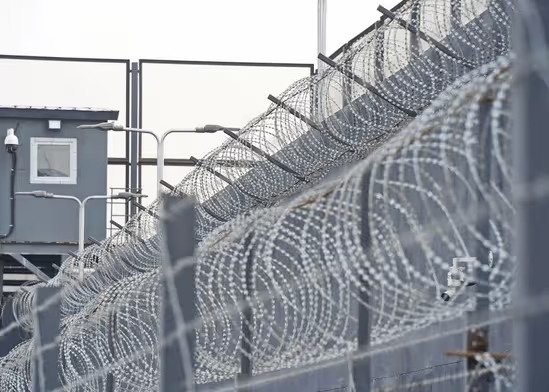





COXSACKIE―The New York State Department of Corrections and Community Supervision (DOCCS) is in crisis, according to a letter sent by the New York State Correctional Officers & Police Benevolent Association (NYSCOPBA) Executive Board to Gov. Kathy Hochul.
The letter, dated April 17, details what the union describes as an “alarming surge in violence, dangerous contraband, staff assaults, overdoses, exposures, and deaths inside state prisons.”
Among the incidents cited is one that happened on March 30 at Coxsackie Correctional Facility when a convicted murderer with a broken pen attacked multiple officers, sending two to Albany Medical Center.
On April 5, at Mohawk Correctional Facility in Oneida County, three officers and two National Guard members were hospitalized after exposure to an unknown substance found on papers brought into the facility by a visitor. One officer was placed in intensive care and required a ventilator, the union noted.
“In just a matter of days, three separate deaths at Upstate, Riverview, and Gouverneur were placed under investigation by State Police, with early reports indicating fatal incarcerated-on-incarcerated violence. DOCCS’ data reflects 44 incarcerated deaths year-to-date as of April 1, including six ruled suicides,” the letter to Hochul states.
Another one of those deaths happened on April 6 at Upstate Correctional Facility in Franklin County when, according to NYSCOPBA, one inmate murdered another.
“A simple review of the perpetrator’s history shows this was not his first murder. DOCCS management had tried to avoid double bunking but was forced to assign him a bunkie, whom he ultimately killed,” the union stated.
“These are not isolated occurrences—contraband is driving disorder, medical emergencies, violence, and fear across the entire system,” the union told Hochul. “This is not normal. These are not routine disciplinary issues. They are unmistakable warning signs of a correctional system under extreme pressure—one that is becoming increasingly unstable and dangerous for everyone who lives and works behind the walls.”
Unsafe workplace conditions was the leading cause of last year’s wildcat strike of some 12,000 corrections staff who walked off the job between February 17 and March 10.
Understaffing was another reason for the strike, with officers reporting at the time that they had been mandated to work shifts of 24 hours or more.
Earlier this month, the state Comptroller’s Office issued a report that found DOCCS paid more than $708 million in overtime in 2025, up from $205 million in 2016.
Between 2024 and 2025, the DOCCS workforce decreased by over 2,700 while overtime hours per employee grew 32.7% to reach an average of 432 hours―nearly triple what it was in 2020, the report noted.
Throughout the state, some 7,000 New York National Guard troops were called in to stabilize prison operations during the strike and an estimated 2,500 remain deployed to facilities across the state.
“Our members are being assaulted. Staff are being exposed to unknown and potentially lethal substances. Contraband is flooding the system and driving disorder, medical emergencies, violence, and death,” NYSCOPBA President Chris Summers said this week.
“This is a crisis that demands the governor’s direct and personal intervention,” he added.
The letter urges Hochul to immediately engage with the State Legislature and advocate for the adoption of the statewide HALT Committee’s recommendations to amend the Humane Alternatives to Long-Term Solitary Confinement Act, commonly known as HALT.
Passed in 2021 and effective since April of 2022 in all state correctional facilities, HALT prohibits solitary confinement in excess of 17 hours per day exceeding 15 days under any circumstances, and places strict limits on solitary confinement exceeding three consecutive days, or six days in any 30-day period.
The HALT Committee was formed in March 2025 as part of a Memorandum of Agreement with NYSCOPBA following the strike. Its recommendations include expanding serious offenses eligible for segregated confinement, allowing temporary special housing unit or residential rehabilitation unit placement for protective custody when safety risks are unreasonable, and permitting up to 15 days of special housing unit for repeated misconduct after alternative interventions have failed.
“These recommendations must not remain on paper—they must be enacted into law,” the union told Hochul.
Summers also called for stronger penalties under New York’s contraband laws for smuggling drugs, weapons, and toxic materials into the state’s 42 facilities—whether by visitors, mail, packages, or external deliveries—and for a comprehensive statewide strategy to reduce and ultimately eliminate double bunking where it compromises security and human safety.
“Our correctional facilities are no longer operating under normal conditions. They are under extreme pressure and becoming increasingly unstable and dangerous for everyone inside the walls,” said Summers.