William de Mott: Fifer in the American Revolution
Published on:
February 15, 2026





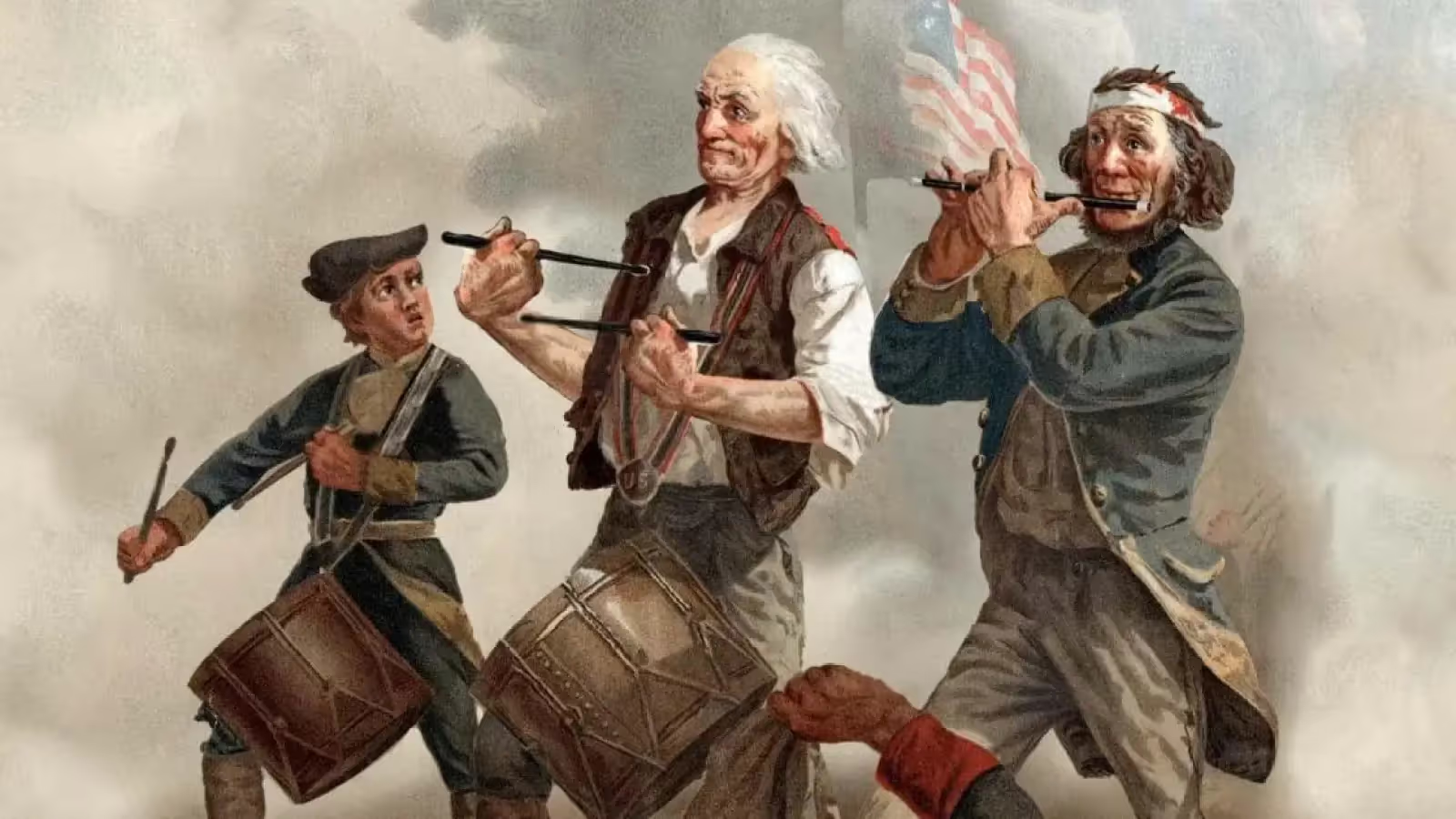




It was in June or July of 1779 that 10-year-old William de Mott enlisted in the Continental Army at West Point, New York. Given his age, and likely inclination, he became a fifer in the 8th Company, commanded by Captain Joseph Thomas, in the Second Regiment of Artillery, commanded by Colonel John Lamb of the Continental Line. He served for four years and was discharged in June or July of 1783.
A few years ago, I was working with a client who promised her mother that she would try to get into the Daughters of the Revolution (DAR). For the last three years I have been on and off again working on my client’s family tree.
I can safely say that I have discovered a number of Revolutionary War Patriots in her ancestry. In fact, there are eight altogether.
Three of her Patriots―Petrus Van Etten, William Hallenbeck and Jurry Van Loan―placed their signatures on what is commonly called the Coxsackie Declaration.
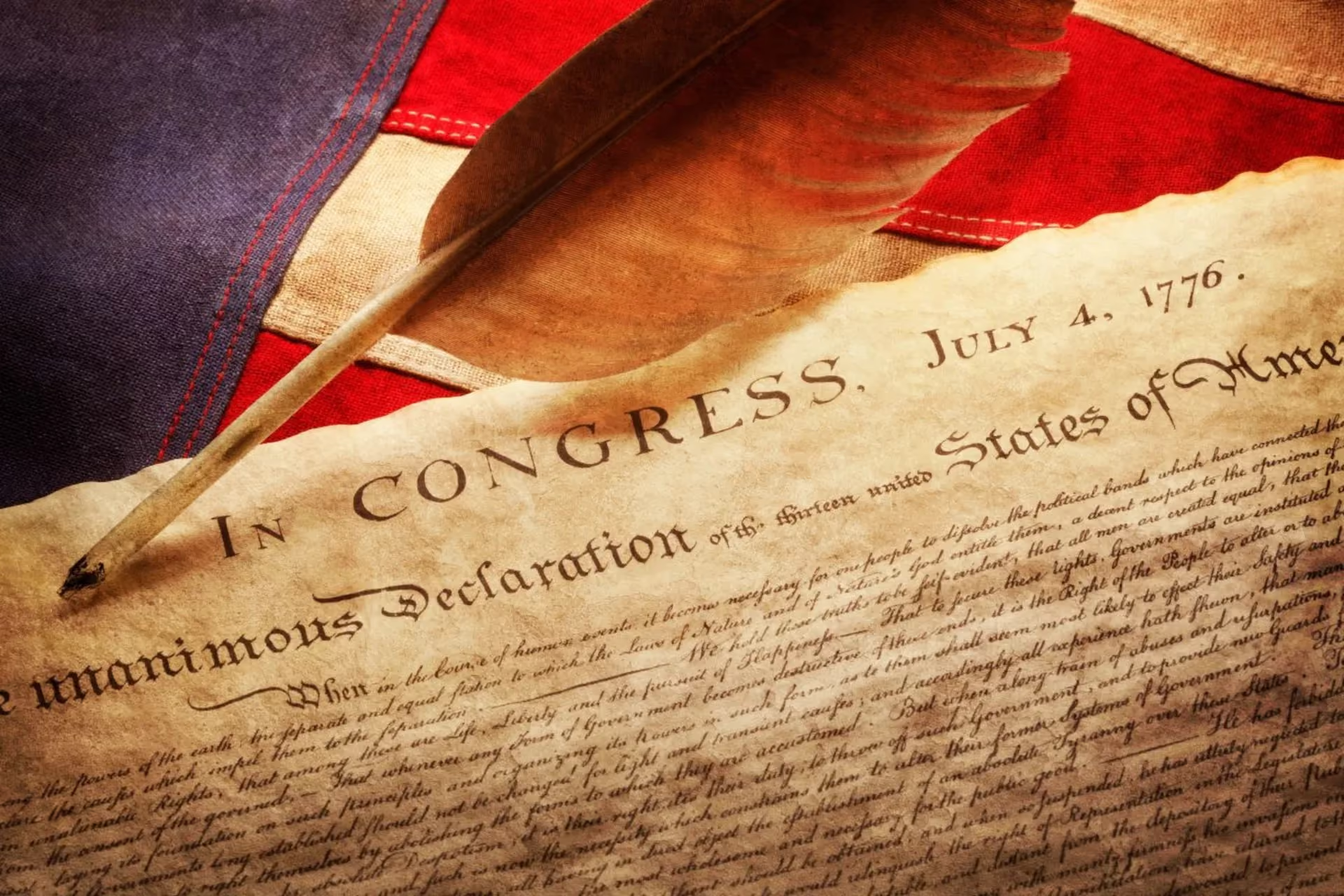
The Coxsackie Declaration was signed the 17th day of May 1775 by 225 “Freeholders and Inhabitants of the District of Cocksackie in the County of Albany.” It was almost identical to the text of the Association document signed in New York City on April 29, 1775, and transmitted to all the counties in New York State for the respective signatures of their local Freeholders and Inhabitants. Completed Association lists were to be returned to New York City by July 15 of that year.
The text of the Coxsackie Declaration was quite clear; it required all the Freeholders and Inhabitants (only men of legal age and no slaves) to choose a side. By signing the document, the individual indicated that he was in agreement with the actions of the Continental Congress and became universally known as a Patriot. The names of those who chose not to sign were listed on a separate paper and were thereafter known as Tories.
The Coxsackie Declaration read:
“PERSUADED that the Salvation of the Rights and Liberties of America, depends, under God, on the firm Union of its inhabitants, in a vigorous prosecution of the Measures necessary for its Safety, and convinced of the necessity of preventing the Anarchy and Confusion which attend a Dissolution of the Powers of the Government:
THAT the Freeholders and Inhabitants of Coxsackie District in the County of Albany, being greatly alarmed at the avowed Design of the Ministry to raise a Revenue in America, and shocked by the bloody Scene acting in the Massachusetts-Bay: DO in the most solemn Manner resolve never to become Slaves; and do also associate under all the Ties of Religion, Honour, and Love to our Country, to adopt and endeavor to carry into Execution whatever Measures may be rendered by the Continental Congress, or resolved upon by our provisional Convention for the purpose of preserving our Constitution and opposing the Execution of several arbitrary and oppressive Acts of the British Parliament, until a reconciliation between Great Britain and America on constitutional principles (which we most ardently desire) can be obtained; and that we will, in all Things, follow the advice of our general Committee, respecting the purposes aforesaid, the preservation of peace and good Order, and the safety of Individuals and private property.”
The Coxsackie Declaration is currently held at the Albany Institute of History and Art, the only original Association document from New York State to have survived from the American Revolution.
The Daughters of the Revolution has long supported the notion that the men who signed the Association documents are true Patriots.
My client also has a number of Patriots who served in the 11th Regiment of the Albany Militia during the American Revolution. This Regiment was drawn from the men who lived in the Districts of Coxsackie and the Groote Imbocht, basically from the Albany/Greene border in the north, south to the Ulster County border and as far west as the area known as Greenville today.
The 11th Regiment was commanded by Colonel Anthony Van Bergen and was comprised of five Companies. The 1st Company was commanded by Captain Thomas Houghtaling, the 2nd Company by Captain Philip Bronk (later Captain Myndert Van Schaick), the 3rd Company by Captain Samuel Van Vechten (later Captain Benjamin DuBois), the 4th Company by Captain John A. Whitbeck and the 5th Company by Captain David Abeel.
Each of these captains would be located in strategic locations within the district and would know firsthand which men would be eligible to serve in the militia.
My client’s ancestors―Arend Van Dyke, who served in the 1st Company and Henry Brandow who served in the 4th Company―are also considered eligible Patriots for admission to the DAR.
Stephen Van Dyke, Arend’s father, was born in 1726 in Columbia County. He married Eytie Van Loan at the Zion Lutheran Church in Loonenburg (now Athens) on August 28, 1752. His name appears in the DAR database as a proven Patriot, although I still need to identify the appropriate source documents.
Johannes Jurry Richtmeyer, another ancestor, served in the 15th Regiment of Albany County Militia. This Regiment was commanded by Colonel Peter Vroman and was comprised of companies of militia from what is today Schoharie County. His service has also been proven in the DAR database.
I discovered the Patriot past of William de Mott recently, much to my surprise. His statement that he joined the Continental Line at West Point in June or July of 1779 appears in his sworn statement given in the Court of Common Pleas in Greene County on the 18th day of June, 1818. At this time, William was about fifty years old and a resident of the Town of Catskill.
The search for additional information on William and his family has proven to be challenging. The chance discovery of his Revolutionary War pension packet has allowed me to discover much more about William than I had thought possible.
Serving under Captain Joseph Thomas in Colonel John Lamb’s Artillery Regiment placed young William at West Point in the Highlands Department in New York. Colonel Lamb was the artillery commander at West Point in 1779 and 1780.
William de Mott was most certainly stationed at West Point when American General Benedict Arnold was put in command of this strategic fortification on the bluffs overlooking the Hudson River, just forty miles north of British-held New York City. He would have been an eyewitness to the events that unfolded when Arnold’s treason was discovered and English Major John André was found with the plans of West Point upon his person and subsequently hung as a spy.
On August 28, 1781, Lamb’s Regiment of Artillery was reassigned to the main army and marched south for the Yorktown Campaign. According to William’s own statement, he was one of the 225 men from Lamb’s Regiment who were present at the Siege of Yorktown in the fall of 1781.
The American forces were led by General George Washington in command of 8,000 regular troops and 3,100 militia. America’s ally, France, was by his side with 7,800 to 8,800 regular troops and 29 war ships under the command of the Comte de Rochambeau.
They faced off against the British Army, 9,000 strong, including Hessian mercenaries, commanded by English General Lord Cornwallis. Cornwallis’ forces were backed into a corner on the Yorktown Peninsula, with no escape.
William, as a fifer in the regiment, played an important role in the battles that raged from September 29 until the British surrendered on October 19. Males younger than 16 and older than 50 were deemed to be either too young or too old to fight and filled the role of musicians that were attached to the army’s many companies.
The fife, with its high, shrill sound and the drum, with its low tone, could be heard by the soldiers in the battlefield, despite the din of cannon fire, muskets and shouting that surrounded the men on the ground. The musicians kept order on the battlefield, conveying signals and directing troop movements with their tunes.
Specific songs, like Cease Fire, would signal to the soldiers on the field to stop fighting and at the end of a battle they would play Parley to indicate to the opposing forces that a surrender or peace talk was being sought.
Musicians would also play in camp to regulate the daily army life. Every task that was needed in camp was signaled by the fife and drum, from when to wake up, to when to eat and when to perform camp chores. Musicians would also play while the army marched, regulating the pace of the soldier’s step.
I wonder whether William was present when English General Cornwallis sent his emissary to surrender his sword to General Washington. Reportedly, Cornwallis was too ill to do the task himself. When the sword was initially presented to the French commander, he deferred to George Washington, who, in turn deferred to his subordinate. Washington was not going to accept Cornwallis’ sword from anyone other than Cornwallis himself.
The Americans captured 8,000 British troops, 214 artillery pieces, thousands of muskets, 24 transport ships and innumerable wagons and horses. The American Revolution was effectively over, although skirmishes would continue for the next year.
On August 24, 1782, Lamb’s Regiment was reassigned to the Highlands Department and William marched home to the Hudson Valley. In the summer of 1783 William, along with his company was discharged.
Nothing is known of William’s parents or siblings at this time. Where William went after he was discharged is unknown, however he must have been apprenticed to a shoemaker, as this was his profession at the time he made his second statement in front of the Court of Common Pleas in Catskill on May 30, 1820.
William had been awarded a pension of $8 a month effective June 18, 1818, based upon his sworn statement in 1818. Fearing fraudulent statements, the Federal Government decided to amend the previous pension legislation, requiring all pensioners to prove that they were indigent and in need of government support.
Assessors Moses I. Cantine, Thomas R. Barker and Benjamin Haxtun estimated that the personal property of William De Mott was only $38.35. He owned no real estate.
Included in his possessions was one cow worth $15, one pig worth $2, one spinning wheel, six chairs, three pots, one tea kettle, table and chairs, pails, tubs and barrels, and various cooking utensils. William also indicated that he had one chest of clothes valued at $15 and a set of shoemaker tools worth $2.
William explained that he was asking for his pension to continue because his eyesight was failing and he had rheumatism in his right shoulder, which affected his ability to ply his trade. He was unable to support his wife, Betsy, and his children who still lived at home, James, aged 16, Caty, aged 14, Ann, aged 12, Maria, aged 9, Peter, aged 6 and Eave, aged 2.
Not mentioned in his pension application are William’s older children, William, born in 1795, Geti, born in 1797 and Margaret, born in 1801, all in Germantown, Columbia County.
William died July 22, 1833, in Athens, NY, however neither the location of his burial, nor that of his wife, Elizabeth, has been found. The search continues to flesh out the life of this Patriot and his family. Elizabeth has been called Elizabeth Rockefeller, Elisabeth Kohl and Elisabeth Gill in the baptismal records of her children, so additional research on her is also needed.
But, at the end of the day, that is what makes genealogical research so much fun!
Signers of the Coxsackie Declaration
Note: During Colonial times many people could not read nor write. They would "make their mark" by writing an "X" and another literate person would add their first name to the left of their mark and their last name to the right.
John Schuneman V.D.S.
Theunis Van Vechten
James Barker
Henry Van Bergen
John L. Bronck
Jacob X Hallenbeck
William X Hallenbeck
Anthony Van Bergen
John A Whitbeck
Samuel Van Vechten
Pieteer Conyne
Thomas Hoghtelen
Michael X Collyer
Francis Salisbry Jr.
Johannes X Jansen
Lambert Van Valkenburgh
Casper Hollenbeck
Myndert V. Schaick
William Van Bergen
Casperse Hallenbeck
Peter Bronck
Leonard Bronck
Abraham Hallenbeck
Peter X Vanette
Wilhelmus Vandenburg
John Vanette
Wessel Salisbury
Carperse Halenbeck
John Groog
Abraham Salisbury
Reychert Van den Berk
Richard Johnson
John Vosburgh
Richard X Vandenberg
Henry Wabber
Arout Van Schaick
Jacob Van Loon
Jacob Hallenbeck
A. Doonhalten
Ebenezer Stanton
William Brandow Jr.
Edward Groom
Haedirick X Schram
Clement Overbagh
Benjamin van Gerdener
Frederick Schram
William Jones
Reuben Stanton
Reuben van der Berk
Wilhelme Sammon
Jno Moore X John
John X Goes
Cornelius Connine
Richard Ten X Broeck
John X Hallenbeck
John X Munday
James Donney
Joseph Groom
Albert Van Loon
Joachim X Ryal
David Rose
Gererdus Neukirk
Matthias X Hallenbeck
Storm Prosa
Christian Blodaar
John Persaly
Burent Albartsen
Benjamin Cornelius Dubois
Benjam Dubois
Henry Irison
Nikasas Yare
Matthias Van Con Jan
Caspar Pare
John Romear
BenjaminX Essex
John van Steinburg
Gared Peresen
John C. Claus
Jeremiah X Steenbergh
John X Wall
James X White
John X Snyder
Nicholas Van Loon
Martin Hallenbeck
John V. Schake
John W. Bught
Nickolas V. Schake
Peter Van Burgan
John Parree
Isaac X Collyer
Jacob X Livingston
Thomas X Templar
Joseph Nesbit
William Groom
Henry Knoll
Isaac Witbeck
William Wells
Samuel Stogles Salisbury
Hendrick X Smith
William X Smith
George Rosa
Martin G. van Bergen
Wilhelmus X Dederick
Jary Van Loon
Johan Wesdernich
Solomon Schut
Nicholas V. Scake
Dirk Van Veghten
John X Vosburgh
Frederick Dederick
Johan Niew
J. Wood
Wilhelmus X Oorbagh
Laurance Dubois
John Van Housen
William X Klauw
Jon Spoor
Johannis Sousa
Petrus Van Loon
Albertus Van Loon
John Rouge
Pet X Schram
Dirck Spoor
Andres X Eaghler
William X Cudney
Frederick Scheck
John Bronck
John Van Loon
Casper Hallenbeck
Matthias X Boom
Pete X Janson
John H Schurmerhorn
Hugh Denniston
Laurence Winney
Stephen Haight
Thomas Garnett
John Ellis
John X Lampman
Mod. Van Sand
Henry Oothoudt
Samuel Allen
Abraham Camer
Wilhelmus Lampman
Herman X Becker
Casper Hallenbeck
Nicholas Van Loon
Robert Thomas
Jacob X Shoup
Peter Van Loon Jr
Abraham Van Loon
Hendrick X Rose
William Rea
Philip Conyne
Reychert van den Berk
John X Schrader
Arent X Cooss
Philip Conine Jr
John van den Berk
Peter Conine
Jam. Hearn
Benjamin Smith
Peter Smith
John X Curby
Francis Salisbury
Cornelius Dubois
John Dubois
Thouny D. van Veghten
Cornelius Schermerhorn
Jacob Egbertsen Jun.
Thomas Fish
Peter Bogardus
Thomas Aston
Johannes X Brandow
John Casper X Van Hoefer
Thomas Burdick
Arent X Fedder
Peter Soufer
William Schutt
Jacob X Cook
Coenrad Flaake
Coenraet X Hoghtaline
Richard X Houghtaline
Baltus Van Slyk
Jeremiah X Conine
Peter Van Slyk
Philip Bronck
Martin V. Bargen
Petrus X Brandow
Jacob Van Vechten
Abraham Salisbury
Heiybartus Dubois
Benjamin Dubois
William X Brandow
Gysbort Oosterhoudt
Garret P. X Steenbergh
Egbert Bogardus
Johannes X Van Garde
John Person
Johannis Conyn
Nicholas X Planke
Abraham Van Garde
Jam. C. Van Waganen
Richard Conways
John Taylor
Goefrie Brandow
Sylvia is a Hudson Valley historian, genealogist and lecturer with more than 30 years’ experience. She is also the president of the Cairo Historical Society. You may contact her at sylvia@northriverresearch.com.