The strength of Charlotte Rickert Stengel
Published on:
August 11, 2026









CAIRO―By the time Charlotte Rickert Stengel reached her 90s, the world had largely forgotten the spectacle that once surrounded her name.
The crowds. The bright lights. The circus rings of Europe. The impossible feats that made her famous before she was old enough to drive a car. The announcer’s booming voice introducing her to thousands of awestruck spectators as the strongest woman in the world.
But in Greene County, she was the beloved little lady who ran the food pantry. The one who would show up when someone needed help. The one who could still make people laugh with a sharp joke and a mischievous smile.
And, according to those who knew her best, she was also the woman who could surprise you.
Ray Houghtaling, a longtime South Cairo resident, remembered visiting Charlotte when she was already a nonagenarian and witnessing something that seemed impossible.
“She was doing pull-ups,” he recalled.
That was Charlotte. A woman who had spent her life refusing to be defined by age, circumstance, tragedy, or hardship.
Charlotte passed away on January 20, 2013, at the age of 93. Her story might have disappeared into history if not for the efforts of people who understood that her life was something extraordinary.
One of those people was James Goldwasser, a researcher who spent years collecting Charlotte’s photographs, memories, and stories. Around 2010, Houghtaling reached out to Goldwasser after learning about his work documenting Charlotte’s remarkable past.
Over time, Houghtaling became one of the unofficial keepers of Charlotte’s story—a bridge between the woman his community knew and the young German circus performer who had once captivated crowds across Europe.
Among Houghtaling’s favorite memories was an evening when he and his wife were invited to a dinner honoring Charlotte at The Bavarian Manor in Round Top.
Charlotte, who had made her living as a performer, looked out across the room and jestingly announced herself as that night’s entertainment. There was only one problem. She did not bring any of her performance equipment with her.
Houghtaling had anticipated that.
“I had gotten ahold of her juggling clubs before we left her house and snuck them in so I could hand them off to her on the stage,” he recalled.
Then Charlotte picked up the clubs and the woman who had spent a lifetime performing beneath the spotlight once again became the center of attention.
“She juggled for the entire crowd right then and there,” Houghtaling said.
It was not a comeback performance. It was not a grand circus act. It was simply Charlotte being Charlotte.
Her real name was Lieselotte, but everyone called her Charlotte. She was born in Germany on October 31, 1919, to Richard Rickert and Elisabeth Nufer, a family deeply connected to the circus tradition that flourished throughout Europe during the early 20th century.
Her father was a weightlifter and performer. From the beginning, he saw potential in his daughter.
According to accounts Charlotte later shared, her father began preparing her for the stage almost from infancy. He balanced her on his hands as soon as she was able to stand, and he trained her in gymnastics, acrobatics, and strength exercises.
The circus was not simply entertainment for the Rickert family. It was their life.
When Charlotte was only two and a half years old, the circus ringmaster introduced her to audiences with the dramatic language of the era: "Ladies and gentlemen, girls and boys and kids of all ages, may I direct your attention to the center ring and the death-defying feats of Miss Charlotte Rickert, the youngest acrobat on Earth."
The little girl who began by tumbling above the circus ring would eventually become one of the most unusual performers in Europe. She could juggle, she could sing, she could dance and she could perform extraordinary feats of flexibility and balance.
But as Charlotte grew older, another talent began to emerge. Her strength.
When Charlotte was about 14 years old, while performing with her family in Switzerland, she became fascinated by another act in the show. The performer was a traditional strongman—the kind of circus figure who wore a skin-tight costume and amazed audiences by lifting enormous weights.
Charlotte watched the man and became curious. She went backstage and decided to test the equipment herself. According to Charlotte’s recollection, she lifted the weights with surprising ease.
Her reaction was not admiration. It was annoyance.
“This guy a crook,” she had said. “Here he is making three times as much as the rest of us but it’s all fake.”
The strongmen discovered what she had done and challenged her to demonstrate her strength―to which Charlotte accepted.
And when she lifted the weights effortlessly and handed them back to the men, they reportedly struggled to hold them.
From that moment forward, Charlotte’s career changed. The acrobat became the attraction. The young girl became the headline act.
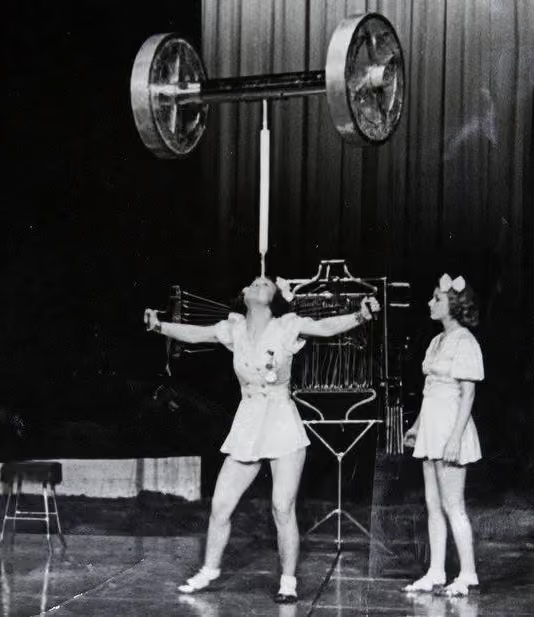
By her teenage years, she was being promoted as the "world’s strongest girl", and soon after, the "world’s strongest woman."
Unlike the larger-than-life strongmen who traditionally dominated such performances, Charlotte was small in stature—about five feet tall—and audiences were captivated not only by her strength but by the contrast between her petite appearance and her extraordinary abilities.
At 15, she was challenging the strongest men in the audience to attempt pulling a high-tension spring expander that she had mastered. She became famous for feats of strength that seemed impossible for someone her size.
One of the measurements touted with her performances was an expander force of approximately 300 kilograms―about 660 pounds and an extraordinary amount of pressure for a teenage performer.
But Charlotte’s appeal was never only about power, it was about personality. The audience did not simply watch a strong woman, they watched Charlotte.
In that era, Europe loved spectacle. Variety theaters, cabarets, circuses, and traveling shows filled the cultural landscape, and performers who could astonish an audience were celebrated like modern celebrities. Charlotte was one of those performers.
In 1935, she joined a major German variety production known as "Nachwuchs am Varieté" translated roughly as “up-and-coming talent.” The show highlighted the abilities of young performers like dancers, singers, musicians, jugglers, and acrobats.
The production appeared at Berlin’s famous Wintergarten Theater, a legendary venue that had been a centerpiece of the city’s nightlife since the late 19th century. The theater had hosted some of Europe’s most celebrated entertainers and now Charlotte Rickert stood beneath its lights, still only a teenager.
Yet her name was already appearing prominently on the bill.
She was not the stereotypical image of a massive weightlifter or a towering performer. The audience saw a young woman who looked almost delicate—but who possessed a strength that seemed impossible.
In 1936, Berlin became the center of the world’s attention as the Olympic Games were coming to Germany, and the country was determined to showcase itself as a place of athletic excellence and cultural achievement.
Women’s weightlifting was not an official Olympic sport at the time. However, Charlotte was connected with Olympic-era exhibitions celebrating athletic ability, and accounts of her life describe her performing in association with the 1936 Olympic festivities.
According to stories Charlotte later shared, she received a special gold medal recognizing her participation.
Her abilities attracted enormous attention because she was demonstrating strength at a time when women were rarely celebrated for physical power.
By the summer of 1939, Charlotte was performing in Denmark with one of America’s then-most famous cowboy movie stars, Tom Mix. For a young performer who had spent her childhood dreaming of new stages and new opportunities, it seemed like another door was opening. There were plans for Charlotte to appear in a film with Mix.
Hollywood seemed within reach. But history intervened and the outbreak of World War II changed everything. And tragedy soon followed.
Tom Mix died in 1940 in a car accident in Arizona, ending those plans. The Hollywood opportunity disappeared, and Charlotte and her family remained trapped in a Europe consumed by war.
The performer who had once traveled freely across borders now lived in a continent where borders were closing and danger was everywhere.
During the war years, the Rickert family continued performing. According to Charlotte’s recollections, they were ordered to entertain German troops, including soldiers near active combat zones. For performers who had spent their lives bringing joy to audiences, the circumstances were increasingly grim.
They were no longer simply traveling entertainers. They were people trying to survive.
One of the most dramatic stories Charlotte told from this period involved an incident in Ludwigshafen. Her family was staying in a house when an Allied bomb landed on the roof. According to Charlotte’s account, the bomb did not explode.
Her father, recognizing his daughter’s unusual combination of strength and agility, ordered her to climb onto the roof and remove it. Charlotte did what she had been trained to do her entire life. She climbed. She lifted. She carried. And, fortunately, the bomb turned out to be a dud.
The most harrowing chapter of Charlotte’s wartime story came later, when her family was sent to perform near the front lines in Poland. She later suggested that they were viewed with suspicion because of alleged assistance given to Jewish people, and that some believed the circumstances placed their lives in danger.
During one such episode, the family found themselves caught in active fighting.
Charlotte’s mother, Elisabeth, was shot in the back and badly wounded and what happened next became one of the defining stories of Charlotte’s life. According to her account, the teenage performer who had once carried circus props and lifted weights now carried something far more important: her mother.
Charlotte used her strength to lift her injured mother and carried her through difficult war torn forests, eventually reaching safety and medical assistance.
It was not a performance. There was no audience. No applause. Only survival.
When the war finally ended, the Rickert family had lost nearly everything: fame, money, the comfortable life of European performers—all of it had been swept away.
Charlotte later remembered that at one point she had no shoes. Someone saw her situation and gave her a pair.
That simple act stayed with her and she made herself a promise. If she ever saw someone else in need, she would help them. It was a vow that would shape the rest of her life.
When American forces entered the German city of Wiesbaden at the end of the war, Charlotte found herself standing face-to-face with a new beginning.
According to Charlotte’s recollections, she greeted the arriving American troops with bouquets of flowers. Among then was a young officer named George Stengal.
He was working with U.S. Army intelligence, and while he was becoming interested in Charlotte personally, he was also gathering information as part of his duties during the occupation. Charlotte later laughed when remembering that period.
“I knew him for almost a year before I realized that he was fluent in German,” she said.
The young officer and the former circus star quickly became close and what began amid the uncertainty of postwar Germany became a lifelong partnership.
They were married in Wiesbaden, and in 1947 George brought his bride to the United States. For Charlotte, America represented something she had spent years dreaming about: a chance to rebuild.
When she arrived in the United States, Charlotte attempted to reclaim the career that had defined her youth. She returned to performing and joined a traveling circus that toured the eastern part of the country.
The stage had always been her home. The applause had always been familiar. But life changed.
The same courage that had carried her through war would soon be tested again. During one performance, tragedy struck.
A fire and explosion erupted in her trailer. Charlotte immediately rushed inside to save her son, George, Jr., who was only 19 months old.
She managed to get him into the arms of someone waiting outside, but when she tried to escape herself, smoke and confusion overwhelmed her. She became disoriented and could not find the door.
Charlotte suffered severe burns over a large portion of her body—injuries that left her near death for weeks.
The woman who had lifted weights, carried injured people, and performed feats of strength now faced a battle unlike any she had encountered before. Her performing career was over.
But Charlotte Rickert Stengel had never been defined by only one role.
She was not simply a strongwoman. She was a survivor.
After recovering from her injuries, Charlotte settled with her family into a quieter life.
She returned to New York, where she opened a storefront school in Queens to train circus performers, including jugglers and acrobats. But as George’s rope business career grew in Coxsackie, the couple began spending more time in the Catskills.
The region had long been a destination for travelers, performers, and families seeking a slower pace of life. For Charlotte, it became home.
She and George eventually settled in Greene County, with a primary residence in Cornwallville near Durham and another home in Cairo. They owned and operated the former Star Synthetic Manufacturing Corp. in East Durham
It was here that she found a different type of fulfillment in the hills and small communities. She no longer needed a spotlight. She found purpose in service.
The lesson Charlotte carried from her father was simple: “Always remember, nobody is better than you and nobody is worse than you.”
Those words stayed with her and became the foundation for the way she treated people.
She remembered being displaced. She remembered needing help. And she never forgot the person who gave her shoes when she had none.
At first, helping others meant opening her own home. People who needed food, clothing, furniture, or simply a place to rest found their way to Charlotte. Her house became a refuge.
Eventually, that effort grew into something much larger. Charlotte helped establish what became Greene County’s first food pantry. She became the driving force behind food donations at Resurrection Lutheran Church in Cairo, managing the Cairo Community Food Pantry for more than sixty years.
And she did not simply sit behind a desk. She worked. Five days a week, she organized donations, recruited volunteers, delivered supplies, and searched for ways to help people get back on their feet.
She drove thousands of miles along back roads every year to help those who needed it.
The irony was not lost on those who knew Charlotte. The same hands that once bent heavy springs for cheering crowds were now carrying boxes of food for neighbors. The same woman who had once challenged strongmen was now challenging poverty―and with the same personality.
Houghtaling remembered that Charlotte had a unique ability to combine kindness with a strong sense of humor.
If someone came to the food pantry smoking a cigarette, Charlotte had a simple response. She would snatch the cigarette away and tell them: “If you can afford cigarette, then you can afford food!”
Even as she aged, Charlotte refused to slow down. At 73, she was involved in a serious automobile accident that left her with a damaged disc in her back. Many people would have stepped away after such an injury. Charlotte did not.
She returned to helping others while still undergoing physical therapy. She could still move heavy bookcases. She could still work harder than people half her age. And she still believed that helping someone else was simply what a person was supposed to do.
By the time Charlotte reached 90, her accomplishments had multiplied. She had become a beloved community figure. At one point, the Cairo Rotary Club honored her as its Person of the Year. In 2008, she received the Tyson Foods Hunger All-Star of the Month Award for her dedication to fighting hunger.
The recognition was meaningful, but she never helped people for awards. She helped because she remembered what it felt like to need help―making Charlotte Rickert Stengel, indeed, the strongest woman in the world.






%20F.avif)