The early summer black bear blues are here
Published on:
July 30, 2026




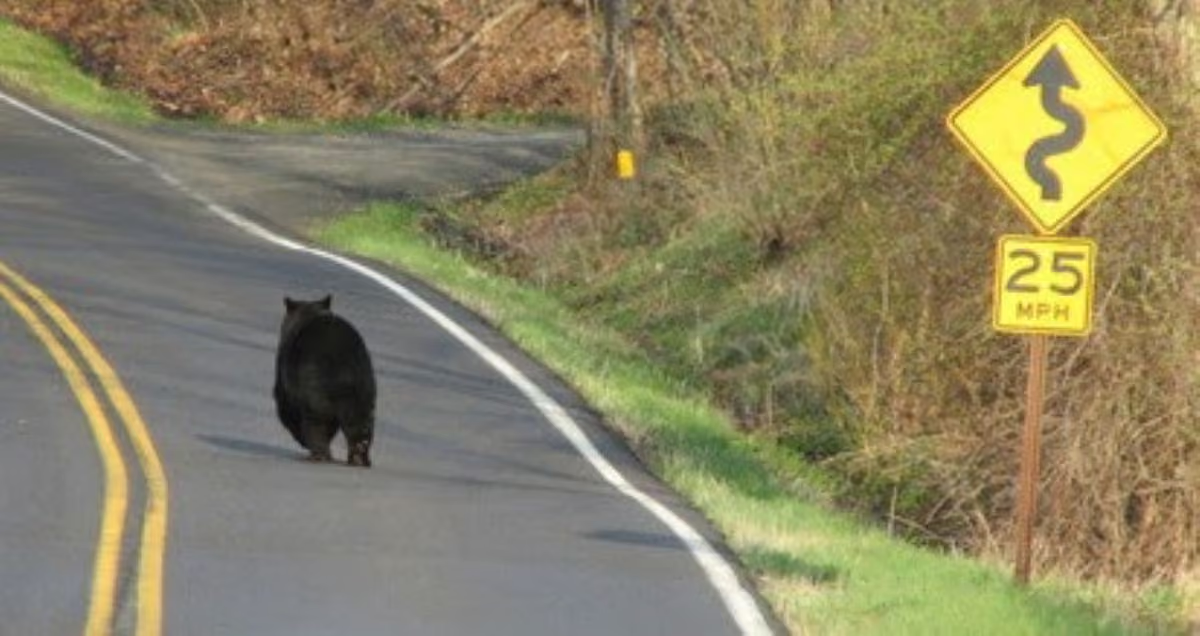





Bear complaints are heavy and I can personally attest to persistent increased bear activity and damage this year.
The New York State Department of Environmental Conservation (DEC) just released guidance entitled, Why Early Summer Brings More Bear Sightings. You can also check out DEC’s advice from their partner Bearwise at https://bearwise.orgwhy-early-summer-brings-more-bear-sightings.
DEC and Bearwise say there are reasons we see an increase in bear sightings this time of year. Bears have been front and center in television and print media coverage recently. Even if there are no real negative impacts from a bear sighting, it makes a good news story, especially when they are seen and photographed in unexpected places. One serious incident involved an injury sustained by a Palenville woman just a few weeks ago.
Bear complaints are heavy and I can personally attest to persistent increased bear activity and damage this year. In the past few weeks, I observed six different bears, from sows with cubs to twin bachelors and one larger lone boar who have been destroying large sections of my front and side yard fruit trees. I’m currently deploying a pretty inexpensive remote/motion activated audio speaker system to see if that gets the job done. I’ll advise in a future column if the cheap remote motion speakers did the trick or not. The only surefire way to keep bears from things like bee hives, fruit trees, etc. is to surround them with an electric fence. That’s easier said than done but it remains a costly but effective alternative.
Here’s the professional’s official explanation for this annual human-bear phenomenon.
Most bears spotted in unlikely or unusual places in early summer fall into three categories:
Juvenile male bears that denned up with their moms last winter and got booted out this spring. No matter how big and furry they look, these bears are about 18 months old and are just trying to figure out how to live on their own. Juvenile males need to disperse and find a place to call home where they can find food, shelter and eventually a mate. Juvenile female bears, however, are often allowed to move in next door to their moms, so most wandering bears are males. These young bears are often lonely and lack the fully developed survival skills of an adult bear. They are also hungry and inquisitive and will check out anything that seems as if it might be a source of food. Like human teenagers, they are at a very impressionable stage of life. If they quickly discover that human places should be avoided, they will be forced to learn to support themselves as wild bears. If they find the backyard pickings are easy, they start down a road that is often a dead end for them.
Adult male bears are roaming far and wide in search of a mate. Both male and female bears may mate several times in early summer. In fact, it’s not unusual for cubs from a single litter to each have a different father. But female bears rarely leave their home ranges. For the good of the gene pool, they let the males come find them. So, adult male bears may travel long distances through various females’ home ranges.
New moms have lots of mouths to feed. Mother bears may have between one and six cubs depending on her for their survival. Natural spring and early summer food sources such as grasses and developing plants are just not as calorie-dense and nutritious as the nuts and fruits that ripen later in the year. So, mother bears often need to travel further from their dens looking for food. Cubs take after their parents in several ways: they are super-smart, learn quickly and are very adaptable. If mom teaches them to raid the garbage or bat down bird feeders or sends them in through pet doors to see what’s in the kitchen, it creates a whole new generation of problems for people and bears.
Don’t approach bears. Don’t feed bears. Be extra-vigilant during this extra-critical time. Follow the At-Home BearWise Basics and use the BearWise At-Home Checklist make sure there’s nothing around your property or home that will attract bears
What can you do to discourage bears and minimize conflicts?
Follow the recommendations contained in At-Home BearWise Basics by:
Never Feeding or Approaching Bears
Securing Food, Garbage and Recycling
Remove Bird Feeders When Bears are Active
Never Leave Pet Food Outdoors
Clean and Store Grills and Smokers
Alert Neighbors to Bear Activity
Go online and use the BearWise At-Home Checklist.
I’ll add Negative Conditioning to the list. While removing what attracts bears to your home remains the single best way to keep bears where they belong and just passing through your property, some attractions like fruit trees, apiaries etc. cannot be removed. They require additional deterrence. Loud sounding “Critter Gitter” type motion activated speaker devices can be deployed to protect specific areas, but a well-maintained electric fence is the only proven effective deterrent. You can also, keep an airhorn on hand. They are loud and startling, and can give a bear a sound blast from a safe distance.
What can DEC do? In my opinion, the most effective thing DEC can do to protect residents in Greene County is to increase opportunities for hunters to harvest more bears. It’s far better that hunters kill bears rather than DEC having to spend time, money, and manpower to euthanize problem bears. Local and statewide bear populations are at an all-time modern high. Where the season is open, hunters can, and do target nuisance bears during the early gun season. Many in areas where they do lots of damage and pose a risk to the public. Specifically, DEC needs to open Wildlife Management Units (WMUs) 4S, and 4O, in Region 4. Frankly, due to high bear densities and the constant long-standing migration of bears from New Jersey and Pennsylvania into New York, the entire Southern Zone should be open to the September bear firearms season. This geographic area includes Palenville, where the woman was swatted and sustained injuries recently. It’s also adjacent to the location where a serious bear-inflicted injury to the throat of a man took place in Round Top last year. WMUs 4S and 4O are also adjacent to other areas with heavy traditional human-bear conflicts. This change is long overdue.
Hopefully, the two recent physical human-bear contacts/injuries in Greene County will be the final evidence needed to push DEC Wildlife to the logical conclusion to open WMU 4S and possibly the entire Southern Zone to the early bear gun hunt. It’s been called for by regional bear biologists for more than a decade but seems to be running into an annual bureaucratic veto at DEC HQ each year. Let’s hope they make the right decision this year so hunters in the 2026 September gun season can catch more bad bears in their late summer nuisance patterns. It is much easier for hunters to harvest problem bears in September than it is during the regular season because bad bears can be taken while they are actively causing the most problems.
Happy hunting, fishing, and trapping until next time!
A resident of Durham, Larry is a retired captain with the New York State Department of Environmental Conservation.






%20F.avif)

.avif)