Prison overtime costs soared to $708 million last year
Published on:
April 13, 2026





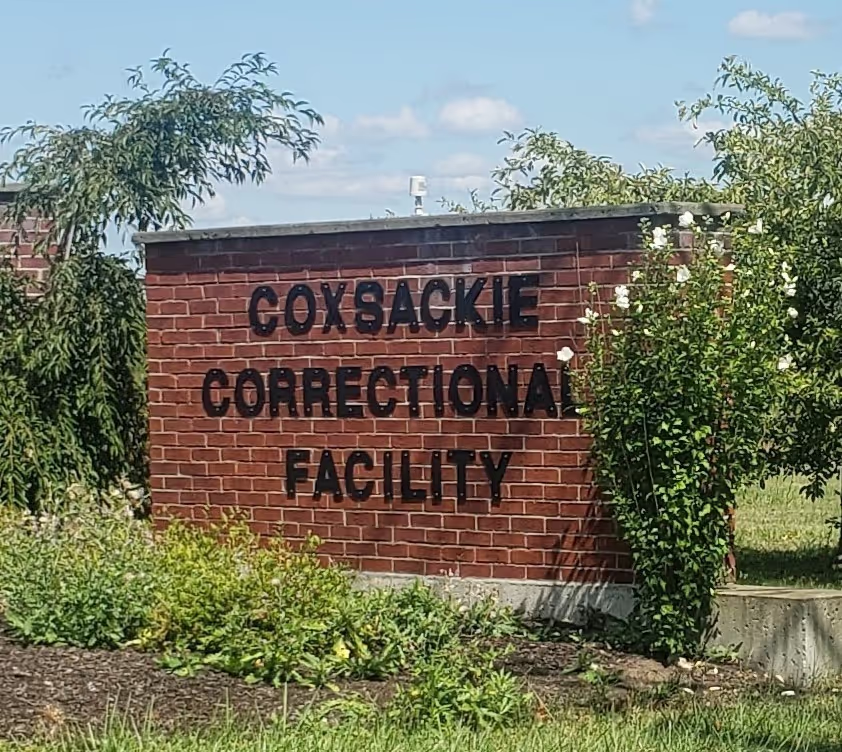





COXSACKIE―In 2016, the state Department of Corrections and Community Supervision (DOCCS) paid out around $205 million in overtime. Last year, it topped $708 million.
Those numbers come from a recently released report from the state Comptroller’s Office on New York State agency overtime costs.
Between 2024 and 2025, the DOCCS workforce decreased by over 2,700 while overtime hours per employee grew 32.7% to reach an average of 432 hours―nearly triple what it was in 2020, the report found.
Unsurprisingly, those figures were influenced by the wildcat strike of some 12,000 corrections staff who walked off the job between February 17 and March 10 of 2025. DOCCS―already operating with staffing levels below target―fired approximately 2,000 officers who did not return to work when the strike ended. About 900 of them have since been rehired, according to DOCCS.
But there remains approximately 4,600 correction officer vacancies, according DOCCS Commissioner Daniel Martuscello who testified to lawmakers during a February budget hearing.
Martuscello said the department has “made record financial investments in our recruitment process,” referring to DOCCS’ Recover, Recruit, and Rebuild Initiative launched in March of 2025.
“We have seen a considerable increase in people signing up and taking the exam. We have received over 60,000 interest forms and it translated to over 20,000 people taking the exam,” he said.
The efforts have resulted in about 550 new correction officers graduating the academy. The most recent class of 57 graduated on March 6.
“We still have a long way to go,” Martuscello told lawmakers.
According to the Comptroller’s report, DOCCS overtime hours totaled 8,702,912 in 2025 with the average pay per overtime hour averaging $81.46.
Going back to 2016, the DOCCS total workforce decreased by 32.8 percent, from 29,959 to 22,866 in 2024 and down to 20,144 last year.
But when it comes to the number of correction officers, that number was at 11,278 in 2025, according to DOCCS. It represents a drop from 14,095 in 2024 and is down from 19,233 in 2016.
At the same time, the incarcerated population saw a slight increase from 33,677 in 2024 to 33,845 in 2025―down from 51,466 in 2016 and more than 70,000 in 1999. That extreme reduction has been driven by criminal justice reforms relating to parole revocations and supportive of diversion programs, as well as New York State largely dismantled the Rockefeller Drug Laws.
Currently, New York State currently has one of the lowest imprisonment rates of any large state in the nation, according to DOCCS that has closed 28 prisons since 2009. Forty-two facilities currently remain open, including medium-security Greene and maximum-security Coxsackie.
Throughout the state, some 7,000 New York National Guard troops were called in to stabilize prison operations during last year’s strike and an estimated 2,500 remain deployed to facilities across the state.
The troops have already cost New York State around $700 million and Gov. Kathy Hochul’s FY 2027 executive budget includes another $535 million to extend their deployment.
“But that is not the long-term sustainable solution,” Martuscello said.
In 2025, total state payroll costs for all agencies were $22.4 billion, with overtime totaling $1.6 billion, the report found. Overtime earnings as a share of total payroll grew from 4.3% in 2016 to 7.3% in 2025.
“Overtime hours and earnings have continued to surge at the Department of Corrections and Community Supervision… growing [since 2024] by 1.3 million hours and $264 million in 2025, the most of any agency,” according to the report.
New York State Correctional Officers & Police Benevolent Association (NYSCOPBA) Director of Public Relations James Miller said the Comptroller’s report comes as no surprise given ongoing staffing challenges within the prisons.
“Since 2023, total staffing levels have decreased by over 4,500, leaving the dedicated men and women of NYSCOPBA to shoulder the burden of hundreds of overtime hours just to maintain operations across the state,” he said.
“We have repeatedly stressed that the current system is unsustainable. Our members are without a work-life balance due to mandated overtime, and many have opted to retire or resign as a result,” Miller said. “Meanwhile, recruitment efforts have been unsuccessful in addressing the staffing shortfall.”