Opposition mounts on proposal to cap Kaaterskill Falls visitors
Published on:
April 15, 2026





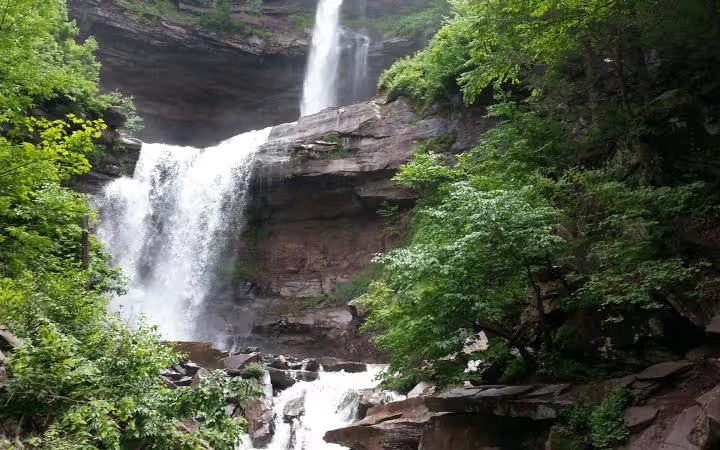





HUNTER―An estimated 200,000 people visit Kaaterskill Falls each year, helping contribute to millions of dollars in annual county sales tax revenue. So, the possibility of curtailing those sightseers and hikers, as suggested in a new state-commissioned report, is a fight local officials are ready to take on.
The proposal comes after the Department of Environmental Conservation (DEC), in 2023, commissioned a Montana-based consultant firm to prepare a report on Visitor Use Management (VUM) for the iconic Catskills Park landmark. The 107-page document was released earlier this month.
Among the recommendations is to limit the number of visitors to Kaaterskill Falls to 1,000 per day, enforced through manned entry points and a daytime reservation system.
“This is an extreme approach. This is a machete when you need a scalpel,” Hunter Town Supervisor Sean Mahoney told county lawmakers Monday night.
According to the report, persistent issues include crowding on trails, parking congestion at access points to the falls, and traffic and safety issues in parking areas and on local roads and State Route 23A.
The problems are nothing new and Legislator Daryl Legg, who previously served as Hunter’s town supervisor, noted that town officials approached the DEC about 20 years ago looking for help with parking problems along Route 23A and addressing safety issues at the 260-foot waterfall.
“We had a lot of incidents at the falls as far as hikers, people getting injured and death,” Legg said.
“The first thing they did was they implemented the stairs from 23A to the falls. They put in an observation deck which was phenomenal,” he explained.
For years, the Town of Hunter has worked with the DEC and other stakeholders to identify what local officials call commonsense strategies. They expanded and better managed parking on Laurel House Road and Scutt Road; improved traffic flow and roadway management; increased staffing and enforcement during peak periods; and improved site management, along with wayfinding and signage.
Parking on State Route 23A has also been prohibited during the peak summer season.
The DEC, Legg noted, has “come a long way in trying to help us provide safe access,” noting that the state agency has invested a lot of time, effort and money into the area.
“But what this particular paper says really wasn’t looking toward what we were trying to accomplish,” Legg said.
According to the report, on weekdays from Memorial Day Weekend through Labor Day 2023, Kaaterskill Falls saw an average of approximately 860 daily visitors and a maximum of more than 1,800. On weekends and holidays during that same period, the number averaged 1,850 and went as high as 3,000 people per day.
Legg said the consultant’s proposal would not only cap the visitors to 1,000 per day but also limit parking to no more than 100 daily vehicles and 50 at one time.
“One of the additional problems would be that as part of the thousand people that would be allowed to use it, the campers at North South Lake would be included,” Legg said. “So, if you know how big North South Lake is with all the campsites, that is going to probably take up your thousand people a day just about on its own.”
And while local officials and stakeholders were involved in discussions for preparation of the report over a period of about 18 months, Mahoney said the consultant chose to discount what they were asking for and “take the easy way out.”
“We were looking for more rangers to help manage the people. We were looking for help from State Police to manage the roadside. We were looking for anything but what we really got,” Legg added.
“We went into it with the DEC eyes wide open,” Mahoney said. “Let’s look at all of the challenges, all of the solutions, let’s figure out what we want to do as a community.”
“Their desired conditions―this third-party consultant―is to have nobody there. That is essentially it,” Mahoney said, calling the idea of limiting visitors a “lazy approach that doesn’t deal with any of the issues at all.”
Implementing the gated entry and reservation system would be impractical and largely ineffective, according to Mahoney who noted that there are at least seven different ways to access the falls.
“I can tell you I go there and I try to go when it is extremely busy just to see,” Mahoney told lawmakers. “The issue isn’t when you are in there, the issue is finding a place to park.”
Mahoney has already sent a letter to DEC Commissioner Amanda Lefton, emphasizing that the “current trajectory appears to elevate restrictive tools before even attempting to utilize the practical and locally informed solutions identified through years of discussion.”
During every single meeting with the consultants, Mahoney said local officials also addressed economic development, but “that is not the consultant’s priority.”
“I don’t need to remind you guys what this means from a sales tax perspective. All of those people coming here, how detrimental this would be to our community if we just sat on our hands and let this happen,” Mahoney told legislators.
In 2024, visitors to Greene County spent an estimated $318 million, generating $17.5 million in local sales tax revenue, according to a state report from Tourism Economics. For the entire Catskills region―Ulster, Greene, Sullivan and Delaware counties―the report found that without tourism-generated state and local taxes, the average household would have to pay an additional $2,013 to maintain the same level of government revenue.
The Catskill Center, an Arkville-based non-profit environmental organization, responded to the report, saying it applauds the DEC for “advancing a science based, indicator driven approach that seeks to define desired conditions, protect sensitive natural resources, improve public safety, and provide a high quality visitor experience, while recognizing the Clove’s regional economic and cultural importance.”
“At the same time, we remain cautious about recommendations that contemplate permit systems or other measures that could unnecessarily restrict public access to the Forest Preserve,” the Catskill Center noted.
“Consistent with our long standing position, we believe intensive, on the ground management through better infrastructure, smarter parking and transportation solutions, strong stewardship and enforcement, and robust education should be fully pursued before any consideration of permits or similar restrictions,” the organization stated.
Jeff Senterman, executive director of the Catskill Center, said they have been calling for a “comprehensive, data driven Visitor Use Management plan for Kaaterskill Clove for years, and this report is a significant move in that direction.”
“Our goal is a Kaaterskill Clove that remains wild, safe, and welcoming, where natural resources are protected, local communities benefit, and all New Yorkers can continue to enjoy their Forest Preserve without unnecessary barriers,” Senterman said.
Mahoney is asking every town board in the county, as well as the legislature, to join Hunter is passing a resolution opposing the visitor cap. He emphasized that it is not a done deal and that the DEC is taking public comments on the recommendation up until June 1.
The DEC is also holding a virtual meeting on the Kaaterskill Clove report on April 29 at 6 p.m. Additional information, including how to submit comments and participate in the meeting can be found at https://townofhunterny.gov/kaaterskill-clove-visitor-use-management-vum-report-town-of-hunter-response.
“What’s going to happen? People are just not going to come any more,” Mahoney said. “They are just going to be like, ‘Why would I do that? What a pain in the butt. I’m not getting a permit, so I’m just going to go somewhere else’.”