Letter: What is at stake in Windham’s 2026 election
Published on:
June 5, 2026








To the editor:
This election in Windham matters. It matters because Windham faces some hard decisions about its future. Do we want to allow gentrification to continue unabated in our community? Or do we wish to create a legacy in which our community will stand up to those who seek to exploit our beauty for their exclusive profit?
Our present trajectory is one that will lead to the unabated gentrification of our community at the expense of our character as a community. The character of Windham is not found in buildings or colorized maps, as zoning would suggest. It is found in the residents who make up the fabric of Windham. Buildings change, communities grow and evolve, but what really matters are the innovative people who make up that community. The people who build and grow with Windham are the legacy that matters. If we, as Windham residents, allow this new zoning law to gut the future of our residents by leaving them unable to afford homes or to create small businesses in the community, the entire community is left depleted.
We are facing many existential threats to the character of this community from the replacement of our residents with private equity firms and investors looking at our town as an investment, not a home, to skyrocketing costs of living. We need to make Windham a home for future generations of middle and working-class people in our community. People who will help shape the future of Windham for generations. Generations of teachers, tradespeople, skilled workers, nurses, EMTs, municipal employees, and small business entrepreneurs are just some of the people our new zoning law is excluding in what can only be called “Snob Zoning.”
This type of government overreach uses regulations to restrict our ability to use our own property. Each new regulation is a new tax on construction that raises prices at our cash registers or for services rendered. Ask yourself, is this not the action of “Big Government”? It would seem that Big Government is not just a federal phenomenon; it is also when a local government reaches into your pocket to enrich itself at your expense. Uncle Sam, the DEC, or DEP will no longer be the only Big Government in your life when you build a new home or attempt to create a business. Your own town board and neighbors will now be forcing you to comply with extra regulations that will increase costs and act like a de facto tax on your investment in your property. This at a time when our community is being battered by rising costs of living from all sides.
Our residents are facing historic affordability issues with high prices in utilities, gas, and groceries. I ask you this: as a community, can we afford the burden of government overreach, which costs the town board nothing, while you and I pay the bill for using our own property as we see fit through needless regulations? Why should our local government be an obstacle to the development of business in our community and not an aid? Why is our local government making sustainable futures for our business community harder, not easier? Instead of exploring ways to create positive growth in this community by making more land productive in businesses that create jobs, our town board has opted to restrict this type of growth in favor of single-family detached homes.
Instead of creating a community economic development organization that seeks to fund innovative new local businesses, our zoning law will make it more costly to start a Home Business. Instead of creating microloans and supporting local investments in businesses, our Town Board is supporting the Gentrification of our Community. Instead of exploring ways to reduce the costs for consumers at the cash register, needless zoning regulations will only increase these prices. Who does this benefit? Certainly not you or me when we shop or contract a service. And it doesn’t benefit our local businesses, who are already facing the impacts of tariffs and the extra burden they’ve brought to the local economy.
Ask yourself what your local government could do to help to create a thriving community? The answer is more than our current administration believes is truly possible. The facts are that our local economy needs to grow, and our Main Street needs to thrive to keep our community viable. Gutting the engine of growth by pricing out our youth from the community is certainly not the way to create a thriving community that lasts for generations. Nor is avoiding grants for revitalizing our community’s Main Street. We must, as a community, come together and create solutions that will sustain our community for generations.
Imagine a community with a town-financed small business incubator that helps our residents find the funding they need to grow? Imagine a community with a program for home efficiency, where grants and assistance are provided to the most vulnerable members of our community, low-income families, and those on fixed incomes, to reduce the costs of winter and summer utilities. Imagine a community where investments in local businesses are made by residents in our business sector through a community partnership between businesses, the town, local banks, and residents; this is known as a SHARE program. The SHARE program would put our money to work in the business sector, making loans to startups or existing businesses to expand. Thus creating the vital local investments we need to grow our local economy.
Now is the time to stop imagining these things, and it is time to act.
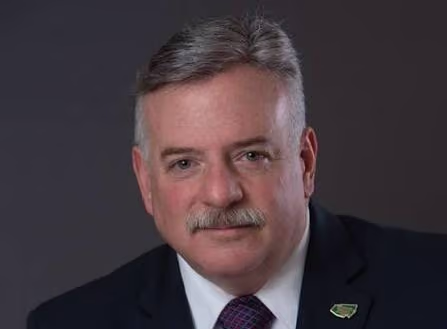
I’m Connor R. Exum, and I’m running for town supervisor. Ask yourself whether it is time for Windham to realize its full potential. I believe it is time to open Windham up for business! I believe it is time for Windham to create positive growth that welcomes all to the table by creating dynamic planning in our community that welcomes all stakeholders.
Connor R. Exum
Windham, NY
The views expressed in letters to the editor are those of the author and do not necessarily reflect the official policy or position of Porcupine Soup.