‘It’s about keeping what was alive in a different way’
Published on:
June 8, 2026




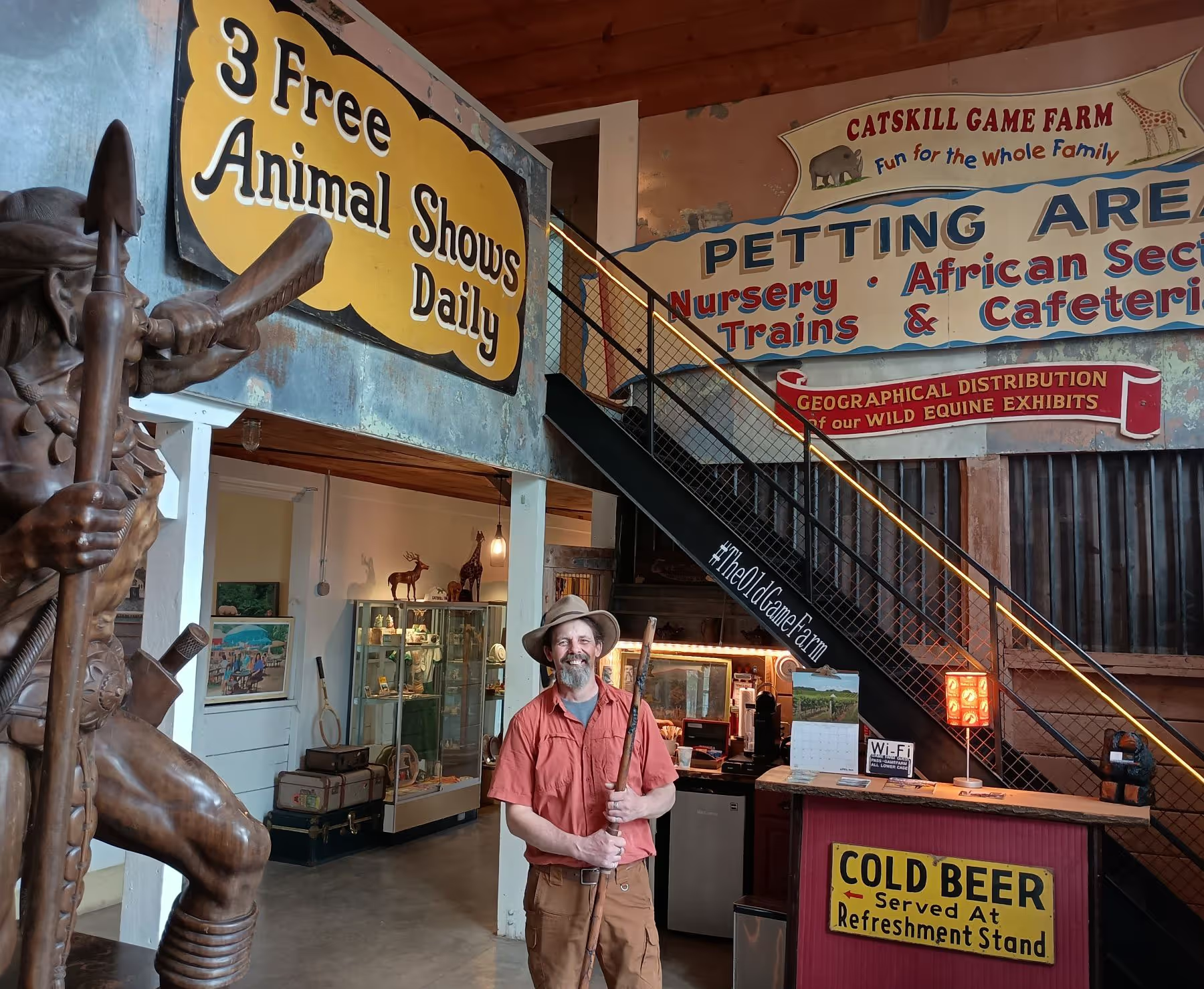





CATSKILL— For more than 70 years, the Game Farm was a rite of passage for kids far and wide. Opened in 1933 by Roland Lindemann and later run by his daughter Kathie Schulz, it grew from a modest collection of deer and donkeys into a sprawling, federally recognized zoo.
America's first privatized zoo, at its height, roughly 2,000 animals across 150 species drew families from across the Northeast.
Then, in 2006, it ended.
Its animals, “the pig and most of the other animals,” were auctioned off. The closure, framed at the time as another “nostalgic casualty,” came with controversy. Animal rights groups, including PETA, raised alarms about where the animals might end up, pushing for sanctuary placements and stricter oversight as bidders from across the U.S., Canada, and Mexico descended on the farm.
Some animals were indeed relocated to sanctuaries, others to private collections, and the optics of it all left a complicated aftertaste in the Catskills.
For years, the land sat in a kind of limbo. Not abandoned, exactly—but paused.
Now, under the stewardship of General Manager Shawn Johnson, the Game Farm has taken on a second life that is less about spectacle and more about memory—though not without a little spectacle of its own.
The enclosures remain, but they’ve been repurposed. The giraffe pen has become the Long Neck Inn, an Airbnb where guests sleep beneath some rustic lamps Johnson built himself. Along one wall, faint grooves remain—etchings left behind by giraffes rubbing their ossicones (their small horns) preserved like fossils of a more recent past.
Down the hall, areas are named for former residents. There’s the Zebra Room and the Elephant Room—each decorated with a careful hand that avoids the average kitsch in favor of a quiet homage.
Even the bar carries a past life. It sits where a pygmy hippo named Jose once dwelled.
“It’s about keeping what was alive in a different way,” says Johnson of his work.
The Game Farm has also become a venue—weddings, reunions, weekend stays booked through platforms like Expedia. Guests wander trails that once guided schoolchildren and summer tourists, now recontextualized as something closer to a living museum.
There was even, for one night, a deliberate embrace of the eerie. A flyer still pinned to a board on premise kept beautifully framed advertises “Nocturnal Creatures,” a creative mixer featuring guided lantern tours through the abandoned zoo, ghost stories, and Halloween attire. It was held on October 23, 2024—a one-off event that leaned fully into the property’s after-hours mythology.
Despite its quiet tone, the property has not gone unnoticed. Independent films and music videos are regularly shot on-site. At one point, Johnson says, Steven Spielberg even brought a crew of 300 to film a sci-fi project titled Disclosure Day, complete with teamsters and full production logistics—a surreal echo of the crowds the farm once drew in its heyday.
The Catskill Game Farm's story is also back on the silver screen with the documentary American Zoo, directed by Tim Travers Hawkins. The film, which recently premiered in Tribeca's Documentary Competition, explores the rise and fall of America's first privately owned zoo through thousands of archival materials discovered among the ruins of the former attraction.
Drawing on home movies, interviews, and newly uncovered historical records, the documentary examines both the cherished memories generations of visitors associate with the Game Farm and the more complex history that unfolded behind the scenes.
By revisiting the legacy of founder Roland Lindemann and the people who lived and worked on the grounds, American Zoo presents the Catskill Game Farm as both a beloved regional institution and a subject of deeper historical investigation. The documentary's inclusion in the prestigious Tribeca Festival places one of the Hudson Valley's most recognizable landmarks before an international audience, ensuring that the story of the Game Farm continues to spark curiosity and conversation long after its gates closed 20 years ago.
Today, the sound of hoofs and paws still echo, though softer and in less number, across the grounds. There are five goats that roam the property—Baby Goat, Dotty Diva, Mama Millie, Gary Gyro, and Salem. A neat little herd of Boer goats, Nubian goats and Welsh Nubian goats, kept by Johnson as both companions and a nod to the farm’s earliest days.
There’s “Fido’s Vineyard,” a former enclosure now fenced with grapevines where guests can let their dogs run free.
There’s also a story—half joke, half local legend—about Johnson chasing would-be trespassing teenagers off the grounds dressed as Bigfoot. He tells it with a grin, the kind that suggests he enjoys the mythmaking as much as the preservation.
Perhaps the most literal symbol of the Game Farm’s second act is the bridge.
The original structure connecting the front and back of the property collapsed years ago. Johnson rebuilt it using a salvaged truck scale, now lined with LED lights that cast a soft glow at night—industrial bones turned into something unexpectedly eye-catching and elegant.
Nearby, volunteers are helping Johnson on restoring a small, long-overlooked cemetery on the grounds. Headstones bearing old names like Greene and Scribner hint at histories that predate even the Game Farm itself to its days as an orchard, adding another layer to a place already thick with memory.
Inside the inn’s game room—stocked with dozens of board games—a charcoal drawing of the Long Neck Inn hangs on the wall. Johnson says a guest sketched it overnight while staying there.
The Catskill Game Farm is no longer what it was. It cannot be. A place where a chandelier hangs where giraffes once stood. Where children once fed animals, now couples exchange vows. Where history isn’t restored so much as lived with.
“Keeping the memories,” Johnson says, “is what keeps this place alive.”