DOH updates advice for Hudson River fish consumption
Published on:
April 10, 2026








On April 1, the New York State Department of Health (DOH) updated its advice for eating fish caught in waterbodies statewide. This annual update provides New Yorkers with important information to those who fish and eat their catch. The timing of the announcement coincided with opening day of both striper and trout seasons which both commenced on the first of April.
A key finding found declining levels of polychlorinated biphenyls (PCBs) in some lower Hudson River fish mean for the first time in 50 years, anglers and their families can eat some of the fish they catch. New, more restrictive advice was also issued for other waters across New York due to the levels of perfluorooctanesulfonic acid (PFOS) detected in some fish.
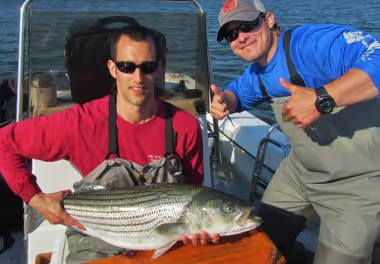
The lower Hudson River runs from the Rip Van Winkle Bridge in Catskill down to the Battery in New York City. Species enjoying more liberal consumption guidelines include striped bass caught in that stretch of the Hudson.
The DOH report cites PCB levels in several fish species allowed them to, “…relax advisories based on highly protective PCB guidelines issued in 2020. The Sensitive Population (people who can become pregnant and children under 15) can now enjoy up to one 8-ounce meal a month of striped bass among some others from this portion of the river. The general population can now eat up to four meals a month. The Department recommends that everyone not eat Carp and Smallmouth bass from the Lower Hudson due to PCBs.”
See changes for several other species here.
Stripers are slowly making their way up the Hudson for the annual spawning run. The unusually cold winter and spring is delaying the striper run. Schoolie size stripers have been reported caught as far north as Newburgh. They will continue upriver followed by larger striped bass as river temperatures warm in the coming weeks.
DOH says contaminant levels in fish north of the Rip Van Winkle Bridge up to the Federal Dam at Troy did not warrant advisory changes at this time. DEC’s catch-and-release regulation, "take no fish, eat no fish," still applies between Hudson Falls and the Federal Dam in Troy. Those regulations include a prohibition on bowfishing for carp.
DOH and DEC recommend that since PCBs remain in the fatty portions of fish, you should skin fish and trim off fat when prepping before cooking-then cook in a way that promotes the fat to melt off. The agencies report that can reduce the amount of PCBs in a fish meal by roughly half. For crabs caught in the Hudson, you can reduce PCBs by not consuming or cooking crabs until you remove the tomalley (mustard, hepatopancreas) and discarding the cooking liquid, which contains most of the PCBs.
DOH Issues Updated Advice Due to PFOS Guidelines
New York is among the first states to update fish consumption guidance that reflects the emerging science on PFOS.
Last year the DOH issued new health guidelines to update its advice for eating fish to protect New Yorkers from PFOS―the most common type of per―and polyfluoroalkyl substances (PFAS) found in fish. These guidelines consider both the health risks of PFOS as well as the benefits of eating fish and are protective for even the most sensitive populations, including pregnant people and children.
Bodies of water that now have updated fish consumption advice include Lake Ontario, Lake Erie, Upper Niagara River, Mohawk River between locks E20 and E21, Lake Champlain's Cumberland Bay, Lake George, Seneca Lake and Catharine Creek.
The PFOS guidelines are used along with guidelines for other chemicals, like mercury and PCBs, to protect against exposure to chemicals from eating fish, according to DOH.
Reducing Exposure to Chemicals When Eating Fish You Catch
For information on waters that have specific advice due to certain fish having elevated levels of chemicals like mercury, PCBs, or PFOS visit www.health.ny.gov/fish. If the water is not listed, anglers should follow the Statewide Advisory or the Catskill or Adirondack advisories when fishing in those regions.
The goal, according to DOH, is to “help people make healthier choices about which fish to eat and which to avoid. People who become pregnant and eat contaminated fish may be at a higher risk of having children with developmental or learning delays. Children who eat a lot of contaminated fish may also have potential for negative effects on their development and long-term health.”
The Department's health advice is based on a risk management approach and uses fish contamination data collected by DEC's statewide fish monitoring program . Each year, DEC performs several thousand chemical analyses on more than 1,000 fish samples and provides the results to DOH for use in setting consumption advisories.
Visit the Department's website for Health Advice on Eating Fish You Catch, here.
Find Frequently Asked Questions regarding the updated fish advisory PFOS guidelines here.
Additional information about how the Department sets fish advisories is available here.
Happy hunting, fishing, and trapping until next time!
News and Notes
Save the Date for Youth Turkey Hunting Events Coming up in April in Greene County
On Saturday, April 18 NYS ECO Lucas Palmateer and the Norton Hill Wildlife Club in partnership with the Northern Catskills Longbeards Chapter of the National Wild Turkey Federation and the New York Conservation Officers Association (NYCOA), are hosting a “Turkey Hunting Skills, Tactics, and Patterning Day” at the wildlife club at 946 Big Woods Road in Greenville. All Youth turkey hunters are welcome to attend this free educational event but must be accompanied by a parent /guardian.
The training/patterning opportunity is in preparation for the 2026 Youth Turkey Hunt Event that takes place on Saturday, April 25. A limited number of mentors may be provided, upon request, to take youths aged 12-15 out hunting with their parent or guardian. Any and all youth hunters and their parent/guardians are invited and encouraged to attend the prep and skills day. All kids and their families are invited to bring their bird and/or their story to discuss with other youth hunters over a BBQ lunch provided by the Norton Hill Wildlife Club from 11 a.m. to 2 p.m. on Saturday April 25. There will lots of giveaways and opportunities to commiserate with fellow youth hunters about the birds that did and didn’t get away! Call ECO Lucas Palmateer at 518-478-1698 to check availability of mentors and for further information.
Remember to report poaching violations by calling the 24-hour ECO Dispatch at 1-844-DEC-ECOS.
A resident of Durham, Larry is a retired captain with the New York State Department of Environmental Conservation.