Cairo still believed to have the world's oldest fossil forest
Published on:
September 22, 2026





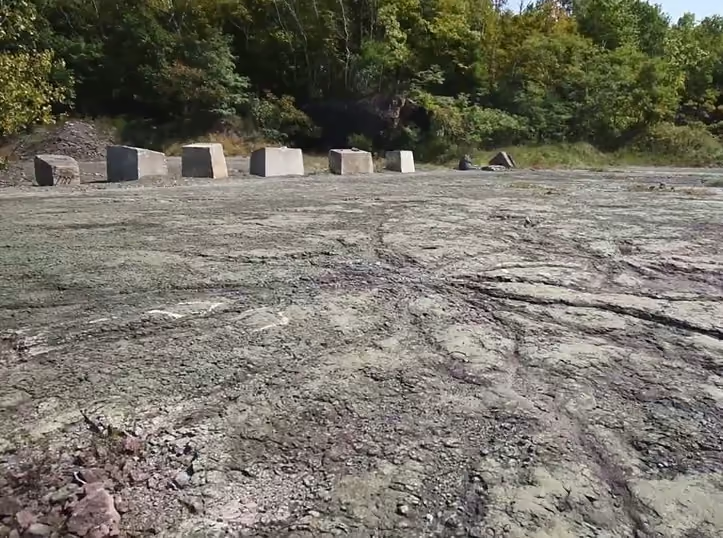





CAIRO―In 2019, a groundbreaking scientific study put the small town of Cairo, New York, in the international spotlight with the discovery of what was believed to be the world’s oldest known fossil forest. But less than five years later, a finding along England’s Devon and Somerset coast pushed the Greene County site into second place.
Now, the record is once again being rewritten with Cairo holding onto the remarkable distinction.
“We still firmly believe the Cairo quarry to be evidence of the first fossil forest,” the New York State Museum confirmed this month.
Staff and scientists at the Albany-based museum regularly conduct active scientific and historical research. The issue of the first fossil forest, they say, is nuanced and comes down to the definition of a forest.
“The trees discovered along the west coast of Somerset, United Kingdom are on the order of two meters, or 6.5 feet, tall and stood far apart from each other. In contrast, some of the roots of one of the three types of trees discovered in the Cairo Fossil Forest extend at least 7.3 meters, or 24 feet, laterally outward from the largest tree,” according to the museum.
“Because of that, we still consider the Cairo quarry site as evidence of what the first forests were like, but the Somerset fossils and that site are also extremely important in helping us understand the development and evolution of forest ecosystems,” the museum added.
The characterization of a forest is difficult even for paleontologists and geologists to identify and define, the museum notes, because there are no standard criteria for a cutoff of an ecosystem as a forest during the middle Devonian Period.
And these forests, as they are seen today, do not contain trees with trunks, branches, leaves or needles. Rather, they are fossilized root systems in the ground.
“The Somerset fossil site is older than the Cairo quarry by a few million years. The plants at that site, while larger than many of the plants of the age, are still only about six feet tall. On the other hand, the Cairo quarry site, growing only a few million years later, has root traces that extend out at least 24-plus feet, suggesting trees of considerable height, and likely had a structure and stature that would be more easily recognized as a forest,” the museum states.
The Devonian Period spanned roughly 419 to 359 million years ago―some 100 million years before the first appearance of dinosaurs.
During that time, some freshwater fish began the transition from water to land, giving rise to early tetrapods—the ancestors of land-dwelling vertebrates. The planet they inhabited looked vastly different from the world we know today, with expansive shallow seas, rising mountain ranges, and the emergence of the first forests. Plants developed true roots, leaves, and woody tissues, allowing them to grow taller, spread across the landscape, and anchor themselves firmly in the soil.
Fast forward to 2009, when a group of land surveyors made an astonishing find off State Route 145 at an abandoned sandstone quarry owned by the Town of Cairo. Quite by accident, they found what a research team, led by faculty at Binghamton University and Cardiff University in the United Kingdom, would later identify as the world’s oldest fossil forest―dating back approximately 385 to 387 million years.
The discovery at Cairo revealed a forest some two to three million years older than the previous record-holder at nearby Gilboa in Schoharie County.
Excitement grew within both the local and scientific communities, and the Town of Cairo was awarded a $170,000 grant secured by Senator Michelle Hinchey to install a fence around the property.
The site has received a substantial amount of press coverage from around the world and, for security reasons, is not open to the public―yet.
Town Supervisor Debra Bogins said the New York State Museum recently reached out to her with news that Cairo was back in the top spot.
“We are the oldest―it is very exciting,” she said.
Bogins has already had a meeting with museum officials, along with representatives from the town and county. Part of the ongoing discussion is to build a museum at the fossil forest with a walkable platform around the site. Grant money is available, she noted.
“It’s great news for Cairo,” Bogins said. “Just imagine what this could do for tourism.”
According to the museum, regardless of whether the Cairo site continues to be recognized as the first forest, it and other sites like Gilboa show scientists what the first forests were and provide a significant snapshot of an ecosystem that occurred 385 million years ago.






%20F.avif)