An American Visionary: New Thomas Cole exhibition opens April 25
Published on:
April 14, 2026





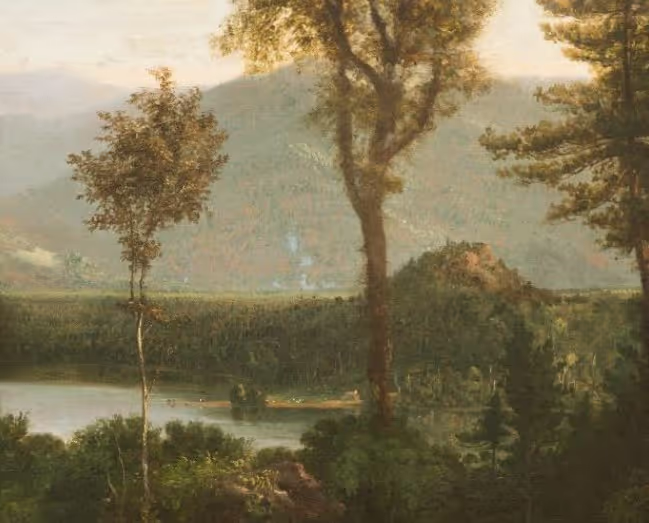





CATSKILL―The Thomas Cole National Historic Site has announced the exhibition Thomas Cole: An American Visionary, a dynamic installation of landscape paintings, painting objects, and easels of Thomas Cole (1801-1848) that explores his evolution into an artist of international renown. Cole’s paintings conveyed a visual identity for a young nation and continue to inspire artists to this day.
The exhibition illuminates Cole’s beginnings as an artist, his creative process and inspirations, his deep connection to the Catskill Mountains and the Hudson Valley, and his emergence as an international artist. The exhibition also explores Cole’s role as teacher and mentor to Frederic Church (1826- 1900), the 200th anniversary of whose birth is being celebrated this year. The exhibition includes 16 original paintings by Thomas Cole and one by Frederic Church (painted while a student of Cole), plus drawings and sketches, painting objects, easels, and sources of inspiration.
It will open on April 25 and run through December 2026.
This will be the inaugural exhibition in the new Richard Sharp Gallery on the second floor of the 1815 Main House of the Thomas Cole Site. The gallery is already affectionately known simply as “The Rick,” a light-hearted take on a prominent New York City museum.
Rick Sharp’s substantial contribution to redesign the gallery space and support related programming inspired leading experts to become involved in the project. The gallery is designed by Architectural Digest 100 Stephen Shadley, the acclaimed New York City-based interior and architectural designer, who is a member of the Board of Trustees of the Thomas Cole Site and best known for creating homes for Hollywood stars including Jennifer Aniston and Diane Keaton.
Helping to envision the new space are such nationally renowned authorities as Betsy Kornhauser, Curator Emerita at The Metropolitan Museum of Art; Dan Kershaw, the senior exhibition designer at The Metropolitan Museum of Art; and Carrie Feder, the independent curator who spearheaded the restoration of the interiors of the Main House alongside Jean Dunbar.
To commemorate the opening of the Richard Sharp Gallery and inaugural exhibition, Sharp has donated the iconic Thomas Cole painting Diagram of Contrasts to the permanent collection of the Thomas Cole Site. It has previously been on long-term loan to the Site. Now famous as Cole’s “Color Wheel,” this painting was a “tool” that he created as a diagram of contrasts to guide him in his studio to shade landscapes and complement colors. Over the years it has become, in effect, the “Rosetta Stone” of the Hudson River School of landscape painting, used to decipher the visual harmony and relationship of colors in many 19th -century American landscapes.
“I first saw the ‘Color Wheel’ when an issue of the Magazine Antiques arrived in my mail in 2006. I was immediately captivated by it,” said Sharp. “I asked myself how it was that Thomas Cole could have painted this work in 1834, when it has the visual impact of a modern abstract painting, so unlike his landscapes. When I was fortunate to acquire it, I knew that it was a masterwork that I could not selfishly hang on my wall. It had to be seen and in no better place than its home, where Cole used it in his studio. I am now thrilled that it will be featured in the inaugural gallery exhibition and become part of the historic site’s permanent collection.”
Sharp’s donation of the funds to redesign the gallery and of the “Color Wheel” continues and extends his longstanding support of the Thomas Cole Site. He has gifted to the site the largest number of artworks and objects by Thomas Cole from a private individual outside of the artist’s family. In addition, he has made long-term loans of still more Cole artworks, including the earliest work known to be painted by Cole, which will also be featured in the exhibition.
Sharp’s vision for the gallery is that it be a refuge where visitors can contemplate original works by Thomas Cole and other artists in an inviting, comfortable setting that will engage everyone, particularly new generations from diverse backgrounds.
“My hope,” Sharp says, “is that the Gallery will open the eyes of young people to the beauty and joy that Cole's art has brought to my life.”
“We are enormously grateful to Rick Sharp for funding this gallery design and related programming and for his extraordinary donation of the ‘Color Wheel’ to our growing collection of Cole paintings,” said Maura O’Shea, executive director of the Thomas Cole National Historic Site.
“Rick is a major force in preserving and illuminating the work of Thomas Cole and the Hudson River School artists whom Cole inspired. Rick has now brought that commitment to enhancing the visitors’ experience at the Thomas Cole Site. We look forward to engaging new generations through Rick’s extraordinary generosity and passion,” O’Shea added.
In designing the gallery space, which measures about 22 feet square and was once a bedroom used by Thomas Cole’s three sisters-in-law, Shadley created the engaging space that Rick envisioned, while honoring the historic home. He retained all of the plaster trim and chose to use on the walls the same lavender paint color that Thomas Cole had chosen to use in the ground floor’s west parlor where he displayed his paintings for visitors. The color evokes the morning haze over the Catskill Mountains that so captivated Cole.
To maximize the gallery’s display space, Shadley designed an innovative bespoke system of 10-foot-high, four-foot-wide, wooden panels that sit directly in front of the two windows. He placed them on a pivot mechanism that allows them to become perpendicular and create niches of additional display space. The windows can be visible, covered up, or can frame the niches of added exhibition space, giving the room flexibility in how it presents art and related objects.
A discreet, recessed, lighting system in the ceiling adds flexibility by allowing for any number of lighting scenarios. The original painted-wood floors are made more welcoming by centering a nine-foot-square hemp rug, on top of which is a large, custom, circular ottoman designed by Stephen Shadley. The ottoman encourages viewers to stay and contemplate the art; it comes in two semi-circular parts, which can be separated and placed in front of the two niches created by the window panels to create still more flexibility in viewing.
“It seemed fitting to create a gallery within Thomas Cole’s home, a place where he once displayed his work,” said Shadley. “I wanted the design to feel uniquely modern without altering the 19th -century architectural details and to be a welcoming and contemplative space for visitors. Hopefully, a space Cole himself might appreciate!”
In the early 19th century, Thomas Cole transformed the landscape of the United States into an iconic symbol of the country, giving rise to its national identity of “America the Beautiful.” Cole emblazoned his canvases with vast forests, towering mountains, and sublime skies, and in doing so formulated a unifying emblem for the young country.
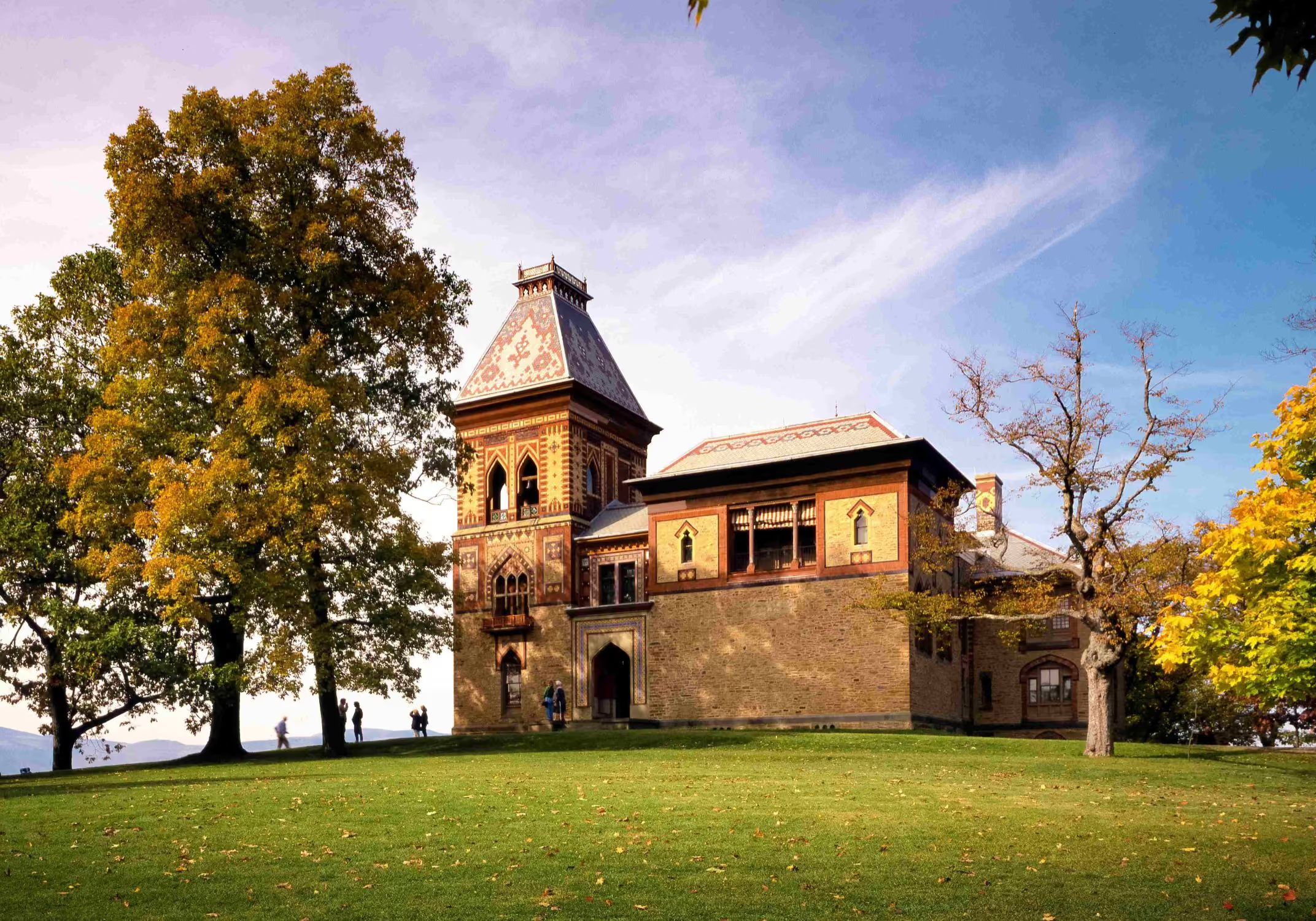
From 1844 to 1846, Thomas Cole taught Frederic Church. During that period, they often sketched together on the hill where Church later chose to build his architectural tour de force, Olana. Their friendship is one of the most impactful in the history of American art. Their two historic homes are now connected by the Hudson River Skywalk, a pedestrian walkway over the Hudson River.
The exhibition is part of a broader initiative of the Thomas Cole Site titled “Thomas Cole: Painting the Nature of America.” This year, the 250th anniversary of the nation’s birth, is an appropriate time to recall the pivotal role that Cole played in creating the visual identity of the young nation. From October 26 to November 4, 1825, the display of three paintings by Cole―in the windows of Colman’s bookstore on Broadway near Fulton Street in Manhattan ―changed the course of American art. The three paintings became an immediate success when purchased by renowned painters John Trumbull and William Dunlap and engraver Asher Durand. The display launched Cole’s career and gave birth to what is now known as the Hudson River School of landscape painting. Cole’s work gave America a visual identity reflected in the still-vibrant concept “America the Beautiful.”
For more information, visit thomascole.org.