Three local churches to participate in Sacred Sites Open House
Published on:
April 27, 2026





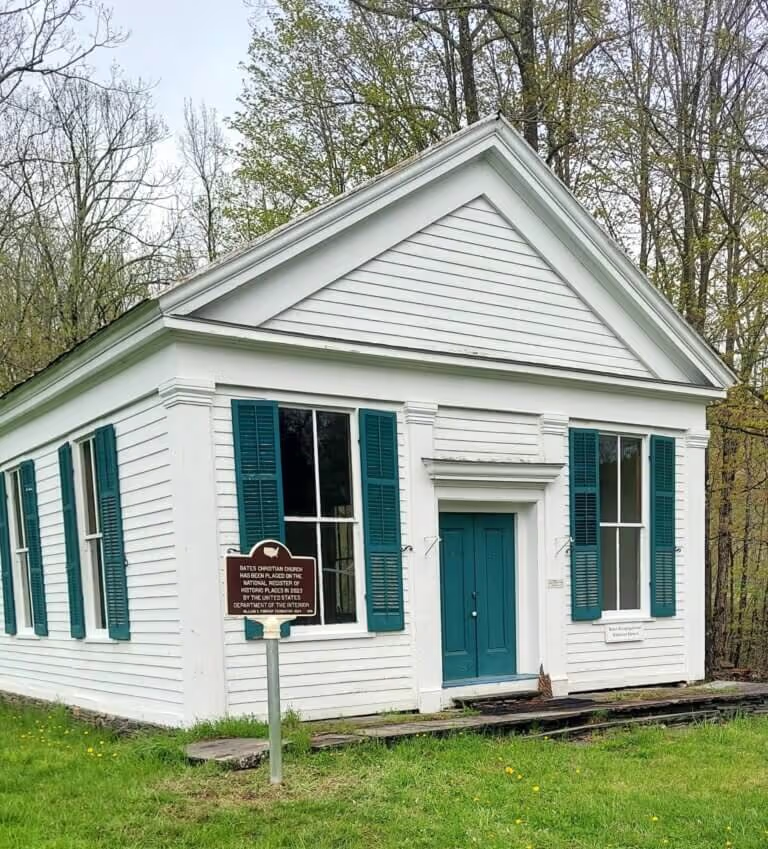





Three churches in Oak Hill and Vicinity will participate in the Sacred Sites Open House, May 16-17. They include the Oak Hill United Methodist Church, the Durham United Methodist Church, and the Bates Community Congregational Church.
The Sacred Sites Open House is an annual event sponsored by the New York Landmark Conservancy. All churches across the state that are listed on state and national historic registers are invited to participate.
This year’s theme is “Holding Community Memories.” Churches are encouraged to highlight memories of the founding of their sacred sites and of how they involved their communities.
The Oak Hill United Methodist Church, located at 7886 Route 81, will be open on May 16 from 11 a.m. to 2 p.m. A member of the congregation will be there to welcome visitors and share memories.
The Bates Church will be open May 16 and 17 from 12:30 to 3 p.m. Now known as the Bates Congregational Christian Church, it is located in the hamlet of Bates Hollow at 1 Bates Church Road in the Town of Broome, Schoharie County.
The Durham United Methodist Church, at 552 Route 22, was built in the English Gothic style, and will be open from 10 a.m. to 2 p.m. on May 16 and for morning worship on Sunday, May 17 at 10 a.m.
A guide will be there to welcome visitors, light refreshments will be served, and a brief organ concert will be presented. Visitors can see the historic pipe organ which is still used today, the historic chandelier which began as an oil light, the dark wood interior and thr large colored glass windows.
A brief history of the buildings and their congregations:
The Oak Hill United Methodist Church was organized in 1858. Charles Pierce, Israel Utter, James Welch, William Paddock were elected trustees. Before then the Methodists in Oak Hill met in the schoolhouse and Rev. A. F. Selleck preached on Sunday evenings. In the morning, he preached in Cornwallville, in Durham during the afternoon and at Cooksburg on a weekday evening.
In 1858, a building committee of nine men was appointed, and the church was commissioned at a cost of $1500. Stephen Osterhout and his associates were awarded the contract to construct the building. These folks were a financially conservative group and $900 was pledged before building commenced. They asked for a “belfry suitable to hold a good size bell.” The building was dedicated on November 2, 1859, with three preaching services. The bell was not commissioned until 1863 when it was forged at the West Troy Bell Foundry (during the Civil War) at a cost of $340. The pews were purchased in 1897 for $250.
According to the 2006 National Register Listing, the Oak Hill United Methodist Church is architecturally significant as an intact example of later Greek Revival-style ecclesiastical design. The church features a straightforward floor plan, with the first floor given over almost entirely to a worship space. There is no basement, only a crawl space inside the foundation walls. Finishes consist of plaster on lath ceilings and walls, beaded board wainscot, and plank flooring; the lathe is of the split type.
The dais is fronted by a railing of turned elements. Noteworthy is the open bell tower, which is capped by a pyramidal roof and spire. From a distance the fluted bell stage columns that support the roof and spire appear to be of the Corinthian order; upon closer inspection the treatment becomes more apparent. In order to replicate the effect of a highly ornate, foliated Corinthian capital, the builder composed the capitals of simple, scroll-sawn pieces, which when viewed from a distance, with the effect of light and shadow provide the same effect. The old Tripp store next door used a similar design on their front porch. The windows in the original building were clear glass and one still remains in a side room today.
The church was refurbished in 1928 and 1929. Walls and ceilings were renewed, new hardwood floors, memorial windows and lanterns were installed at a cost of more than $5,000. The windows were dedicated to Addie Tripp, who grew up in the column house and was the long-time church organist; as well as Israel DeWitt, Niles S. Gifford, Helen Mabey (daughter of William Paddock), Elcha T. Dewitt, and James and Mary Utter. Overseeing those modifications were Mr. and Mrs. D. C. Dewitt, Harriet Broom, Mrs. Lovett Head, I U Tripp, Calvin Burnett, Horatio Hale, William Delamater, Ernest Ford and the Hilzinger family.
The Bates Christian Church and Cemetery are located in what was once a bustling hamlet. The current community now includes only the church, several residences around the crossroads and the cemetery.
On December 24, 1842, a group convened at the schoolhouse to be acknowledged as a church. As there was no house of worship, they initially met at the schoolhouse. The land for a church building was donated by Comfort and Hulda Smith. The building was constructed for $600. In 1859 it was dedicated.
The church is a Greek Revival, wood frame post and beam building on a dry laid stone foundation with a rectangular footprint. The interior space is a meetinghouse style with three sections of pews and two aisles, two cast iron wood stoves in the northeast and southeast corners and a pump organ in the northwest corner. Pews appear to be made in the community and there is no bell or bell tower.
Few changes have been made to the church. There is no electricity or central heating. The cemetery across the road was established in 1853. The church and cemetery retain a high degree of integrity of design, location, setting, materials, workmanship, feeling and association and are contributing resources to the significance of the nomination.
The Durham United Methodist Church was built in 1895 when the original Presbyterian building on Route 22 was destroyed by fire. It houses a pipe organ built by Simmons of Boston in 1863 and installed first in the Presbyterian Church of Catskill in 1864.
According to writings of Ralph Hull, “The old pipe organ… had many wooden pipes behind the fake pipes in the front. The pipes that make the music were square and ranged in size from seven inches square to about ten inches square and ranged in height from four feet to eight feet. The air came from large bellows about three feet by five feet with a long handle which someone had to keep lifting up and down all the while the organ was playing. My older brothers all pumped that organ at one time. I took my stint at it too for quite a while. I was to receive 15 cents a Sunday for pumping the organ which I donated back to the church because I was always pumping the organ when they were taking up the collection."
When the Presbyterian Congregation declined in number, the church became Methodist. Wesley Brown, son of Rev. Clemen Brown and an organist himself, provided a more technical description of the organ: “This is a two manual organ with 30-foot pedals. There are seven ranks in the great, or lower keyboard, five in the small, or upper keyboard, and one on the pedals. This totals 678 pipes in the organ. These pipe range in size from 10 inches square and eight feet tall to the size of a lead pencil. It is a tracker action organ. Once air was provided by lifting a lever up and down in a small pump room behind the organ. Later the organ was electrified.”
Ralph Hull wrote that the chandelier was wired for electricity in the early 1930's. Would the organ have been converted then also?
The church continued with services until 1978 when winter caused so much damage to the building that it was decided that they could not use the sanctuary until repairs could be made. Services would be at Oak Hill until the repairs were made. Rev. Clemen Brown, the minister then, worked to obtain grants to repair the building and did much of the work himself as well as overseeing workmen. By March of 1979, the congregation was able to have a service back in the building.
Today, the Durham church is yoked with the Oak Hill church and together they hold services weekly on Sunday morning, usually at the Durham Church.
Mary Lou Nahas serves as the Town of Durham historian. She owns and operates I.U. Tripp & Co. Antiques and Collectibles in the heart of Oak Hill.