Report suggests limiting visitors to Kaaterskill Falls
Published on:
April 7, 2026





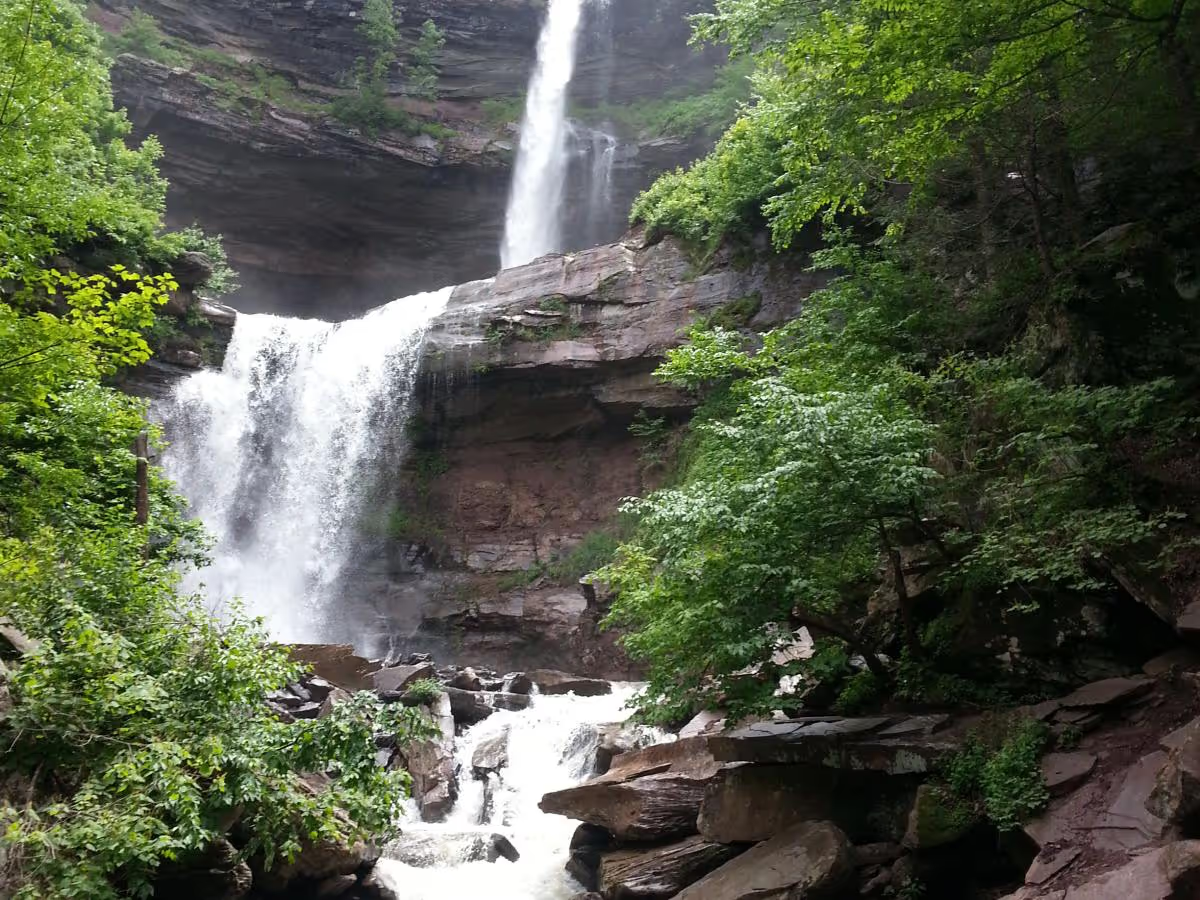





HUNTER―The New York State Department of Environmental Conservation (DEC) is considering limiting the number of visitors to Kaaterskill Clove. The proposal comes after two reports, prepared by planning firms DJ&A and Otak, regarding Visitor Use Management (VUM) for the popular Catskills Park landmark and the Adirondack High Peaks Wilderness.
But the idea is not sitting well with town officials in Hunter.
“While this plan is being presented as a way to address safety and environmental concerns, it includes potential measures such as reservation systems and visitor limits on access to Kaaterskill Falls and the Clove,” said Town Supervisor Sean Mahoney.
Over the last decade―and especially since the pandemic―visitation to public lands across the country, including New York’s Forest Preserve, has been on an upward trend. The Adirondack High Peaks and the Catskill Park’s Kaaterskill Clove are among the most highly visited regions in New York State, according to DEC, with each location experiencing the compounding effects of traffic and parking congestion, potentially unsafe conditions along busy state highways, crowded trails, summits and other points of interest, and physical degradation of trails and other facilities.
So, in 2023, DEC awarded a two-year consultant contract to conduct concurrent VUM planning processes for the central High Peaks Wilderness in the Adirondack Park and the Kaaterskill Clove region of the Catskill Park. The results were released last week.
According to the report, persistent issues at Kaaterskill Clove include:
- Parking congestion at access points for Kaaterskill Falls;
- Traffic congestion and safety issues in parking areas and on local roads;
- Crowding on trails and at Kaaterskill Falls; and
- Traffic and pedestrian safety issues on Route 23A.
“In recent years, parking on Route 23A has been banned during the peak summer season and this has helped to address traffic and pedestrian safety issues there. However, some visitors still walk on the steep, narrow, and winding road shoulder from the hamlet of Palenville or from trolley stops on Route 23A to access the creek. When this occurs, it creates safety hazards for vehicle passengers and pedestrians alike,” the report notes.
Among the recommendations in the report is to limit the number of visitors to Kaaterskill Falls to 1,000 per day, enforced through manned entry points and a daytime reservation system.
“On weekdays during the period from Memorial Day Weekend through Labor Day 2023, Kaaterskill Falls experienced an average of approximately 860 visitors per day and a maximum of over 1,800 daily visitors,” the report found.
“Use on weekend days and holidays during the same period was more than double that of weekdays on average, with an average of approximately 1,850 visitors per day and a maximum of nearly 3,000 daily visitors,” the report stated.
Mahoney said that the Town of Hunter has reviewed the report carefully, “and we stand FIRMLY OPPOSED to these recommendations proposed by a third party consultant hired by DEC.”
“For years, we have worked collaboratively with DEC to address the very real challenges of congestion, safety, and increased visitation in the Clove and at the Falls,” Mahoney said.
“We support responsible management of our natural resources. However, this document suggests moving in the absolute wrong direction by focusing on restricting access rather than implementing practical, on the ground solutions that we have consistently suggested for years,” he added.
Among the concerns, Mahoney said, are that restricting access to public lands will have a negative economic impact on the community that depends on “responsible visitation.”
In addition, he said a reservation or gated system will not reduce demand. Rather, Mahoney said, “it will shift it elsewhere chaotically, creating new congestion and safety issues in other places.”
“Common sense solutions such as expanded parking, improved traffic flow, and better on site management have not yet been attempted or implemented,” Mahoney continued. “We believe there is a better path forward by working together with the DEC and other stakeholders to address the many challenges we have seen in this area of our Town for years.”
According to DEC, the release of the report does not signify that the agency will adopt any of the recommendations.
DEC is holding a virtual meeting on the Kaaterskill Clove report on April 29 at 6 p.m. Comments can also be submitted to forestpreserve@dec.ny.gov by June 1, 2026.
Public input on the proposal is critical, Mahoney said.
“If you care about access to Kaaterskill Falls, and the future of our town, now is the time to speak up,” he said. “The Town of Hunter strongly encourages residents, business owners, and visitors to submit comments opposing restrictive access measures and supporting practical solutions.”
“This is about much more than Kaaterskill Falls. It is literally about the future of our community,” Mahoney said.
More information, including a link to the reports, can be found at https://dec.ny.gov/nature/forests-trees/forest-preserve/visitor-use-management/adirondack-high-peaks-kaaterskill-clove.