Highlights of Gov. Hochul’s $260 billion Executive Budget
Published on:
January 20, 2026





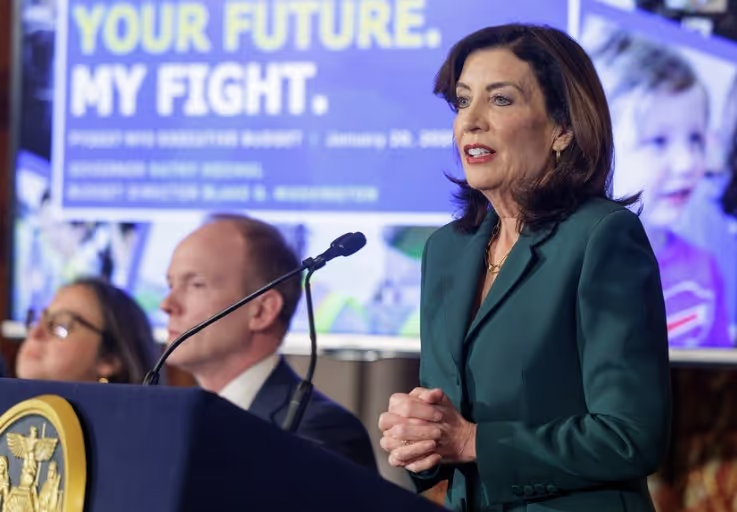




ALBANY―Governor Kathy Hochul on Tuesday laid out plans for what she called “a stronger, safer, more affordable New York” as she unveiled the Executive Budget for Fiscal Year 2027 that does not raise income taxes.
The Executive Budget projects State revenue collection to increase by 9.9 percent and FY27 all funds spending is projected at $260 billion, an increase of 0.7 percent.
“Every dollar in this year’s budget is being put to work to fight for families,” Hochul said.
“While Washington tries to break our budget, we are making smart investments, protecting taxpayers and committing to delivering the services New Yorkers need most,” she added.
According to Hochul, “Spending is up very slightly and that’s primarily to offset federal cuts especially to healthcare.”
“That’s because federal funds in this budget are down roughly $10.3 billion. That’s an 11.4 percent decrease from just last year. Some of that was pandemic relief that we knew would run out. But $3 billion of it is recurring Medicaid funding money that New York depends on to provide care for millions of people,” she added.
Hochul also noted that her plan maintains reserves at $14.6 billion.
“Let me take a minute to put that number into context. When I came into office in 2021, we had about $2.5 billion in reserves. Over the last few years, we built our reserves to the gold standard of responsible budgeting strong enough to protect New York in a downturn and flexible enough to act when families and businesses needed help,” she said.
Hochul’s Executive Budget will now head to a months-long negotiation between the governor, State Senate, and Assembly. A deal is supposed to be struck by April 1, but late budgets are not uncommon.
Locally, Assemblyman Chris Tague (R/C-Schoharie) called the governor’s plan “nothing short of disappointing.”
“Now that we are in an election year, the governor wants to pretend to be concerned about affordability? Please,” said Tague. “Democrats are funneling our hard-earned dollars into endless social programs, climate initiatives and giveaways that do nothing for the average New Yorker.”
Senator Michelle Hinchey (D-Saugerties) had not issued a statement on the Executive Budget as of Tuesday night.
Nassau County Executive and Republican candidate for governor Bruce Blakeman slammed the budget, saying it “does nothing to help everyday New Yorkers pay their bills.”
“There’s no income tax relief, no property tax relief, no utility cost relief—nothing that helps families and seniors keep up with the rising cost of living,” Blakeman said.
According to Blakeman, “Hochul’s budget keeps $4.3 billion flowing to migrant shelters, healthcare, and legal services with no cap and no end date, while Medicaid spending jumps roughly 11% as free healthcare for illegal migrants continues [and] Hochul refuses to disclose how much of that increase is driven by migrant healthcare, leaving taxpayers with a multi-billion-dollar bill.”
New York State United Teachers (NYSUT) President Melinda Person praised Hochul’s budget proposal, saying it “underscores the critical role that public education, from early childhood through higher education, plays in strengthening New York’s families, economy and future.”
New York State Comptroller Thomas P. DiNapoli said the Executive Budget “proposes several actions to improve affordability, speed housing construction, expand childcare opportunities, mitigate food insecurity, address energy costs and invest in clean water.”
“While commendable, the state’s long-term fiscal challenges persist, as spending growth remains above inflation and the state’s economy and finances continue to be disrupted by actions taken in Washington. Out-year budget gaps are estimated to be $27.5 billion,” DiNapoli said.
"Policymakers will face a complicated task crafting a budget this year given the heightened uncertainty in the economy and the prospect of even more unfavorable federal policy changes. It will be important to evaluate how budget proposals impact the costs businesses and residents are facing while also protecting essential programs and services that New Yorkers rely on,” he added.
“My office will release a more detailed analysis of the Executive Budget in the coming weeks,” DiNapoli said.
Key highlights of the governor’s plan include:
Childcare & Education:
- $4.5 billion total statewide in childcare and Pre-K services, including $1.7 billion in new investments statewide
- Over $3.2 billion in childcare vouchers statewide to address waitlists
- $500 million over two years for NYC’s 2-Care program
- $60 million to pilot childcare programs in Broome, Dutchess, and Monroe Counties
- Enhance and reform the Child and Dependent Care Credit, providing 230,000 filers with an average increase in benefit of $576
- $395 million for year two of the Universal Free School Meals program
- $34 million for library construction grants
- An additional $90 million in support to maintain a tuition freeze for resident undergraduate students at SUNY and CUNY four-year colleges
- $12.5 million to expand our free community college program
Healthcare:
- $38.2 billion for New York’s Medicaid program, including $1.2 billion this year in federal funding generated through an assessment on Managed Care Organizations (MCOs) that will be disbursed to health care providers and programs, including hospitals, health clinics, nursing homes, assisted living programs, and more
- $1 billion in new capital and a minimum of $330 million in operating funds for the existing Safety Net Transformation Program to support projects that promote financial sustainability and quality of care in New York’s safety net hospitals.
- $750 million in new health care resources to promote access to high quality services provided by hospitals and nursing homes
- $80 million to protect access to reproductive health care and to secure reproductive health centers
- $3.2 million to improve cardiac emergency preparedness by establishing regional centers of excellence for CPR training
- $17.5 million to expand the Teen Mental Health First Aid training to be available to all tenth graders in New York State
Housing:
- $100 million for the MOVE-IN NY homeownership program, which leverages innovative prefabricated technologies to build new homes twice as fast and at lower cost, helping more families move into high-quality starter homes
- $50 million for the Resilient and Ready program to help homeowners recover from and better prepare for extreme weather events
- $5 million for the Manufactured Home Park Revolving Loan Fund to finance improvements to critical infrastructure and upgrades for residents
- $50 million for the Housing Access Voucher Pilot Program (HAVPP), consistent with the four-year pilot, designed to provide rental assistance for housing vouchers for individuals and families who are homeless or who face an imminent loss of housing
- $40 million for the Homeowner Protection Program (HOPP) to provide legal assistance and housing counseling to help preserve homeownership and protect at-risk homeowners from foreclosure
- $20 million for lead abatement programs to protect tenants in areas of high risk outside New York City from lead hazards
- $153 million for the Homeless Housing and Assistance Program (HHAP) to provide capital funding for supportive housing
Public Safety:
- $352 million in gun violence prevention funding, of which $50 million is included for Law Enforcement Technology grants
- $4.5 million for a new Crime Analysis Center (CAC) in Westchester to reach complete statewide coverage
- $500,000 to address illegal homegrown guns, which is coupled with legislation to crack down on 3D-printed firearms and DIY machine guns
- $35 million for Securing Communities Against Hate Crimes (SCAHC) program to protect houses of worship and other vulnerable locations
- $77 million to continue the partnership with New York Police Department (NYPD) to increase police presence on subway platforms and trains
- $25 million to increase support for Subway Co-Response Outreach Teams (SCOUT) to engage individuals in crisis and connect them to care, treatment, or shelter
- $150 million in additional capital funding to complete the construction of a Statewide Emergency Operations Center
- $6.7 million to support upgrades to forensic laboratories across the state to solve crimes more efficiently
- $2 million to investigate and build criminal cases against auto insurance scammers and fraudsters
- $5.3 million in funding to establish a new Urban Search and Rescue capability
Energy:
- $3.75 billion five-year commitment to enhancing clean water infrastructure
- $425 million for the Environmental Protection Fund
- $200 million for on-going parks capital projects
- $50 million for EmPower+ Program which helps homeowners save money on energy efficiency upgrades to their homes
- $33 million for the new Excelsior Power Program
- $20 million for upgrades to Denny Farrell Riverbank State Park
- $75 million for the Building Recreational Infrastructure for Communities, Kids and Seniors (NY BRICKS) capital grant program to support municipalities and nonprofit organizations in developing community centers that promote physical health, mental well-being, and community connections for youth and older adults.
- $7 million for projects celebrating the 250th anniversary of the American Revolution
- $15 million for dairy industry modernization grants
- $30 million for tariff relief funding to directly support our farmers
Transportation:
- $8.6 billion in total operating aid for the Metropolitan Transportation Authority (MTA)
- $50 million in funding to design a reimagined Jamaica Station for subway, LIRR, and AirTrain riders
- $25 million to begin preliminary engineering and design to extend the Second Avenue subway tunnel westward across 125th St to Broadway
- $1 billion in operating aid for Non-MTA Public TransitSystems
- $6 billion for the fifth year and final year of a record $34.4 billion DOT Capital Plan which includes:
- $1.4 billion for local roads and bridges
- $648 million for the Consolidated Local Street and Highway Improvement Program (CHIPS)
- $140 million for the State Touring Routes Program
- $100 million for the Pave Our Potholes Program
Economic Development:
- $400 million for the NY Works Economic Development Fund
- $100 million for a second round of the Promote Opportunity with Electric Readiness for Underdeveloped Properties (POWER UP) Fund to create power-ready sites for advanced manufacturing
- $200 million for the Downtown Revitalization Initiative and NY Forward
- $150 million for another round of the Regional Economic Development Council (REDC) program
- $25 million to establish a new Semiconductor Chip Design Center that links the downstate knowledge economy to upstate manufacturing
- $10 million to launch the Governor’s Manufacturing Modernization Program to support the state’s small and mid-sized manufacturers
- $50 million for the County Infrastructure Grant Program
- $100 million for the Quantum Research and Innovation Hub at SUNY Stony Brook
- $60 million to establish four additional Quantum Technology Commercialization Hubs across the state, which will be regional anchors for quantum innovation and high-tech start-ups
- $65 million for the Bolstering Biotech Initiative to make New York the epicenter of life sciences innovation
- $10 million for the Saving Performing Arts and Cultural Experiences (NY SPACE) program which will provide grants to help nonprofit performing arts organizations acquire venues
- $100 million for grants administered by the New York State Council on the Arts
- $300 million in funding to support economic development and revitalization projects in the City of Rochester and Monroe County, including $75 million for the creation of a new High Falls State Park in Rochester
- $6 million for NY Kicks which aims to continue the momentum from the FIFA World Cup 2026 soccer tournament by building lasting infrastructure for outdoor youth recreation and funding programming, equipment, and training to maximize use of these new facilities
Hunger:
- $66 million for the Hunger Prevention and Nutrition Assistance Program (HPNAP) to expand funding to the State’s network of regional food banks and emergency food providers
- $55 million for the Nourish NY Program
- $10 million to combat food insecurity through NY PLATES, a new capital grant program for food pantries, food banks, and other hunger prevention organizations