Flip Flach’s Canvas of Greenville: Main Street
Published on:
March 21, 2026










Notes and Program by Flip Flach
Article by Town of Greenville Historian Don Teator
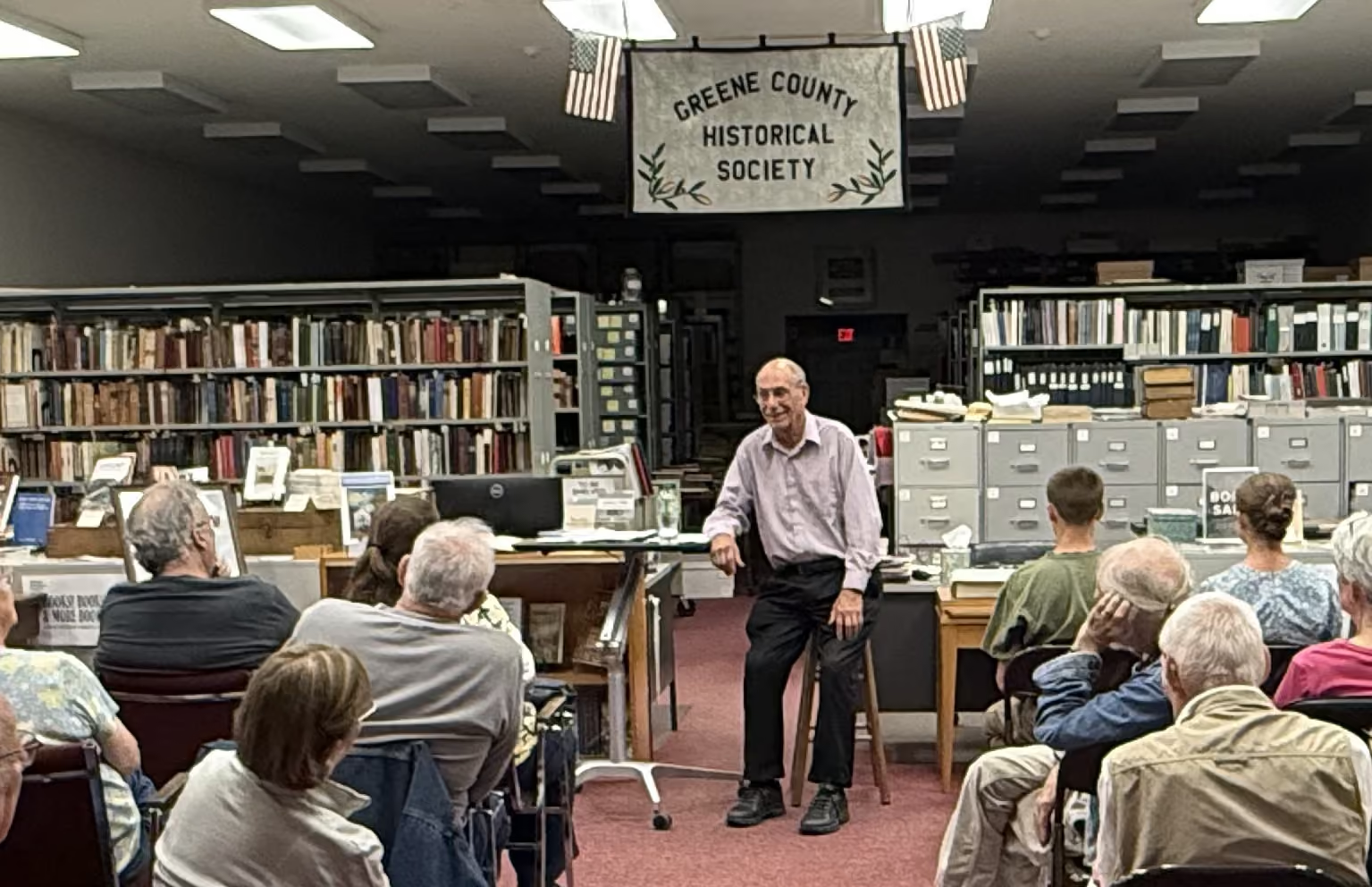
In a November 2025 Greenville Local History Group program, Flip Flach provided another memory-filled trip, details of which others confirmed, and some of which scratched the edges of our memory recall. The program idea started several years ago. Eventually, it crystalized to: An Extended Village Canvas: a presentation of memories of "ex-buildings, ex-businesses, ex-entrepreneurs" that graced and inhabited the roadways a half mile or more from the four corners of Greenville.
Links to past posts:
Rt 81: Norton Hill to Catholic Church
Rt 32: Albany County line to shopping plaza
Rt 32: Shopping plaza to Four Corners
CR 26 and SR 81: East of the Four Corners
It should be noted that the half-mile range has been generously expanded. Also noted is that although this is officially Flip’s program, he has been gracious enough to allow any of us to add memories or to add sites and people to the discussion. The November meeting was fortunate to have Bill Quackenbush in attendance, with stories from his many years residing at the base of CR 26. And add Joyce Chase who, with her husband, operated Main Street Garage.
The Start of Flip’s Trip
From the Route 26A corner, we drove down the hill. The views of the two houses on the right are blocked by foliage. Photos from a month later showed a better view of the fronts. No one knew the current owners although the Jaycox name was mentioned.
Bill Quackenbush: “I remember playing baseball on the lot adjacent to their house [first house past Tumey’s]. Home plate was near Route 26 and the outfield centered around John and Leila Lennon‘s house. We soon outgrew our baseball park and began depositing baseballs in their kitchen window. Mr. Lennon very sweetly invited us to shut down the park and we moved down behind Cunningham’s funeral parlor where the skateboard park is now.”
The house on the left-hand side is today owned by Rick Ruland and has been for a considerable time.
Bill Quackenbush: “I remember Chuck Kiley walking from his house on 81 [downtown] to Cunningham‘s Funeral Home where he was Lee Cunningham‘s right hand man. Mr. Kiley, always the consummate gentleman, always spoke to us and called us by name.”
From there, we re-started at Stewart’s and looked up the Rt 26 hill. Town Historian Don Teator had drawn a quick map which showed five structures on the left and three on the right.
Staying on the left side while going up the hill, the first house was the Rich Clark house. Caution: Rich Clark has not lived here for some years but our memory banks said it was his house! Apologies to the current owner.
Next was the Quackenbush house.
Bill Quackenbush: “In 1972, Kathie and I purchased this from a retired state trooper Hayward Rasmussen. He had married Lena Chesbro [sister of Matt of hot dog fame]. They raised five daughters. Kathie and I had two children when we moved to our house. We could walk to work, me being only three minutes from the Greenville Pharmacy. We had front row seats for everything that was going on Main Street.”
The third house on the left, the one next to Quackenbush, had room for a wonderful story from Bill.
Bill Quackenbush: “When I lived across the street, I remember the house was owned by Harold and Nell O’Rourke. This was the house where the Quackenbush kids saw our first television program in the 50s. Future owners would be the Lowes and the Tumeys and eventually Tom and Betty Hayden, the current owners.
“Originally from Dublin, Greenville became their retirement home, having worked and raised a family in the New York metropolitan area. They weren’t in the house very long when Betty Hayden came over to see us and explained that Tom was sick and wanted to know if she could call on us if Tom died.
“Of course, we agreed and also recommended that Betty get in touch with Cunningham’s and let them know that her husband was failing and they were planning ahead. Apparently, there’s a rather lovely Irish tradition, that when somebody in the family dies, they might contact someone outside the family to come and be with them at that life-ending event. It looked like we might be called upon sometime down the road.
“Many months passed and we received that late night phone call. It was Betty. Tom was gone! Would I call Curt Cunningham and could you come up? So, Kathie and I donned some presentable clothes and walked to the Hayden’s where the family had gathered. They were saying goodbyes to Tom. We said a few prayers and waited for Curt. In my phone call to Cunningham’s, Curt told me he might need my help. His regular right hand man, Felix Perkowski, was out of town and he couldn’t handle things by himself.
“I got my initiation under fire that night, not only witnessing the death of a dear, good neighbor but also jumping in and being Curt Cunningham’s able-bodied helper. I explained to Curt that I was one and done―my last time assisting Cunningham’s Funeral Home.”
A modest yellow house is next. Names mentioned: Young Harry Ketcham, Bill and Roseanne Vaughn, Brody, and most recently, Spohler.
The last house on the left, before topping the hill onto Orrin Stevens, is a house associated with Hotaling. The mottled look of a different colored tile pattern distinguishes it.
At the top and crossing the road, the top house was built by Wilbur Baumann and his father in 1946. Bill thought it was still in the Baumann family.
The middle house on the south side of the hill is close to Bill.
Bill Quackenbush: “In 1949, my mother, father, and five children moved into the house that Denise Mickelson owns now. The house was built by Wilbur Baumann and his father in 1946 so Wilbur and Tut (Thelma) lived there for just three years before they moved to a new house just up the hill from previous slide.”
The bottom house on County Route 26, the red one, is an old house in Greenville. It is closely associated with Harold Tumey. Not much else was known except for the baseball story of Bill.
On to Main Street!
From the junction of CR 26 and SR 81, by the noisy culvert at the bottom of the hill, the distance from there to the traffic light is but a couple of baseball throws long. However, this piece of road is the most photographed 150 yards of any stretch in town. And we will comment about places as we pass them.
On the left is the Grapeville agency building
From the junction of County Route 26 and State Route 81, we faced the Four Corners and started our tour of east Main Street.
Flip: “On the left is the Grapeville Agency and its customer parking lot. I recall Mr. McCarthy's house and his little dog Binky who used to walk around the village on a regular basis. I remember him as a nice, retired New York City police officer.”
Bill Quackenbush: “As it is said, a policeman never really retired. Always a policeman, Mr. McCarthy regularly walked with his wife and his dog, keeping an eye on all things going on in the village. I can see him to this day, rattling the doors of the businesses at night to make sure that they were locked and secure and safe for the evening.”
Across the street, right at the fence line between Stewart’s and the Clark house stood a very worn looking shingled sided building.
Flip: “I recall that as the Greenville Firehouse initially. The fire engine was parked there. It was very handy for the first responder, usually Gordon Simpson because he was a hundred feet away in his garage. On the right side, I remember a liquor store being in there but I don't know who operated it. That building was often run into.”
A photo of a big hole, a crash event, proves Flip’s point. This photo was not in the program show. A few others noted other times that building was hit.
Just past the Grapeville Agency building is a little cottage type house.
Flip: “I remember Neil Kraft living there. Before Neil, it was Bill Gedney’s.”
Just past the Kraft house is an unusual combination of a regular house, almost hidden from sight, connected in the front with the shop that is/was Variety Video.
Flip: “I first remember when it was Bogdan’s. I remember buying little wooden airplanes and little figurines. In 1957, from what I recall, Bill and Sue VonAtzingen purchased the building. They added clothing as a sales choice. I am thinking that Mr. Bogdan built the front area as a retail store. Today, of course, it is Variety Video.”
In the short time since the meeting, Variety Video has moved next to Sweet Spot Eatery, the former Pharmacy.
Across the street, where Stewart’s is today, was Main Street Garage.
Flip: “Gordon and Evie Simpson owned this building for as long as I remember. After them was Jon and Joyce Chase. Gordon was a terrific mechanic and a super nice helpful guy. His brother Lester was by his side equally as a good mechanic and Willie Bear also was there. We called them The Trio and they were just there all the time helping people, as was Evie.”
From another angle, Joyce Joy Chase writes: “On a dark fall night as we laid in bed ready for sleep, Jon (Gary Jon Chase) announced he wanted to buy Main Street Garage from Gordon and Evelyn Simpson. He was so excited and I was mortified.
“But, for seventeen years it was our home. On Friday, April 30, 1981, we turned the key to our new way of living. All of us came from a farming background and Jon had repaired machinery all his life. As the snow blew through the concrete blocks of our office that first winter, something had to be done. We remodeled our office in 1982 with better electric, and a built-in heater. Working on vehicles outside in the elements was very difficult and in 1983 we extended the garage building to hold even motor homes and tractor trailers.
“We were used to drilled wells, so at the first power outage, we could still flush the toilet and wash our hands with gravity fed water. The cops were called more than once for thefts of our business. Always change your locks when you buy a new place. The blacksmith shop and cabinet shop were gone but the liquor store was still there at purchase time. The children all out of school, we all changed different careers, and the Main Street Garage was sold to Stewart’s in June 1998. In one day, the whole building was scooped up and thrown away. Life goes on.”
Next to the Main Street Garage/Stewart’s site sits a long and narrow maybe-grayish building. Today, it is the Kosich Law Office. Flip’s memory goes back to his father’s time.
Flip: “The only story I know about this old building was from my own dad who told me that when he attended the Greenville Free Academy in 1931, he was in 8th grade [now the site of the Greenville Library]. After school, he would walk over to this building which was Bill Neidlinger’s Barber Shop in the front section. Bill had his cable driven clippers and my dad would watch Bill work and ask questions. Bill would instruct him why he was doing what he was doing. Then Bill would have my dad sweep up. This was as a 14 year old, you know. In the back of the building, in back of the barbershop, was where the guys would go and play pool and hang out.
“The other story is about Bill teaching my dad the trade how to cut hair was the requirement my dad promised that he would never set up in town in a competition to him. They had a verbal confirmation agreement that my dad would never do that and Bill said when I'm ready to retire I'll let you know and you can move in and take over the town as the town barber. That's exactly the way it worked.
“In 1948, my dad was working at General Electric Company in Schenectady as a machinist. He was there all during World War II. Once the war was over, all the workers got hours cut down and some were furloughed. My dad was tired of driving from Greenville to Schenectady on those old bouncy roads with his old cars and decided to give it a try and the timing was just perfect. He was thinking about leaving General Electric anyway when Bill called him. My dad jumped at the chance to open the barber shop in Greenville.”
Before we switched across the street, the program showed three or four slides before the Main Street Garage was built. Instead, there were four to five smaller buildings on the edge of the road. Records probably tell from an earlier program who may have been there but there is no one alive today who can remember those old buildings.
Also, several photos were taken from Main Street and looking up Stevens Hill. The Model T in the photo dated it to the 1920s and possibly dates the photos described in the previous paragraph. These photos focused on the hill and one photo shows about twenty small bodies on the hill. Stories of sleigh riding down Stevens Hill onto Main Street have lasted more than a century.
Across the street, just past Variety Video/Von’s/Bogdan’s is the Masonic building with the stone front.
Flip: “On the south side of the street was the IGA store [grocery store]. I remember going there as a little guy age 10 years old with my mom. The owner went by the name of Murphy Vaughn. Although his real name was Robert Vaughn, everybody called him Murph―certainly a nice gentleman. He would take your shopping list of a dozen, maybe 15 things on it and you would just stand at the cash counter. You would give your list to Murph and he would go up and down the aisles with a paper bag and get your grocery list filled. In the back of the store was a man by the name of Charles Medert who was the Butcher. If you needed meat products, you would do that while Murph was filling your bag. You were given your bag and after paying for it, out the door you'd go. There was no self-service shopping in those days. In that same building, the Masons started meeting upstairs above the store. Eventually the whole building was taken over by Mason's Lodge.”
During the reconstruction of Route 81 [early 1960s] when they widened the road and put in the sidewalks, Bill Quackenbush noted the road closure made shopping at the businesses very difficult.
The next building is the one with all the front glass windows, where Sweet Spot Eatery and, now, Variety Video are. An old MP Stevens glass plate negative showed the store in the early 1900s with all of the glass cases and the soda fountain service. Of course, it was the Greenville Pharmacy, worth a longer story. And a piece of this is shown in one of the footnotes at the end.
Looking across the street, we knew little of the blue residence between Kosich Law and Kelly’s Pharmacy. Most of us, if we remember that far back, can recall it to be the home of Gordon and Evie Simpson, the proprietors of Main Street Garage. However, one old photo, given by from over a century ago had a penciled identification on the back, reading:
“Home of dentist Dr and Mrs George E Smith for 40 years Greenville New York, 1900 June. Mrs Anna T Palmer bought the place off them 1923 and lived there until 1944, June 8th, when she died. She had a little porch built at the front door after Dr Brown had his office there in 1939. The white picket fence all about the place was taken down in April 1940. Mrs. Anna Palmer sold the place to Gordon Simpson and wife Evelyn May 1942. This was the Joseph P. Hallock house in 1880. The first blacksmith in Greenville was on this site in 1810 run by Buel Cheritree, he was succeeded by John Benedict in the same place.”
Wow! And a couple photos, with the picket fence, allowed the viewers of the photo to accept the picket fence in the old photos of this section of street.
A driveway separates the Simpson house from Kelly’s Pharmacy. Flip was too little to experience it, but his father told him a story of when the Kelly’s building was Gus Baker’s, a bar and restaurant:
“I was too little at the time but my dad told me the stories and participated in the Friday night roasts fries at Gus Baker’s, the owner of Baker's Tavern. He would host these roasts and have different meats depending on the time of year. If fall time, and it was deer hunting season, guys would donate venison meat and he would have a venison roast. Beverages were needed so it was a good promotion for his business. In the fishing season, the guys would bring in big fish, lots of them, coming from what we called Mystery Lake. Most people knew it was from the reservoir which was illegal to fish from and still is. A wonderful side story on my dad's part: he liked to spear eels down at the reservoir. He waited until the right time of night and stood in water in one of the little bays where the temperature was just right. He would catch a mess on good nights. He would bring in eels and give them to Gus and Gus would skin them, filet them, and have a good Friday night eel fry.”
This building has been photographed with several names of signs. Hynes’ is one that most of us seemed to remember. Village Inn, LeValle’s, Tavern on Main, et. al., have been documented, each one with a story.
As for Gus Baker’s, one of his granddaughters has her share of stories. I am sure that Barbara Van Auken could tell a bunch about her grandfather’s place.
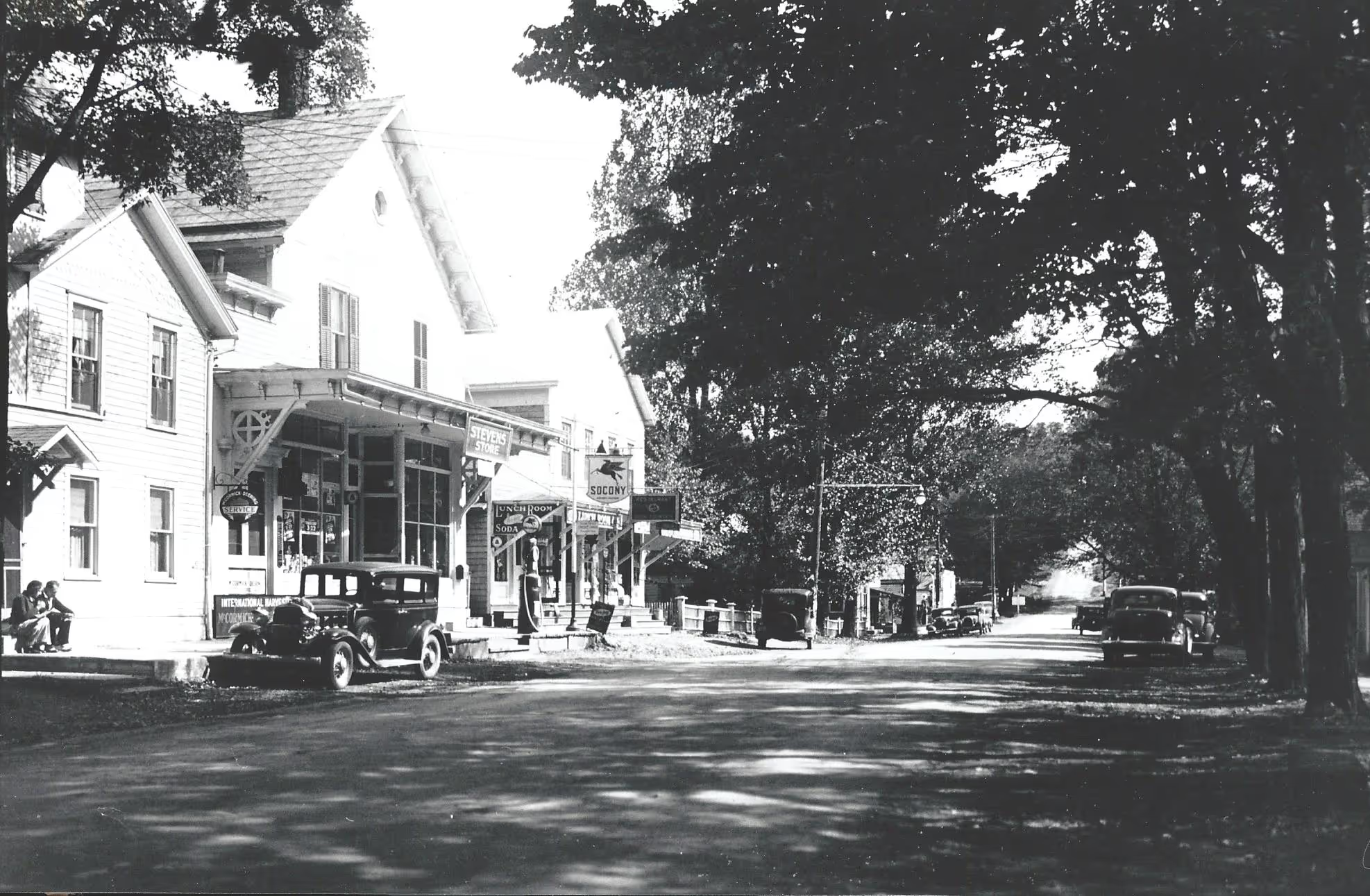
Right next door was one of the village’s anchors for decades: Stevens Store, today The Tasting Lab.
Flip: “The Stevens Store had brothers Pierce and Bill. I think it was Pierce who built the block building for his International Harvester machinery business, later to become home for the Greenville Volunteer Fire Company. Eventually Bill Vaughn was the postmaster with the post office inside. And Randall Cutler ran a hardware store, with in there anything and everything you desired at that at that time. After that came a NAPA store with Mark Wilcox.”
Today, Tom Vance runs The Tasting Lab and has renovated the building quite nicely.
Heading back across the street, next to the Sweet Spot Eatery, is a narrow but long building that is today unoccupied. Flip has some vivid and personal stories, some of which we have heard before.
Flip: “In 1946, my grandfather bought that building and opened Flach’s Bakery. Along with my Uncle Fred, they serviced the area with baked goods, especially bread, and with a retail store in the front. The bakery section was in the back. They delivered bread to 26 different resorts, or we called them boarding houses back then. They would bake all night long and then deliver during the daytime so that by breakfast the boarding houses had their cherry tarts and crumb buns and apple turnovers for the guests by 7:00. In the front, they had what we call frozen custard at that time. Until then, no one had ever seen these machines. The soft ice cream stand lasted until 1969 which is when my uncle Fred went out of business. 1946 to 1969 were the Flach business years.”
Next to the former bakery stands a two-column, small building, today the Read and Read Again bookstore. One local history project that needs doing would be to recall all the different businesses this building has seen. Flip remembered a tobacco shop.
Next to Stevens Store sat the building most of us call the Baumann store. Appliances were sold there as well as the plumbing business goods. Earlier photos show a residence with a turret column that seems to have been taken down perhaps in the 1940s. Today, one side is an accountant office and the other side is the exotic store.
Back across the street is the Baumann building, once the home for Hugo, I think I am told. Today, it is apartments. Hugo is another long story.
Right next to the Baumann apartment building is an empty space on the corner, making for a good view while making the turns under the light. However, before the mid-1960s, the Corner Restaurant sat there.
Flip: “I recall the Corner Restaurant and it had a fountain soda fountain and ice cream inside on the right side. I was an early teenager and I remember the lady's name was Kate DeBus who ran it. There was a jukebox in the back so we kids would walk down there from the school.”
Other photos show an exterior stairs leading to a business on the second floor. And this building was the scene of the 1935 murder, something some call the Greenville Crime of the Century. Very early on, some school overflow led to class being held here, dates not known.
Back across the street, between the Baumann building and the corner, was a small hut of a building, last used as a hair stylist shop. In the 1960s, it served as a bank office for the summer. Now, it has been removed to allow access to the fire department.
The last stop on this tour is where Tiny Diner sits today. But what a tale this site tells. A grand white house filled the corners, edged with a picket fence. We have written about it before and some of the best old photos show it grandly, especially in winter. In the 1940s, an oil company bought the property and built a gas station that most of us “old-timers” remember, a business that has been the topic of many a story around the campfire.
Just around the corner, past Tommy’s Hot Dogs and the creek, sits an office/shop. It’s original claim to fame is that of the Greenville Barbershop where Flip and his dad Joe cut hair for years, and probably where Flip gained some of these stories!
We thanked Flip Flach, for the sixth time, for providing your memories of a town long gone by. And his memory tour allowed others to connect with their memories.
Footnotes from Bill Quackenbush...
How the Quackenbushes Came to Greenville
My father‘s father worked as a credit manager for a wholesale drug company, McKesson and Robbins, with a distribution center in Albany. After high school, my father went to work for McKesson’s as an office boy and he met this lovely switchboard operator named Dorothea McTague―my mother as God‘s plan would have it. When they got married, my father and mother were awarded a sales territory in upstate New York; the Adirondacks really, and they were based in Plattsburgh, where they began a life together.
With five children (three brothers and a sister) born in Plattsburg, my father realized that he needed an income greater than his salesman salary. He asked my grandfather if he would help him find and purchase a pharmacy.
Even though my father wasn’t a pharmacist, he thought that he understood the retail pharmacy business and could manage one. As history would have it, they found a store in Greenville that was owned by Gordon Bartholomew. Gordon would own the pharmacy for only a couple years. He had bought it from Francis Ales who owned the business fifteen years prior to a previous owner, Neil Avery and the McCabes before him. After the pharmacy purchase, they needed a home and moved into the house the Baumann’s had just vacated (Mickelsen).
We had lots of fun in the house on the hill―sledding and tobogganing on the hill in the winter and we had easy access to the Greenville pond for summer fishing derbies, in winter we were ice-skating on a pond well maintained by Lee Cunningham. He was very good to the kids and would always be at the ready, scraping all the snow off the ice on the pond. Occasionally Lee would throw on his own skates and skate right along with us.
My parents, and five additional children, would stay there until 1958 before moving to a new house on Route 26, at today’s junction with Turon Road, not built then.
A Tribute to the Greenville Community
I offer my sincere appreciation for how my community was so welcoming to a local “kid” who came back home in 1967 after five years at Albany College Pharmacy, plus an internship year in Vermont. That appreciation was demonstrable in the way they began to trust the “kid” to fill prescriptions for themselves and their precious loved ones. They trusted the kid enough to drive by multiple pharmacies on their way home from their doctors in Albany, Catskill and many other provider locations to have their prescription needs met in their hometown. Greenville has been a wonderful place and time for the many Quackenbushes to grow and thrive and our children enjoyed the same kinds of things my siblings and I enjoyed growing up. Thank you, neighbors. Amen!




%20F.avif)