Emergency Medicine chief addresses CMH redesignation plan ‘rumors’
Published on:
February 5, 2026





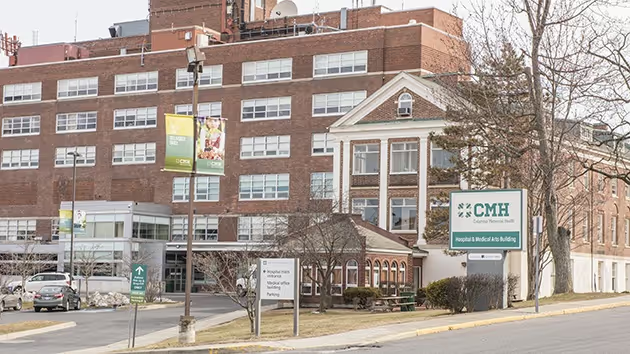





CATSKILL―Columbia Memorial Health (CMH) officials have been unyielding in assuring the public that the Hudson hospital is not closing its doors. But change is on the way, leading to speculation and concern about the future of healthcare in Columbia and Greene Counties.
“There’s been a lot of rumors going around every day that gets worse and worse,” said Dr. Michael Weisberg, chief of Emergency Medicine at CMH and vice chair of Community Emergency Medicine at Albany Medical Center, who spoke Wednesday during a meeting of the Greene County Legislature.
Last fall, CMH officials proposed a new model of care to address financial strains the hospital has been experiencing for years. Officials held a town hall meeting and issued multiple statements, but Weisberg said, “Everyone kind of panicked and heard what they wanted to hear, no matter how many times we’ve said it over and over.”
The three-tiered plan includes an expansion of behavioral health services, a new out-patient surgical center in Jefferson Heights and designation as a Critical Access Hospital (CAH).
Weisberg said CMH has already been “right-sizing” for over a decade. They stopped admitting pediatric patients “like most community hospitals did,” he noted, and closed the birthing center in 2019 after the number of babies being born at CMH dipped to less than 300 a year, among other curtailments.
In 2016, CMH became the first member to join Albany Medical Center in what is now the Albany Med Health System that also includes Glens Falls Hospital, Saratoga Hospital, and the Visiting Nurses.
“It was the right thing to do with the goal of having healthcare in Greene and Columbia counties move forward indefinitely,” Weisberg said.
Each hospital is locally controlled with its own governance, but without affiliation, “independent hospitals can’t survive,” he added.
“Without Albany Med we would not be here. Simple as that,” Weisberg said.
CMH President and CEO Dorothy Urschel has said that since the pandemic CMH has experienced cumulative operating deficits of more than $78 million and in the last decade, Albany Med has invested more than $50 million into CMH.
“Albany Med’s been writing checks, but they cannot do it forever because no hospital is flushed with money. Or no real hospital, I guess. In Beverly Hills maybe, but not anything here,” noted Weisberg, adding that Albany Med did not demand the proposed changes.
Currently, CMH is in the process of applying for state and federal approval to become a CAH, a designation given by the U.S. Centers for Medicare and Medicaid Services. The process, completed with the assistance of consultants, could take two years. Weisberg said it is anticipated to go through.
“The reason that we need this designation is, for whatever infinite wisdom of the United State federal government, a critical access hospital gets paid at full rate. When you spend a dollar, you get back a dollar. Currently, we get about 50 cents in every dollar we bill,” Weisberg explained.
That 50 percent does not fully cover the cost of care provided and even before Covid hit the hospital was just breaking even, Urschel has said. Approximately 89% of the hospital's inpatient revenue comes from Medicare and Medicaid.
CMH is currently approved by New York State as a 192-bed hospital and a CAH designation requires no more than 25 beds. But Weisberg echoed what CMH has been saying for months: it has never actually had 192 beds.
“Just because the hospital has a number of beds licensed on record does not mean they use those beds. We are licensed at 192 beds. There aren’t 192 spaces left in the hospital anymore,” he told county lawmakers.
“Our average census of admitted patients is about 25 or 30 a day. But admitted is different than staying in the hospital. You can come in and, say, you have chest pain and you need to stay overnight and we say we are going to admit you. You are technically not admitted; you are an observation patient,” Weisberg said.
“The observation patients do not count toward the 25 admitted beds,” he added.
“Also, the 25 beds is an average. In the summer, we have lots of empty beds. During cold and flu season, we don’t. We will be able to flex up and down as need be,” Weisberg explained.
Congress created the CAH designation in 1997 after more than 400 rural hospitals closed during the 1980s and early 1990s. According to the Centers for Medicare and Medicaid Services, there are currently 1,385 CAHs in 45 states and 21 across New York, including Cobleskill Regional Hospital and Margaretville Hospital.
A CAH is required to maintain a 24/7 emergency room and be located in a rural area.
CMH also currently has nine intensive care unit (ICU) beds, but Weisberg said they have not had nine ICU patients at one time since the pandemic.
“We usually run a census of four. And our ICU in reality is not the same as an ICU in Albany. Albany Med or St. Peter’s has a cardiac care unit, they have a medical ICU, they have a surgical ICU. They have neuro ICU. We have an ICU which in a lot of places is considered a step down unit. So, we are going to decrease the size our ICU to two beds with some step down,” he explained.
Critically ill patients will continue to be stabilized at CMH and transferred to Albany Medical Center for advanced critical care as they are now, according to the hospital.
One of the changes local healthcare officials have witnessed is what Weisberg called a shrinking community: birth rates are down and the elderly population is up.
“The last 10 years of someone’s life is 80 percent of the healthcare you’ll spend on that person,” he noted.
And mental health, Weisberg said, “as we all know, is a growing crisis.” CMH has already expanded its psychiatric unit once, “but it is not enough,” he added.
At CMH, nearly one in four hospital patients seek mental health services and the hospital is proposing an increase of dedicated mental health beds from 22 to 34.
“One of the issues is geriatric psychiatric problems. When you have a psych floor, you really aren’t addressing medical problems. And on a medical floor, you’re not addressing psychiatric problems. But as these patients get older, they have more medical problems and we have nowhere to address both of them,” he said.
CMH’s plan includes a geriatric psychiatric unit with 12-14 beds.
“They are for older patients who have psychiatric problems and medical problems and are in an environment where you can treat both,” Weisberg explained. “The state has given a huge grant for that.”
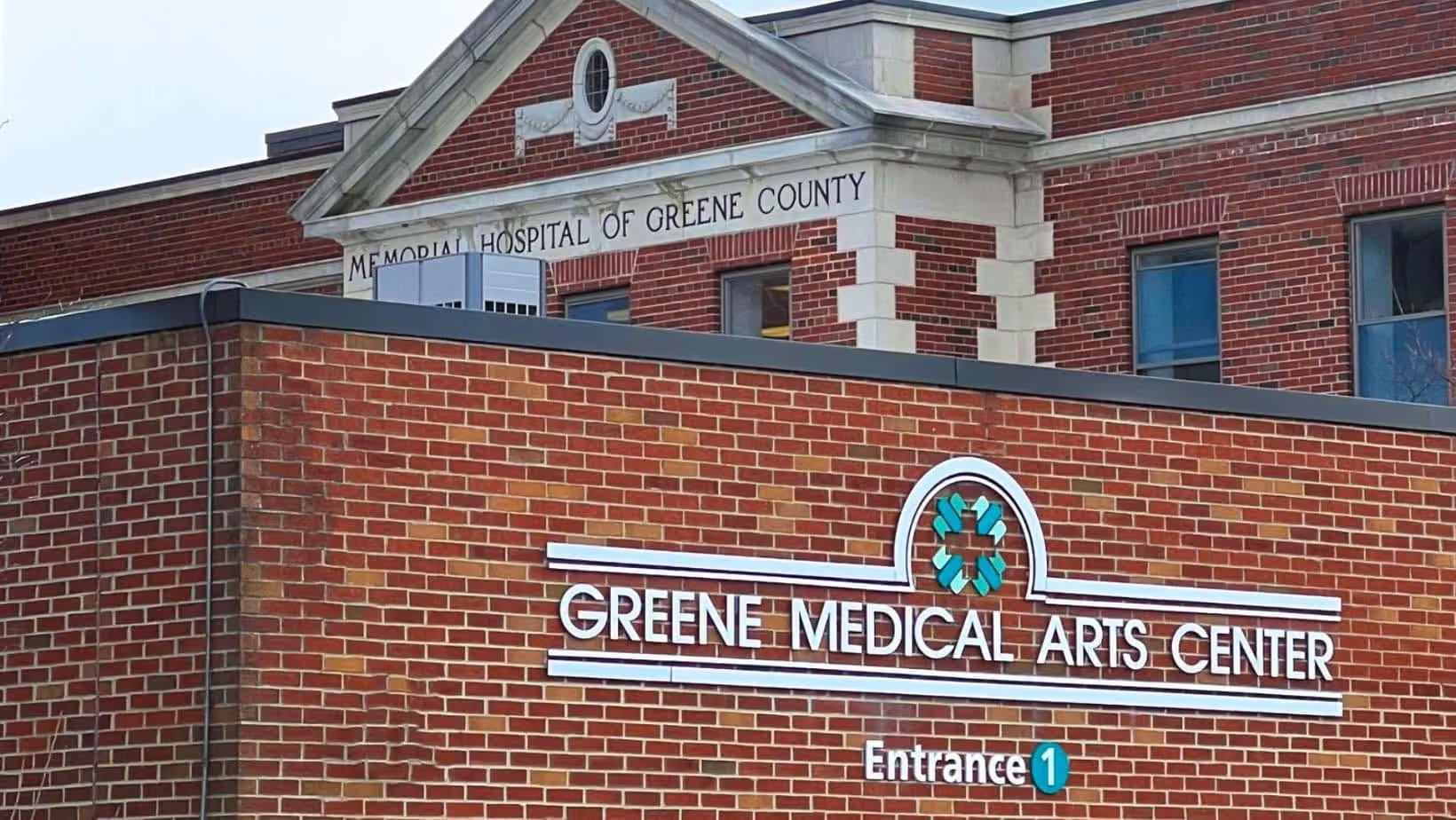
Another change is how surgeries are performed and last fall Albany Med Health System broke ground on a $25 million outpatient surgical center at the Greene Medical Arts Center.
“This will be a state-of-the-art surgery center,” Weisberg told legislators, adding that it also includes a walk-in cardiology center.
When Weisberg first came to CMH in 2007, all surgery patients stayed overnight, he said. But that is no longer the case and today, 84 percent of CMH’s surgeries are done on an outpatient basis.
“The hope is to have this done in the first quarter of 2027. Construction has started,” he said.
Changes are not planned for any of the 37 care centers across Columbia and Greene counties and Urschel said no staff layoffs are on the table.
“From Greene Medical Arts to our Hudson hospital, we anticipate hiring more than 100 professionals,” she said.
The 1199 SEIU, the union representing around 750 of CMH’s approximately 1,300 employees, argues that current staff could be impacted and held a public forum Wednesday evening at Trinity Church in Hudson.
According to the union, the proposed changes help “Albany Med’s bottom line, but what will it mean for you community? How will longer ER waits, fewer jobs, and more residents sent to Albany for care affect you?”
The 1199 SEIU has accused CMH and Albany Med of not being transparent in redesignation plans, citing the CAH application that states, “agency staff and per diem employees are currently needed to fill vacancies throughout the organization, and that this would no longer be necessary if CMH is approved for CAH designation.” But the union claims that half of CMH workers are “per diem.”
Urschel and hospital executives will be hosting another town hall meeting on February 11 to provide updates on the plan, hear concerns and answer questions. It runs from 4:30 to 5:30 p.m. at the CMH Support Services Building at 65 Prospect Avenue in Hudson.
At the last town hall meeting, Urschel fielded questions from employees and residents, including one asking what will happen if CMH is denied the CAH designation.
“We will continue our service locally but continue to go back to the table and look at other options. We will go back to the drawing board and look at other options,” Urschel replied.
“When your environment changes you need to adapt,” Weisberg told county legislators on Wednesday.
“Our goal is to be here. We have been here for over 100 years. Our plan is not to go anywhere. But if we don’t do something, we won’t be here,” he said.