Albany’s new bishop makes first visit to Greene County
Published on:
February 16, 2026





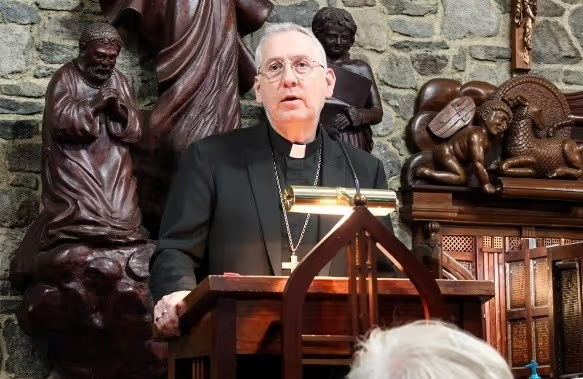





EAST DURHAM —This past Friday evening, parishioners gathered at the Our Lady of Knock Shrine for a rare opportunity: a face-to-face conversation with the new bishop of the Albany Catholic Diocese.
For Bishop Mark O’Connell, who was installed in December, it marked his first trip to Greene County since assuming leadership of a diocese that has faced years of institutional strain, financial pressure and public scrutiny.
The visit began with a meet-and-greet as parishioners from Greene, Ulster and Dutchess Counties lined up to speak with the bishop. He then celebrated Mass.
O’Connell, speaking in a measured tone but with frequent humor, acknowledged the complexity of the role he has inherited.
He told the crowd that the job “is going to be no easy task,” referring to the challenges left by the prior administration. But he also said he “invites challenge,” framing the moment as an opportunity for the diocese to regain stability and direction.
O’Connell’s path to Albany has been shaped by both geography and tradition.
He was born in Toronto and raised in Boston after his father accepted a teaching position at Boston College. O’Connell later attended Boston College himself and described the period after graduation as a time of uncertainty and discernment.
He said he found himself thinking about his future on the back porch of his family home, weighing whether to enter the priesthood.
Religious life had already run through his family: an uncle was a priest, and an aunt was a nun. But O’Connell said he still hesitated, wondering if he needed a sign.
In the end, he concluded that the idea of joining the Church after college was the sign. He was ordained at 25.
As a Canadian-born Bostonian, he also grew up immersed in hockey and played left wing in high school—a small detail, but one that drew smiles from parishioners who later described him as personable and direct.
O’Connell spent seven years working at parishes connected to colleges, then studied in Rome for four years, earning his doctorate.
He later became a canon lawyer and worked in tribunals and other Church structures that address some of the most sensitive matters in Catholic life, including annulments, sexual abuse cases, and decisions about parish closures.
After his ordination to the episcopacy in 2016, he served as pastor of Saint Theresa Parish in North Reading, MA and as the regional bishop of the North Region of the Archdiocese of Boston covering 60 parishes. He became the vicar general and moderator of the curia of the Archdiocese in 2023.
The experience is likely to be central to his leadership in Albany, where diocesan officials have faced both legal and financial strain, and where parish consolidation has been a growing concern.
O’Connell succeeds Bishop Edward B. Scharfenberger, who has served in the Albany Diocese since April of 2014. Bishop Scharfenberger submitted his resignation when he reached the mandatory retirement age of 75 in May 2023.
O’Connell recounted how he learned of his appointment, explaining that he received a call from the Vatican informing him he would be going to Albany. He joked that he would be “bankrupt.”
The remark, made with a smile, was met with laughter. But it also reflected the realities of running a diocese in a time when many Catholic institutions are contending with declining attendance, aging infrastructure, and the financial consequences of past scandals.
At another point, O’Connell described his role as representing the Catholic Church broadly in the New York State Capitol, telling parishioners that he represents “all of the bishops in the Vatican in Albany.”
Several parishioners said they appreciated his willingness to take questions directly and his apparent comfort speaking candidly about the challenges ahead. Some raised questions about the kind of bishop that O’Connell intends to be and how he will navigate a Church that is increasingly shaped by political polarization.
“I am not a liberal. I am not a conservative,” he said. “I am a Catholic who believes in the preservation of life whether that be in the womb or the people in Minnesota.”